
Last Updated: 22 October 2026
Quick Summary
Build a school cleaning tender checklist before you speak to any supplier, covering every area, frequency, standard and compliance requirement. Weight evaluation criteria so quality, staffing and safeguarding count alongside price, and verify DBS checks and insurance before you shortlist.
- Walk the building with your caretaker before writing the tender checklist.
- Ask each bidder how they handled a recent absence crisis.
- Specify who maintains and replaces cleaning equipment at tender stage.
- Verify enhanced DBS checks and insurance certificates before shortlisting.
- Agree a mobilisation timeline and exit plan before signing the contract.
Table of Contents
- Why School Cleaning Procurement Goes Wrong
- Tip 1: Build a School Cleaning Tender Checklist Before You Speak to Anyone
- Tip 2: Use School Cleaning Contractor Evaluation Criteria That Test More Than Price
- Tip 3: Get Serious About School Cleaning Staff Recruitment and Cover
- Tip 4: Choosing Cleaning Equipment for Schools Is a Procurement Decision, Not an Afterthought
- Tip 5: Write a Specification That Covers Frequency, Standards and Reporting
- Tip 6: Check Safeguarding, DBS and Health and Safety Compliance Before You Shortlist
- Tip 7: Plan the Mobilisation and Exit From Your Current Provider
- Bringing It Together
- Frequently Asked Questions
Why School Cleaning Procurement Goes Wrong
Most school cleaning contracts fail before a single mop touches a floor. The tender was too vague, the evaluation leaned on price alone, and nobody tested whether the winning provider could actually staff a 6am shift in January. According to Department for Education guidance on buying for schools, schools must follow a clear procurement process and define requirements before going to market, yet soft services are routinely tacked onto the end of a buying cycle with no real specification behind them.
This guide from Nirvana Managed Services LTD sets out ten procurement tips we would give any bursar or business manager, drawing on how we handle recruitment, contract management and sickness cover for schools and our commercial office cleaning work in Chester and the surrounding region. Below, we’ll show you exactly how to run a school cleaning tender that holds up, and what most guides get wrong about it.
Tip 1: Build a School Cleaning Tender Checklist Before You Speak to Anyone
A school cleaning tender checklist is the document that lists every area, frequency, standard and compliance requirement before you invite a single supplier to bid. Build it first, because everything else follows from it.
Start with the basics:
- Room-by-room schedule of areas and floor types
- Cleaning frequencies for term time, holidays and deep cleans
- Opening and closing times, plus keyholder arrangements
- Consumables responsibility (who buys soap, paper and bin liners)
- Reporting expectations and named site contact
- Safeguarding requirements for anyone entering the site
The common mistake is writing the checklist after shortlisting. By then you have already shaped the contract around what suppliers offered rather than what your school needs. In practice, a checklist built with the caretaker and site supervisor produces a far more accurate brief than one written in an office.
Walk the building with your caretaker before writing the checklist. They know which corridors get muddy in winter and which toilets get missed, and that detail is what separates a workable specification from a generic one.
Tip 2: Use School Cleaning Contractor Evaluation Criteria That Test More Than Price
Price should be one criterion among several, not the deciding factor. A cheap bid that cannot recruit staff will cost you more in cover, complaints and re-tendering within a year.
Weight your evaluation criteria openly and tell bidders the weighting. A sensible split looks like this:
- Quality and method statements: how they clean, with what, and to what standard
- Staffing and recruitment: how they fill vacancies and cover absence
- Compliance and safeguarding: DBS checks, insurance, health and safety records
- Social value and local employment where relevant
- Price, scored on total cost including consumables and cover
Ask each bidder how they handled a recent absence crisis. The answer tells you more than any glossy brochure.
Tip 3: Get Serious About School Cleaning Staff Recruitment and Cover
School cleaning staff recruitment and cover is the criterion most schools underweight and most providers quietly struggle with. Cleaning shifts sit outside normal working hours, pay is modest, and turnover is high, so a provider without a recruitment pipeline will leave you short.
Ask three direct questions:
- How do you recruit for early morning and evening shifts?
- What is your average time to fill a vacancy?
- What happens when a cleaner calls in sick at 5:30am?
A provider that answers “we’ll sort it” has no plan. A provider that describes a bank of trained cover staff, a named supervisor and a response window has one. For schools in Chester and across the wider region, travel time matters too, so local cover beats a distant depot.
Tip 4: Choosing Cleaning Equipment for Schools Is a Procurement Decision, Not an Afterthought
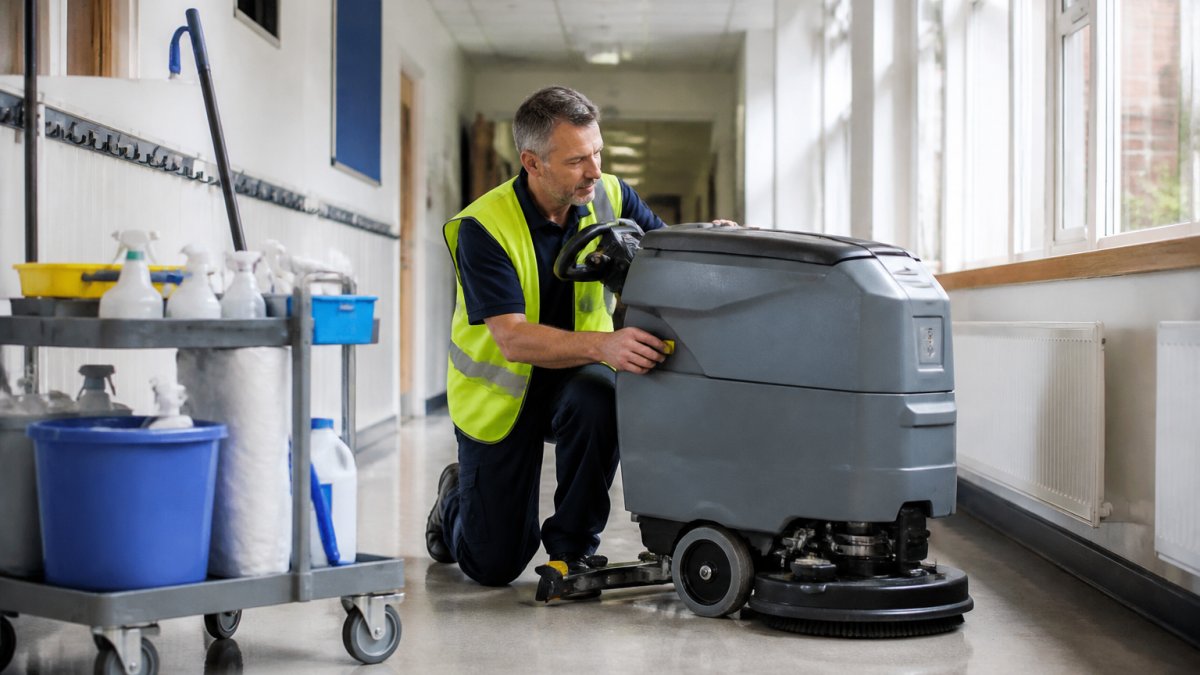
Choosing cleaning equipment for schools decides how fast a team can work and how safe the site stays. Equipment bought on price alone usually ends up costing more in repairs and downtime.
Specify what the contract requires the provider to supply and maintain. Machines need storage space, PAT testing and a maintenance plan. Chemicals need COSHH assessments and safe storage away from pupils. A provider turning up with domestic-grade kit for a commercial kitchen or a sports hall is a warning sign, not a saving.
If the specification does not state who maintains and replaces equipment, expect arguments in month eight when the scrubber breaks and both sides claim it is the other’s responsibility. Put it in writing at tender stage.
Tip 5: Write a Specification That Covers Frequency, Standards and Reporting
A specification is the written statement of what clean looks like, how often it happens and how you will know it has been done. Without one, every dispute becomes an opinion.
Cover three things clearly:
- Frequency: daily, weekly, termly and annual tasks, listed by area
- Standards: what “clean” means for each area, ideally with a simple visual check
- Reporting: monthly performance reports, incident logging and a named account contact
Build in a review meeting each term and a right to audit. The Health and Safety Executive guidance on cleaning and hygiene is a useful reference for the safety side of the specification.
Tip 6: Check Safeguarding, DBS and Health and Safety Compliance Before You Shortlist
Compliance checks belong before the shortlist, not after the award. Anyone working in a school around children needs the right checks, and a provider that treats this casually is a risk you cannot carry.
Verify at minimum:
- Enhanced DBS checks for all site staff, with a written process for new starters
- Public liability and employer’s liability insurance certificates
- Health and safety policy, risk assessments and COSHH records
- Safeguarding policy aligned with your school’s own procedures
- References from comparable schools you can actually ring
The Disclosure and Barring Service guidance for employers sets out what enhanced checks involve. Ask to see the process, not just a certificate.
Tip 7: Plan the Mobilisation and Exit From Your Current Provider
Mobilisation is the handover period when the new provider takes over, and it is where good contracts go wrong. Plan it before you sign.
Agree a mobilisation timeline covering TUPE considerations, site inductions, key handover and a supervised first week. Agree an exit plan with your current provider too, including notice periods and equipment ownership. Skipping this step is how schools end up with two weeks of no cleaning and a lot of finger-pointing.
| Procurement Stage | What to Do | Why It Matters |
|---|---|---|
| Before tender | Build checklist and walk the site | Accurate brief, fewer variations |
| Evaluation | Weight quality, staffing and compliance | Avoids cheapest-bid trap |
| Award | Agree mobilisation and exit plan | Smooth handover, no gaps |
| Contract | Set reporting and review dates | Standards stay consistent |
Bringing It Together
The challenge is not writing a tender, it is holding a provider to it once the shine wears off. Nirvana Managed Services LTD handles recruitment for cleaning and caretaking staff, manages the contract day to day, and provides cover when your own staff are off sick, alongside commercial office cleaning for businesses in Chester and the surrounding area. If you are weighing up a move, get in touch and we will talk you through how a managed service would work for your site.
Frequently Asked Questions
How do schools procure cleaning services?
Schools typically start by defining their cleaning specification, including the areas covered, cleaning frequencies and the standards expected. They then issue a tender or request for quotation to several providers, using a school cleaning tender checklist to compare bids fairly. Evaluation should weigh quality, staffing model, safeguarding compliance and cover arrangements alongside cost. Many schools now ask for evidence of how a provider handles absence cover and staff recruitment, because a low bid that cannot be staffed reliably creates bigger problems later.
What should schools include in a cleaning services tender?
A strong tender includes a room-by-room cleaning schedule, required frequencies, response times for spillages and deep cleans, and the reporting you expect from the contractor. Add your safeguarding requirements, such as DBS checks for all on-site staff, and your expectations for cover during sickness. Include the contract term, break clauses and how performance will be measured. Asking bidders to explain their school cleaning staff recruitment and cover model separates providers who can actually deliver from those who simply undercut on price.
How do you evaluate a school cleaning contractor?
Use clear school cleaning contractor evaluation criteria rather than gut feel. Score each bid on specification match, staffing and cover arrangements, safeguarding and compliance evidence, references from comparable schools, and price. Weight quality and reliability heavily, since cleaning failures are visible to parents and inspectors. Visit a site the contractor already cleans if possible, and ask directly what happens when a cleaner calls in sick. A provider that cannot answer that question with a concrete process should not make your shortlist.
Should a school outsource its cleaning or manage it in-house?
In-house teams give direct control but leave you carrying recruitment risk, holiday cover and sickness absence yourself. Outsourcing transfers that burden to a provider who can supply trained staff and cover at short notice. The right choice depends on your size and how much management capacity you have. Many schools move to a managed service because recruiting and retaining cleaners is difficult, and a single absence can leave the building below standard. Compare the total cost of employment, including cover and management time, not just hourly rates.


