
Table of Contents
- What School Site Maintenance Covers in a Small Primary or Secondary
- Your School Site Maintenance Checklist, Term by Term
- Budgeting for Maintenance When You’re a Small School
- School Cleaning Staff Cover: What to Do When Someone Calls in Sick
- Outsourced School Cleaning: Is It Right for Your Site?
- Cleaning Equipment for Schools: What a Small Site Actually Needs
- Monitoring Standards Without Adding to Your Workload
- Conclusion
- Frequently Asked Questions
Last Updated: 21 October 2026
What School Site Maintenance Covers in a Small Primary or Secondary
School site maintenance is the planned and reactive work that keeps a school building, grounds and equipment safe, clean and working. For a small school, it covers far more than fixing broken locks. It includes the building fabric, the grounds, the cleaning, the caretaking and the compliance checks that sit behind all of it.
At Nirvana Managed Services LTD, we work with schools across Chester and the surrounding area on exactly this problem. Most small schools do not have a dedicated site team. One caretaker, a business manager and a lot of goodwill hold the whole thing together.
Here is the part most guides miss. School site maintenance is not really a building problem. It is a staffing problem wearing a hi-vis jacket. When the caretaker is off sick, the checks do not happen. When the cleaner leaves, the standards slip within a week.
So the practical question is not “what needs fixing?” It is “who is going to do it, and what happens when they cannot?”
That single shift in thinking changes how you plan the year. We will show you how below, term by term, with a checklist you can actually use.
The weakest point in small school site maintenance is not the building. It is cover. Plan for absence first, then plan the work.
Your School Site Maintenance Checklist, Term by Term
A workable school site maintenance checklist splits the year into two halves: the autumn push to get the site winter-ready, and the spring and summer window when you can actually do bigger jobs. Trying to do everything at once is how small sites fall behind.
Here is the summary, then the detail:
| Term | Main focus | Typical tasks | Who usually does it |
|---|---|---|---|
| Autumn | Winter readiness | Gutters, drains, heating checks, grit stock, lighting | Caretaker plus contractor |
| Spring | Recovery and repair | Winter damage, external paint, grounds, playground surfaces | Contractor |
| Summer | Big jobs | Deep clean, floor works, decorating, roof checks | Contractor plus cleaning team |
Autumn Term: Preparing for Winter
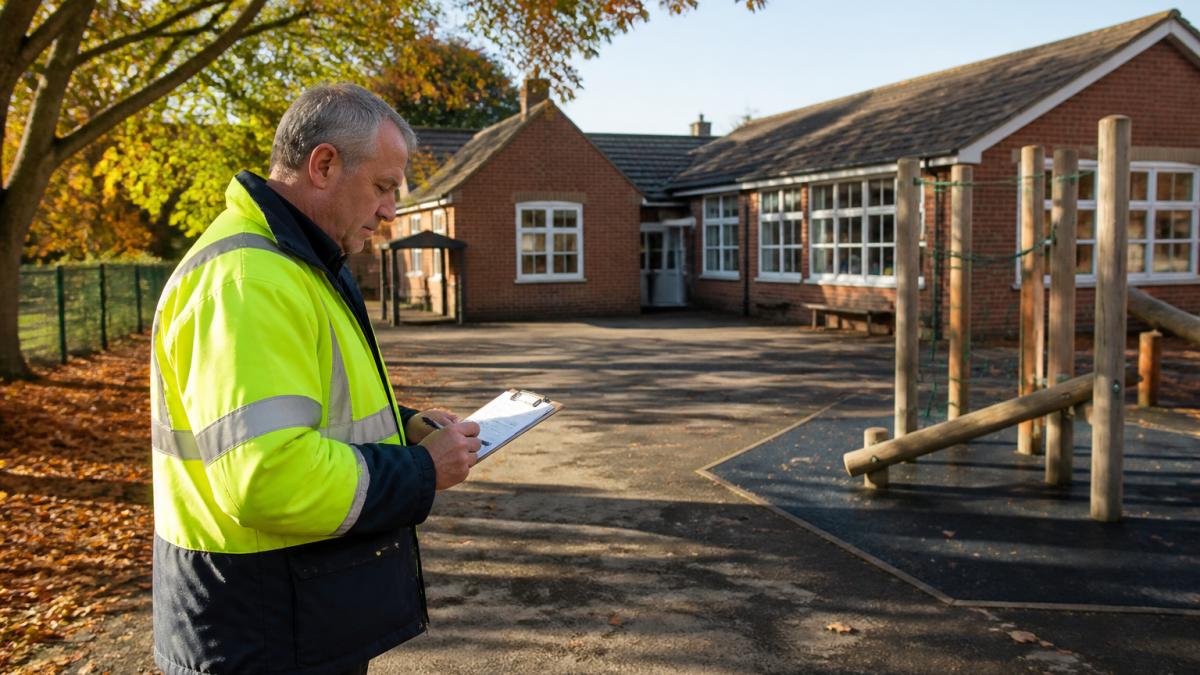
Autumn is about stopping small problems from becoming expensive ones. Clear the gutters and drains before the leaves come down properly. Check the heating before you need it, not after the first cold snap.
The list we would run through:
- Clear gutters, downpipes and drains
- Service the boiler and bleed radiators
- Check external lighting and replace failed units
- Order grit and salt, and confirm where it is stored
- Walk the playground and path surfaces for trip hazards
- Check door closers, locks and window seals
- Confirm the fire alarm and emergency lighting tests are booked
A common mistake is leaving the heating check until November. By then, every contractor in the area is booked out and you are waiting weeks for a repair.
Spring and Summer: The Catch-Up Window
Spring is for putting right what winter broke. Summer is the only realistic window for work that disrupts the building, because the pupils are away.
Use the summer for:
- Deep cleaning of floors, carpets and hard-to-reach areas
- Decorating corridors and classrooms
- Roof and flat-roof inspections
- Playground resurfacing and line marking
- Larger repairs that cannot happen with children on site
Book summer contractors by spring at the latest. The good ones fill their diaries early, and a small school is not always the biggest job on their list.
Budgeting for Maintenance When You’re a Small School
Budget for school site maintenance as two pots, not one. The first pot is planned work you can predict: servicing, inspections, grounds, cleaning. The second is a reactive fund for the things nobody saw coming.
A common approach is to split your site budget roughly into planned and reactive, then protect the reactive pot. Schools that spend the reactive pot on extras in the autumn find themselves stuck in January.
A few rules that work in practice:
- Separate cleaning, caretaking and building repair in your budget lines, so you can see which one is drifting
- Keep a small contingency for emergency cover, not just emergency repairs
- Price the cost of absence honestly, because cover is a real budget line even when it is invisible
- Review the split each term rather than once a year
The most common budgeting mistake is treating cleaning and caretaking cover as a “nice to have”. When someone calls in sick and no cover arrives, the site standards drop fast and parents notice within a day.
Pricing for outsourced cover depends on the size of your site, the hours you need and how quickly you need someone. We would always recommend getting a quote rather than guessing, because the numbers vary so much between schools.
School Cleaning Staff Cover: What to Do When Someone Calls in Sick
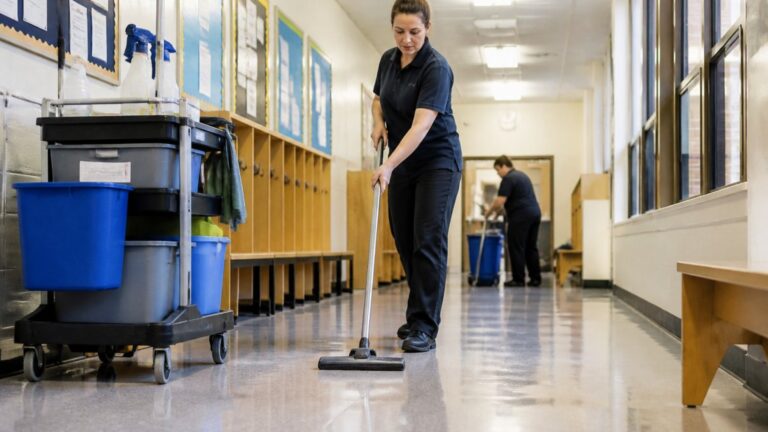
School cleaning staff cover is the arrangement you have in place to get a trained person on site when your regular cleaner or caretaker cannot attend. Without a plan, one absence becomes a visible mess by the school gate.
This is where most small schools get caught out. They have a cleaner, the cleaner is good, and there is no plan B. Then the cleaner calls in sick at 6am and the headteacher is pushing a mop before registration.
What good cover looks like:
- A named contact you can reach early in the morning
- Someone who has already been on your site and knows the layout
- Clear standards so a cover cleaner does the same job as your regular one
- A simple way to confirm the work was done
The key point is speed. Parents dropping children off will judge the school on what they see at the gate. A response that arrives by mid-morning is far better than one that arrives at lunchtime.
Ask any cover provider one question before you sign: “If I call you at 6am, who physically arrives on site, and by when?” If they cannot answer that clearly, the cover is not real.
We built our cover service around that exact question, because it is the one that matters when you are standing in an empty corridor at dawn.
Outsourced School Cleaning: Is It Right for Your Site?
Outsourced school cleaning is where a provider takes on the cleaning and caretaking work, usually with their own staff, their own management and their own cover arrangements. It suits small schools that cannot recruit reliably or cannot afford to keep losing staff.
The honest answer on whether it is right for you comes down to three things:
- Recruitment. If you keep re-advertising the same cleaning role, outsourcing removes that problem from your desk.
- Cover. If absence leaves you exposed, a managed service carries that risk instead of you.
- Standards. If quality drifts and nobody is checking, a managed contract with clear standards fixes it.
Where it falls short: you lose some direct day-to-day control over individuals, and you need a clear contract so expectations are set. That is not a reason to avoid it. It is a reason to get the contract right.
For schools in Chester and the surrounding area, the recruitment problem is real and it is persistent. Many schools find that keeping a reliable in-house team is the hardest part of the whole job.
Cleaning Equipment for Schools: What a Small Site Actually Needs
Cleaning equipment for schools should be chosen for durability and simplicity, not for a catalogue’s worth of gadgets. A small site needs a short list of reliable kit that staff will actually use.
What we would keep on a small site:
- Commercial vacuum cleaners, one per floor where possible
- Microfibre cloths and mops with colour coding for different areas
- A scrubber dryer if you have large hard floors
- Waste and recycling bins that match your collection contract
- Safe storage for chemicals, locked and labelled
- Personal protective equipment for staff
What most guides miss is the storage problem. Small schools often have nowhere sensible to keep equipment, so it gets crammed into a cupboard and breaks. Plan the storage before you buy the kit.
Also, check that whoever cleans knows how to use each machine. A scrubber dryer that nobody has been trained on sits in the corner and gathers dust.
Monitoring Standards Without Adding to Your Workload
Monitoring school site maintenance standards should take minutes, not hours. The trick is to check a few things often rather than everything occasionally.
A simple routine that works:
- A short weekly walk-round with a fixed checklist
- Photographs of the same few spots each time, so you can compare
- One named person responsible for signing off
- A quick log of any issue and when it was fixed
That is it. The value comes from consistency, not from a thick manual. If you outsource, ask for the provider’s own checks as well, so you have two sets of eyes rather than none.
A five-minute weekly walk-round beats a two-hour annual inspection every time. Frequency finds problems; depth just documents them.
Conclusion
The hardest part of school site maintenance for a small school is not the building. It is keeping reliable people on site, day after day, through illness, holidays and recruitment gaps.
That is the problem we exist to solve. Nirvana Managed Services LTD provides recruitment support for cleaning and caretaking staff, fully managed contracts, and cover when your own team member is off sick. We also handle commercial office cleaning for local businesses, so the same standards apply whether you run a school or an office.
If you are a small school in Chester or the surrounding area and you are tired of chasing cover, get in touch. We will walk your site, tell you honestly what you need, and quote you for it.
Frequently Asked Questions
How can a small school manage cleaning and caretaking with limited staff?
Split the work into what must happen daily and what can be scheduled. Daily tasks are toilets, bins, entrance floors and spill response. Everything else, from gutter clearing to deep carpet cleaning, belongs on a termly plan so it doesn’t get forgotten. Give one person clear ownership of the school site maintenance checklist, even if they only spend part of their week on it. Where a gap can’t be covered in-house, use a provider that supplies school cleaning staff cover rather than stretching your existing team until someone leaves.
Should a small school outsource its cleaning and site maintenance?
It depends on whether your problem is recruitment or standards. If you can recruit reliably but want to keep control, keep it in-house and outsource only the gaps. If vacancies keep reappearing or quality drifts between inspections, outsourced school cleaning with a named supervisor usually costs less than repeated recruitment cycles. Ask any provider how they handle sickness cover, who inspects the site, and what happens in the first month if standards slip. Get a written service specification before you sign.
How do schools arrange cover when a cleaner or caretaker is off sick?
The reliable route is an agreed cover arrangement set up before you need it, not a phone call on the morning. A good provider will hold a pool of vetted staff who know your site, your alarm codes and your cleaning schedule, so cover arrives already briefed. Confirm the response time in writing, along with whether the cover is charged at the same rate. Keep a one-page site brief on file covering key holders, chemical storage and bin locations so any cover staff can start immediately.
What cleaning equipment is suitable for school environments?
Prioritise machines that are quiet enough for use near classrooms, simple enough for a small team to maintain, and sized for your floor area. A scrubber dryer suited to a small hall, a commercial vacuum with HEPA filtration for carpets, and colour-coded cloths and mops for toilet and kitchen areas cover most needs. Avoid buying equipment for a large secondary site if you run a two-form entry primary; oversized machines are slower to set up and cost more to service. Check servicing and spare parts availability before you buy.
The challenge is simple: one absence should not undo a term of good work. Get started with Nirvana Managed Services LTD and put a real cover plan in place before the next sick call comes in.