
Last Updated: 27 October 2026
Quick Summary
Effective school cleaning equipment procurement means specifying what each area needs before you shop, then judging every option on whole-life cost rather than sticker price. Build a checklist from a site walk-through, use a template that makes supplier quotes comparable, and give one named person ownership of the maintenance schedule.
- Walk the site with the cleaning lead and caretaker to build your checklist area by area.
- Ask suppliers in writing about local service response, parts availability, training and whole-life cost.
- Budget in three parts: capital purchase, consumables and parts, and maintenance.
- Split maintenance into daily checks, weekly and monthly tasks, and annual servicing.
- Decide in-house versus outsourced by identifying whether recruitment or standards is the real problem.
Table of Contents
- Why School Cleaning Equipment Procurement Matters
- Building a School Cleaning Equipment Checklist
- Using a School Cleaning Procurement Checklist Template
- Choosing Suppliers and Assessing Equipment Needs
- Budgeting and Sustainability Considerations
- Creating a School Cleaning Equipment Maintenance Schedule
- In-House Versus Outsourced School Cleaning
- Next Steps for Your School Cleaning Procurement
- Frequently Asked Questions
Why School Cleaning Equipment Procurement Matters
School cleaning equipment procurement is the process of specifying, sourcing, and maintaining the machines and tools your site team uses every day. Get it right and cleaning takes less time, costs less over the year, and holds up to scrutiny. Get it wrong and you buy machines that sit unused while staff work around them.
This guide covers school cleaning equipment procurement.
The stakes are higher than most bursars assume. A floor scrubber chosen without checking doorway widths, storage space, or who will actually operate it becomes an expensive obstacle. A procurement list built around last year’s supplier catalogue quietly locks in the wrong priorities for another twelve months.
Three things separate a procurement process that works from one that wastes money:
- Specification before shopping. Decide what the site needs before you look at a single catalogue.
- Whole-life cost, not sticker price. A cheaper machine with expensive consumables and no local support often costs more across its service life.
- A named owner. Equipment with no one responsible for its condition deteriorates fast.
Below, we walk through the full process: the checklist, the template, supplier assessment, budgeting, maintenance, and the in-house versus outsourced decision.
Building a School Cleaning Equipment Checklist
A school cleaning equipment checklist is a written inventory of every machine, tool, and consumable your site needs, matched to the areas it serves and the frequency of use. Build it area by area rather than from a supplier catalogue, because suppliers sell what they stock, not necessarily what your building requires.
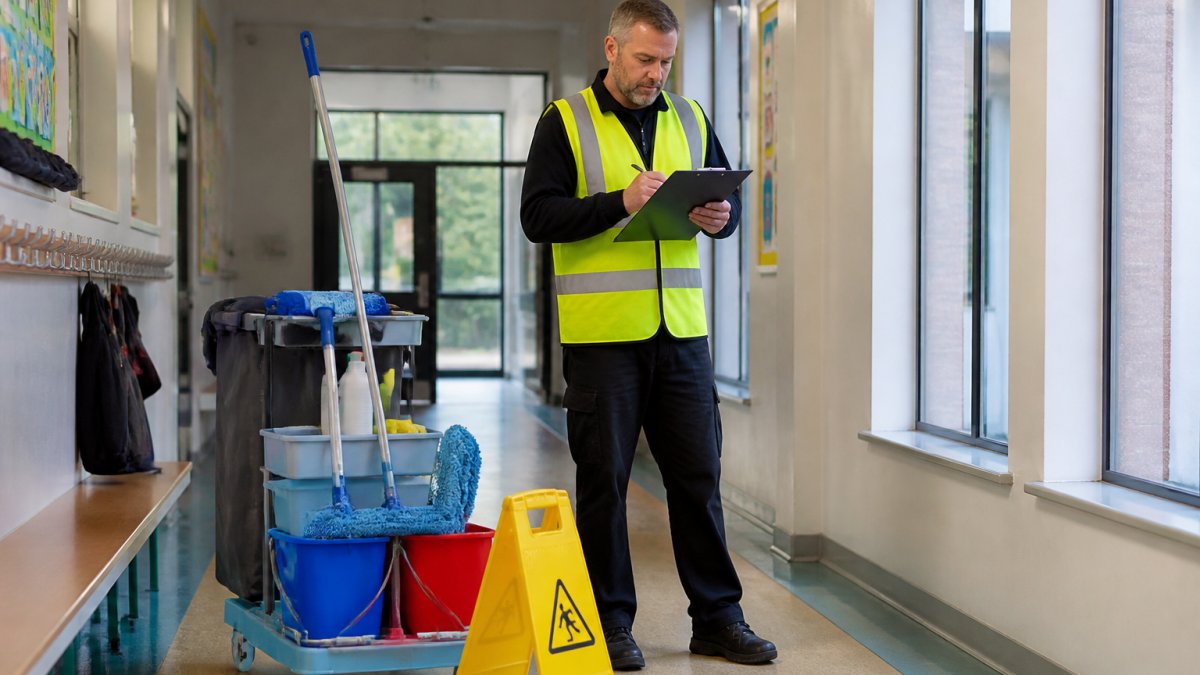
Start by walking the site with the cleaning lead and the caretaker. List every space: classrooms, halls, toilets, kitchens, corridors, offices, sports facilities, and specialist rooms. For each, note the floor type, the soiling pattern, the access constraints, and who cleans it. That walk-through usually surfaces two or three needs nobody had written down.
Essential Equipment for Daily Cleaning
Daily cleaning across most schools depends on a core set of machines and tools. The exact mix varies with floor area and layout, but the categories are consistent:
- Floor care: scrubber-driers or scrubbers for hard floors, sweepers for larger open areas, and mops for edges and small rooms
- Vacuuming: upright or canister vacuums for carpets and mats, plus a wet-and-dry vacuum for spillages
- Waste and hygiene: bins, sack holders, trolleys, and colour-coded cloths and mops to prevent cross-contamination between areas
- High-touch cleaning: spray bottles, trigger sprays, and microfibre systems for desks, handles, and shared surfaces
- Safety and access: wet-floor signs, cones, and steps or platforms for high-level dusting
Choosing between a scrubber and a sweeper is one of the most common decisions. If you are weighing up which machine suits daily cleaning in your buildings, our comparison of floor scrubbers vs sweepers for school cleaning sets out the differences directly.
Specialist Equipment for Science, Art and Sports Areas
Specialist areas need equipment that daily cleaning kit cannot handle. Science labs require spill kits suitable for the chemicals in use, and the relevant safety data sheets should be checked before any spill response is planned. Art rooms need equipment for clay dust, paint residue, and drying racks. Sports halls and changing rooms need heavy-duty wet vacuums, drainage-friendly floor cleaning, and often a separate machine to avoid tracking mud and grit into the main building.
Do not assume the daily cleaning team can cover these areas with standard kit. Specialist equipment is usually the gap that appears when a school moves from an in-house team to a mixed model, and it is worth naming it explicitly on the checklist.
Using a School Cleaning Procurement Checklist Template
A school cleaning procurement checklist template is a structured document that records what you need, why, and how each item will be evaluated before purchase. A good template does three jobs: it forces you to justify each item, it makes supplier quotes comparable, and it gives you an audit trail.
Here is a template you can copy and adapt:
Section 1: Need
- Area or room served
- Cleaning task and frequency
- Current method and its problem
Section 2: Specification
- Machine type and size
- Power or battery requirement
- Storage space available
- Operator training needed
- Consumables required and where sourced
Section 3: Evaluation
- Whole-life cost over three to five years
- Local service and parts availability
- Warranty terms and response times
- Trial or demonstration offered
Section 4: Decision
- Options considered
- Reason for final choice
- Approval and date
The template matters most when budgets are tight, because it stops a single persuasive quote from setting the agenda. If procurement is a weak point in your process, our school cleaning procurement tips cover the traps that catch schools out most often.
Choosing Suppliers and Assessing Equipment Needs
Supplier choice should follow equipment specification, not the other way round. A school letting a supplier’s demonstration shape what it thinks it needs can be a mistake. Demonstrations are useful, but they should test a specification you have already written, not replace it.
When assessing suppliers, ask for four things in writing:
- Local service response. How quickly can an engineer attend, and from where? A machine with no local support network can sit out of action for days.
- Parts availability. Are common wear parts held locally, or ordered in?
- Training. Who trains your staff, and is refresher training included?
- Whole-life cost. Ask for consumable costs and expected service intervals alongside the purchase price.
Assessment does not stop at purchase. Track which machines are actually used, how often they break down, and what they cost to run. That data feeds directly into the next procurement round and stops you repeating a poor choice.
Budgeting and Sustainability Considerations
Budgeting for school cleaning equipment should account for the whole service life, not just the purchase. A machine that costs less upfront but needs frequent consumables and repairs often costs more across five years than a better-supported alternative.
Build the budget in three parts: capital purchase, consumables and parts, and maintenance. Schools that budget only for the first line are the ones caught out when a machine fails mid-term.
Sustainability is increasingly part of the same conversation. If you are weighing up greener products, our guide to the benefits of green cleaning products for schools explains what to expect before you commit budget.
For multi-year planning, forward visibility matters more than precision. Our guidance on how to plan school maintenance budgets covers how to phase equipment replacement so a single year does not carry the whole cost.
Creating a School Cleaning Equipment Maintenance Schedule
A school cleaning equipment maintenance schedule is a written plan of daily checks, scheduled servicing, and replacement triggers for every machine on site. It is the difference between equipment that lasts its expected service life and equipment that fails early.
A practical schedule covers three tiers:
- Daily checks: visual inspection, battery charging, brush and filter condition, and fault reporting to a named person
- Weekly and monthly tasks: deep cleaning of machines, checking consumables, and logging any recurring faults
- Annual servicing: manufacturer-recommended servicing, safety checks, and a review of whether each machine still earns its place
Assign one person to own the schedule. Equipment with no named owner tends to be maintained reactively, which means it is maintained after it breaks. Keep a simple log for each machine: service dates, faults, repairs, and cost. That log is the single most useful document when you next need to justify a replacement.
The schedule works best when it is split into three tiers, each with its own tasks.
| Tier | Tasks |
|---|---|
| Daily checks | Visual inspection, battery charging, brush and filter condition, fault reporting |
| Weekly and monthly tasks | Deep cleaning of machines, checking consumables, logging recurring faults |
| Annual servicing | Manufacturer-recommended servicing, safety checks, review of each machine |
In-House Versus Outsourced School Cleaning
In-house versus outsourced school cleaning comes down to control, cost, and resilience. In-house teams give direct control over standards and equipment use, but they depend on successful recruitment and cover for absence. Outsourced provision transfers that risk, at the cost of some day-to-day control.
The recruitment side is where many schools feel the pinch. Cleaning and caretaking roles are hard to fill, and cover for sickness can leave a site short at short notice.
Before deciding, be clear about what you are trying to solve. If the problem is recruitment and absence cover, a managed service addresses it directly. If you are considering outsourcing, our guide to the risks of outsourcing school cleaning sets out what to manage before you sign.
Next Steps for Your School Cleaning Procurement
Most schools do not need a bigger equipment budget. They need a clearer process: a checklist built from a site walk-through, a template that makes quotes comparable, a supplier assessment that asks about service and whole-life cost, and a maintenance schedule with a named owner.
That is the work. It is unglamorous, and it is what separates sites that stay on top of equipment from sites that lurch from one emergency purchase to the next.
If recruitment and absence cover are the real constraint, Nirvana Managed Services LTD provides a fully managed soft services solution for schools and commercial offices. That includes contract management, cover when a member of staff is off sick, and commercial office cleaning for sites that need it.
Frequently Asked Questions
What cleaning equipment does a school need?
A school needs a core set of equipment for daily tasks: commercial vacuum cleaners, mops and buckets, colour-coded cloths, waste bins, and floor scrubbers for large areas. Specialist spaces require additional items, such as spill kits for science labs, dust extraction for art rooms, and outdoor sweepers for sports areas. Building a school cleaning equipment checklist ensures you cover every area without buying unnecessary items.
How should schools assess their cleaning equipment needs?
Start by mapping the school’s floor types, room usage, and daily cleaning routines. Count the number of classrooms, toilets, halls, and specialist spaces, then match equipment to each area’s cleaning demands. Consider storage space and staff training needs. A school cleaning procurement checklist template can guide this assessment step by step, helping you avoid both overspending and gaps in provision.
What should schools consider when choosing commercial cleaning equipment?
Look for equipment that suits the school’s floor surfaces, is easy for staff to use, and meets safety standards. Check noise levels for daytime cleaning, energy efficiency, and warranty terms. Consider supplier reliability and after-sales support. Always trial equipment before committing to a large purchase.
How can schools compare cleaning equipment suppliers?
Request quotes from at least three suppliers and compare total cost, delivery times, warranty, and training support. Ask for references from other schools. Check whether the supplier offers maintenance packages. A school cleaning procurement checklist template can help you score suppliers objectively. Don’t overlook the value of a supplier who understands the specific needs of educational settings.
How often should school cleaning equipment be replaced?
Replacement depends on usage and equipment type. Vacuum cleaners typically last three to five years with proper maintenance, while mops and cloths may need replacing every few months. Follow the manufacturer’s guidance and keep a school cleaning equipment maintenance schedule to track wear. Budget for gradual replacement rather than sudden large costs.
Should schools manage cleaning in-house or use a managed cleaning service?
In-house cleaning gives direct control but requires recruiting, training, and covering absences. Outsourced school cleaning can provide a managed service. For schools struggling with recruitment or staff shortages, a managed service is an option to consider. Compare costs and your capacity to manage staff before deciding.
What cleaning equipment is suitable for offices in Wrexham?
Offices in Wrexham typically need commercial vacuum cleaners, microfibre cloths, desk and surface sanitisers, and waste management equipment. For larger open-plan spaces, floor scrubbers or sweepers may be useful. Choose equipment that is quiet enough for daytime cleaning and easy to store.


