Last Updated: 25 October 2026
Quick Summary
School cleaning equipment selection depends on your space layout and floor types. Walk-behind scrubbers work best for classrooms and corridors, whilst ride-on machines handle gymnasiums efficiently. Daily sweeping combined with weekly scrubbing maintains standards most cost-effectively.
- Walk-behind scrubbers clean classrooms in 10-15 minutes and suit smaller spaces with minimal training required
- Ride-on scrubbers clean large gymnasiums in 15 minutes versus 45 minutes with walk-behind machines
- Daily push sweepers and vacuums maintain appearance between deeper cleans but don’t remove ground-in dirt
- Pressure washers and steam cleaners handle outdoor areas and deep sanitisation that standard scrubbers cannot
- Ergonomic equipment with adjustable handles and lightweight construction reduces staff injuries and improves retention
Table of Contents
- Why Choosing the Right School Cleaning Equipment Matters
- School Cleaning Equipment Checklist: What You Actually Need
- Floor Scrubbers vs Sweepers: Which Works Best for Different Areas
- Commercial Floor Cleaning Machines for Schools: Pressure Washers and Steam Cleaners
- School Cleaning Health and Safety: Choosing Equipment Your Staff Can Use Safely
- Commercial Office Cleaning Equipment: When Schools Share Facilities
- Getting Your School Cleaning Equipment Right from the Start
- Frequently Asked Questions
Why Choosing the Right School Cleaning Equipment Matters
School cleaning equipment isn’t just about keeping floors tidy. The right tools reduce staff workload, cut cleaning time in half, and make a measurable difference in how hygienic your school environment actually is.
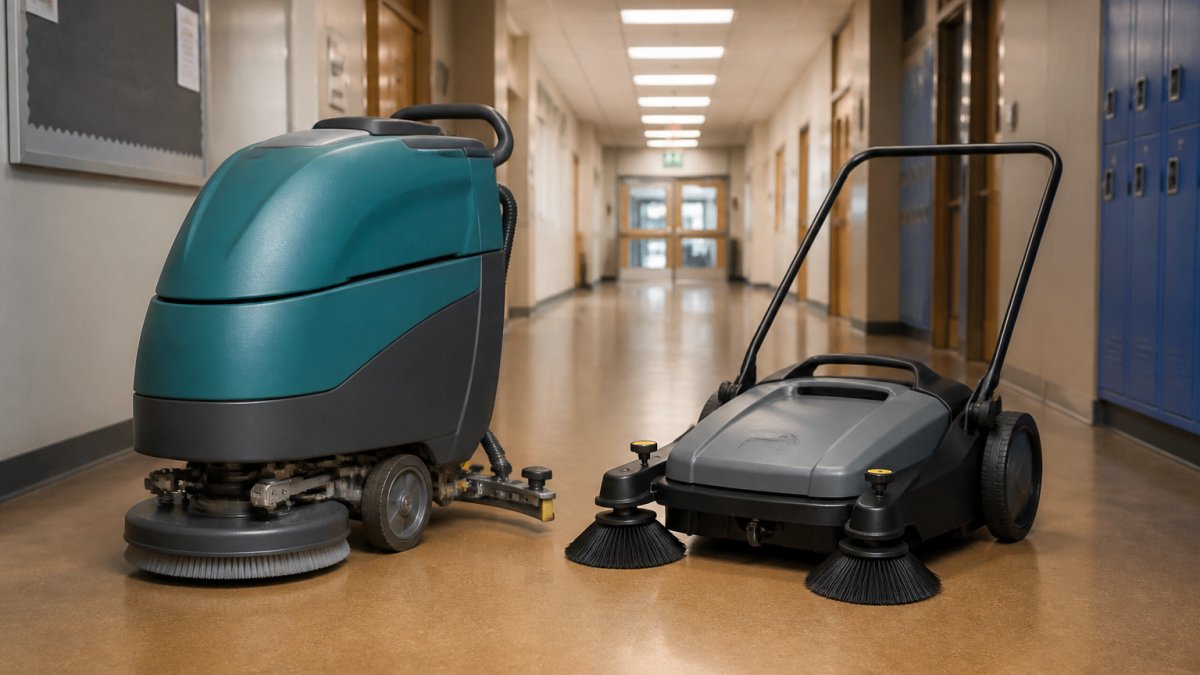
Choosing the right cleaning equipment for school environments determines whether your team can maintain standards consistently or whether cleaning becomes a bottleneck. Walk-behind scrubbers work brilliantly in narrow corridors and classrooms. Ride-on machines handle gymnasiums and large halls far more efficiently. Push sweepers and vacuums keep daily maintenance manageable between deep cleans.
At Nirvana Managed Services LTD, we help schools with recruitment issues for soft services like cleaning and caretaking staff, and we also provide a fully managed service that includes recruitment, contract management, and cover in the event of staff absence.
School Cleaning Equipment Checklist: What You Actually Need
Before you invest in any cleaning equipment, map out your school’s physical layout and identify which areas need which tools. Most schools need a combination of equipment rather than a single solution.
Start with the basics: what floor types do you have? Polished concrete, vinyl tiles, wooden gym floors, and carpeted areas all require different approaches. A machine that excels on hard floors may damage wood.
Next, consider your available storage space. Walk-behind scrubbers are compact and easy to store. Ride-on machines need dedicated space.
Finally, assess your team’s physical capacity. Some equipment requires significant physical effort. Heavier machines demand stronger operators.
Tennant’s school floor cleaning guidance compares equipment formats for different school spaces, helping facilities managers match machine types to area sizes and floor conditions.
A solid school cleaning equipment checklist includes:
- At least one walk-behind scrubber for corridors and classrooms
- A push sweeper or vacuum for daily maintenance
- Microfibre mop systems for spot cleaning
- A pressure washer or steam cleaner for deep cleaning outdoor areas
- Appropriate personal protective equipment for all operators
For schools considering outsourced cleaning services near Chester or across the region, our managed cleaning equipment guide provides practical procurement guidance when selecting equipment as part of a managed service agreement.
Floor Scrubbers vs Sweepers: Which Works Best for Different Areas
Walk-behind scrubbers clean more thoroughly than sweepers, but they’re slower and require more operator training. Push sweepers are faster for daily maintenance but don’t remove ground-in dirt. The choice depends entirely on the space and how often it needs cleaning.
Walk-Behind Scrubbers for Classrooms and Corridors
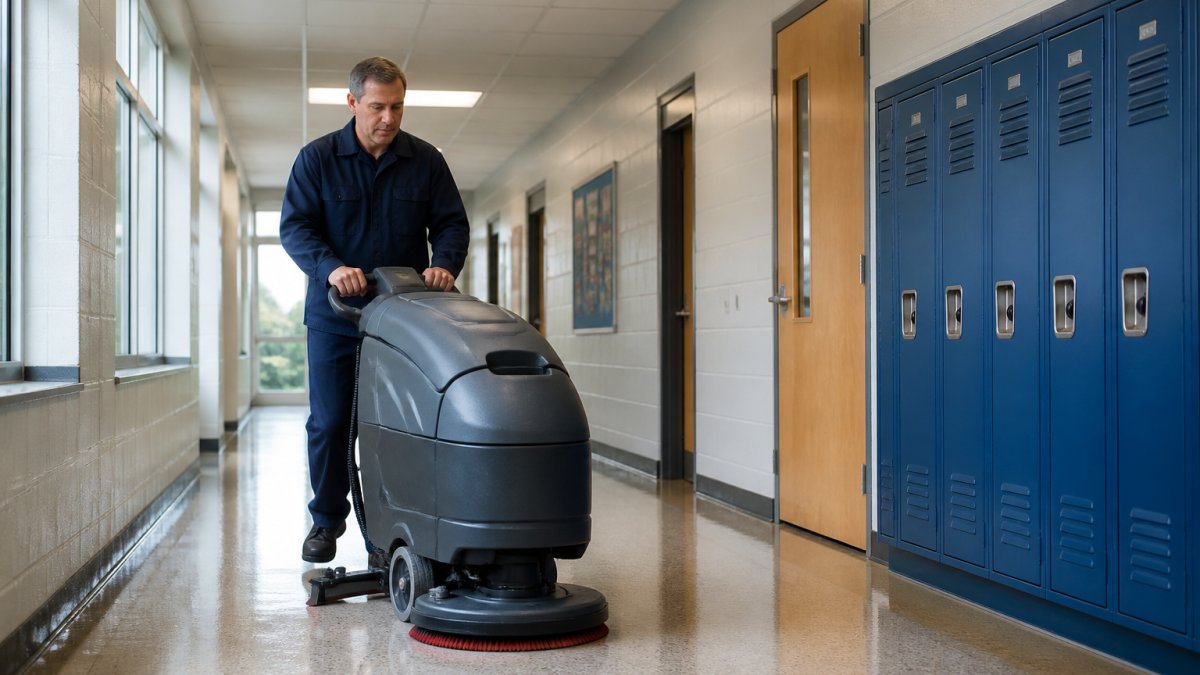
Walk-behind scrubbers are the workhorse of school cleaning. They combine water, cleaning solution, and brush action to remove dirt that sweepers miss. In a classroom or corridor, they deliver a genuinely clean floor in a single pass.
These machines suit smaller spaces perfectly. A classroom is typically cleaned in 10-15 minutes with a walk-behind scrubber. They’re manoeuvrable enough to work around desks, chairs, and lockers. Staff can operate them with minimal training, and they’re quiet enough not to disrupt lessons in adjacent areas.
The trade-off is speed. Walk-behind scrubbers move slowly, typically 1-2 metres per minute. A large corridor takes longer to clean than with a ride-on machine. They also require regular maintenance: brushes wear out, solution tanks need refilling, and the machine needs cleaning after each use.
For schools managing multiple classrooms and corridors, walk-behind scrubbers remain a practical choice for daily cleaning. They’re reliable and effective on the floor types most schools use.
Ride-On Scrubbers for Gymnasiums and Large Halls
Ride-on scrubbers are built for speed and coverage. A gymnasium that would take 45 minutes with a walk-behind machine cleans in 15 minutes on a ride-on. They’re significantly more efficient on large, open, hard-floored spaces.
The downside is cost and complexity. Ride-on machines are expensive to purchase or lease, require dedicated operator training, and need more maintenance. They’re also overkill for small spaces, using a ride-on in a classroom is inefficient and risks damage to walls and furniture.
Ride-on scrubbers make economic sense if your school has gymnasiums, large dining halls, or sports courts. If your facility is primarily small classrooms and corridors, the investment rarely justifies itself. Many schools find that a combination of walk-behind scrubbers and regular deep-cleaning contracts can be a suitable approach.
Push Sweepers and Vacuums for Daily Maintenance
Push sweepers and vacuums handle the daily maintenance that keeps classrooms and corridors looking acceptable between deeper cleans. They remove surface dust, debris, and crumbs quickly, ideal for end-of-day tidying or spot cleaning.
Sweepers work best on hard floors. Vacuums are essential for carpeted areas and soft furnishings. Both are inexpensive, require minimal training, and need little maintenance. A staff member can grab a sweeper and tidy a corridor in minutes.
The limitation is obvious: they don’t clean. They remove loose debris but leave ground-in dirt, marks, and stains. For a school that relies only on sweepers, floors deteriorate visibly within weeks. Sweepers are a maintenance tool, not a cleaning solution.
The most effective approach combines daily sweeping with regular scrubbing. Daily sweeping keeps areas looking acceptable. Weekly or fortnightly scrubbing removes accumulated dirt. This rhythm maintains standards without requiring constant deep cleaning.
Commercial Floor Cleaning Machines for Schools: Pressure Washers and Steam Cleaners
Beyond daily and weekly cleaning, schools need equipment for periodic deep cleaning and outdoor maintenance. Pressure washers and steam cleaners handle jobs that standard scrubbers can’t tackle.
Pressure washers excel at outdoor cleaning: playground surfaces, entrance areas, and exterior walls. They remove algae, moss, and accumulated grime that regular cleaning misses. A pressure washer can restore a weathered outdoor area to near-new appearance in an afternoon.
Steam cleaners sanitise without chemicals. They’re particularly valuable in schools, where reducing chemical exposure matters for staff and pupils. A steam cleaner removes bacteria and viruses effectively, useful for deep cleaning high-touch areas like door handles, handrails, and toilet facilities.
Both machines require training and careful handling. Pressure washers can damage surfaces if used incorrectly. Steam cleaners need regular descaling and can pose scalding risks. Some schools outsource this work to specialist contractors rather than operating these machines in-house.
For schools managing facilities across Chester and the surrounding area, outsourced deep-cleaning contracts can be a valuable option. Kärcher’s education cleaning solutions presents the range of equipment available for educational settings, including pressure washers and steam cleaners suited to school environments.
School Cleaning Health and Safety: Choosing Equipment Your Staff Can Use Safely
Equipment safety directly affects staff retention and wellbeing. Unsafe or uncomfortable equipment can lead to injuries, staff absence, and high turnover.
Ergonomic design matters more than most facility managers realise. A poorly designed mop handle causes back strain. A heavy scrubber leads to shoulder and wrist injuries. Staff working with uncomfortable equipment take more sick leave and leave the role faster.
When selecting school cleaning equipment, prioritise machines with:
- Adjustable handles to suit different staff heights
- Lightweight construction to reduce strain
- Vibration dampening to protect joints
- Clear, simple controls that don’t require extensive training
- Adequate personal protective equipment (gloves, eye protection, respiratory masks where needed)
Staff training is equally critical. Even simple equipment can cause injury if used incorrectly. Pressure washers, steam cleaners, and ride-on scrubbers require documented training and competency assessment. Schools have a legal duty under the Health and Safety at Work etc. Act 1974 to ensure staff are trained and supervised.
For schools struggling to maintain safety standards with in-house teams, managed cleaning services provide an alternative. This approach can eliminate the burden of equipment maintenance and staff training from your school’s shoulders. Our hygiene and infection control guide covers how equipment choices support hygiene and infection control in schools.
Commercial Office Cleaning Equipment: When Schools Share Facilities
Many schools in Chester and surrounding areas share facilities with community organisations, evening classes, or commercial tenants. When your school also functions as a community hub or office space, cleaning needs become more complex.
Commercial office cleaning demands different equipment than school-specific cleaning. Offices typically have carpet, upholstered furniture, and different floor finishes than school corridors.
Combination approaches work best. Daytime school cleaning uses school-focused equipment: walk-behind scrubbers, push sweepers, and spot-cleaning tools. Evening commercial cleaning uses different machines: carpet extractors, upright vacuums, and hard-floor burnishers designed for office environments.
Attempting to use school equipment for commercial cleaning, or vice versa, typically fails. A machine optimised for schools doesn’t perform well on office carpets. A commercial burnisher is overkill and potentially dangerous in a school environment.
Schools managing dual-use facilities often find that outsourced cleaning for the commercial spaces, handled separately from school cleaning, provides better results and clearer cost accountability.
Getting Your School Cleaning Equipment Right from the Start
The best time to plan your school cleaning equipment strategy is before you have a crisis. Schools that wait until staff are overwhelmed or standards slip end up making rushed, expensive decisions.
Start by documenting your current situation: what equipment do you have, how old is it, and what’s actually working versus what’s failing?
Next, map your spaces and identify the specific cleaning challenge in each area. A gymnasium isn’t just “large”, it’s a large space with a specific floor finish, specific usage patterns, and specific cleanliness standards.
Finally, consider whether equipment ownership or outsourced services make more sense for your school. Purchasing equipment requires capital investment, ongoing maintenance, storage space, and staff training.
For schools in Chester, Wrexham, and across the region facing recruitment challenges or seeking reliable cleaning standards, link to page 4 covers how proper equipment selection maintains cleaning standards long-term as part of a managed service approach.
Choosing the right cleaning equipment for school environments isn’t a one-time decision, it’s a strategy that directly affects your school’s appearance, hygiene standards, and staff wellbeing. The wrong equipment wastes time and money.
Frequently Asked Questions
What cleaning equipment does a school need?
Most schools require a combination: push sweepers or vacuums for daily debris removal, walk-behind floor scrubbers for regular deep cleaning of corridors and classrooms, ride-on scrubbers for larger areas like gymnasiums, and pressure washers for outdoor spaces. Toilets and washrooms need specialist disinfection equipment. The exact mix depends on your floor types, building size, and cleaning frequency. A professional audit of your specific spaces helps identify what will work best.
How do you choose school cleaning equipment that is safe for staff and pupils?
Prioritise machines with ergonomic handles to reduce strain on staff, noise levels below 85 decibels to avoid disturbing lessons, and chemical-free or low-toxin cleaning options where possible. Ensure equipment has proper safety guards and emergency stop buttons. Check that your staff receive training on correct operation. Equipment should be regularly maintained to prevent breakdowns that might tempt staff to use unsafe workarounds. Consider machines with adjustable settings so different staff members can operate them comfortably.
Which floor-cleaning machine is best for a school gymnasium?
Ride-on scrubbers are typically best for gymnasiums because they cover large floor areas quickly and efficiently, reducing cleaning time. They handle the heavy-duty cleaning that sports halls need. Walk-behind scrubbers work if your gym is smaller or budget is tight, but they require more staff time and physical effort. Pressure washers suit outdoor courts. The choice depends on your gym size, how often it’s used, and your staffing capacity. Some schools use ride-on machines for monthly deep cleans and walk-behind units for weekly maintenance.
Can a cleaning contractor supply and manage equipment for a school?
Yes. Many professional cleaning contractors provide their own equipment as part of a managed service, which removes the burden of purchasing, maintaining, and storing machines from your school. This approach often works well for schools struggling with recruitment or caretaking staff absences. The contractor handles equipment upkeep, replacement, and staff training. You pay a service fee rather than capital costs. This model can be particularly useful if your school is small or your budget is tight, as you avoid large upfront equipment purchases.


