
Table of Contents
- Commercial Cleaning Services vs Janitorial Services: What’s the Difference?
- What Commercial Cleaning Services Cover
- What Janitorial Services Include
- Commercial Office Cleaning: Scope and Frequency
- School Cleaning Services and Staffing Requirements
- Cleaning Staff Cover for Sickness and Continuity
- Creating a Commercial Cleaning Checklist for Your Facility
- Choosing Between Commercial Cleaning and Janitorial Services
- Frequently Asked Questions
Last Updated: October 6, 2026
Commercial Cleaning Services vs Janitorial Services: What’s the Difference?
Many business managers use commercial cleaning and janitorial services interchangeably, though they’re distinct offerings.
At Nirvana Managed Services LTD, we work with schools, offices, and facilities across Chester and the surrounding region. The difference comes down to scope, frequency, and type of work.
Commercial cleaning services focus on thorough, periodic deep cleaning of specific areas. Janitorial services handle daily or regular light maintenance to keep spaces presentable between deep cleans. One is intensive; the other is routine.
Choosing the wrong service leaves gaps. A school with only janitorial staff might find toilets cleaned daily but floors never stripped and sealed. An office booking only monthly commercial cleaning could look neglected by day 29.
The right approach often combines both. Here’s how to tell them apart and build a cleaning plan that works for your facility.
Commercial cleaning and janitorial services serve different purposes: one handles deep, periodic cleaning; the other manages daily upkeep. Most facilities need both to maintain standards.
What Commercial Cleaning Services Cover
Commercial cleaning services tackle jobs requiring specialist equipment, trained crews, and significant time. These deep cleans happen weekly, monthly, or quarterly.
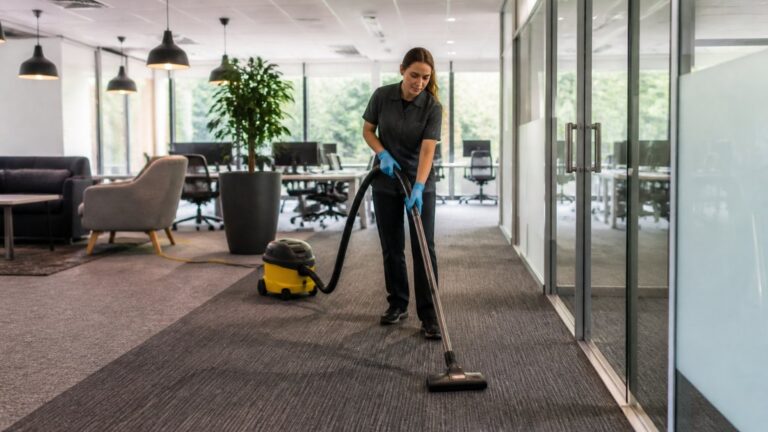
Think carpet extraction, floor stripping and sealing, multi-storey window cleaning, deep kitchen degreasing, or upholstery cleaning, tasks requiring industrial-grade equipment and a team working several hours or a full day.
A commercial cleaning crew arrives with a plan for a specific area or building, moves furniture, accesses hard-to-reach spaces, and uses chemical treatments or pressure equipment.
Common commercial cleaning services include:
- Floor care: stripping, sealing, polishing, and extraction of carpets
- Window cleaning: exterior and interior on multi-storey buildings
- Deep kitchen cleaning: degreasing ovens, extractors, and stainless steel
- Pressure washing: car parks, outdoor patios, and building facades
- Upholstery and fabric cleaning: chairs, sofas, and curtains
- Post-construction cleaning: removal of dust, debris, and protective coverings after building work
For offices in Chester, commercial cleaning services typically happen outside working hours or on weekends, with a team spending 4-8 hours deep cleaning a floor or suite.
The cost model is usually project-based or scheduled monthly, you’re paying for crew time and specialist equipment, not daily presence.
Commercial cleaning works best when scheduled during low-traffic hours. Schools often book these services on Friday evenings or Saturdays so Monday morning the building looks fresh. Offices might schedule them for 6 a.m. before staff arrive.
What Janitorial Services Include
Janitorial services are the daily or weekly routine that keeps a space usable and presentable. A janitorial team visits regularly, often daily, handling basic upkeep that prevents a building from becoming grimy or unhygienic.
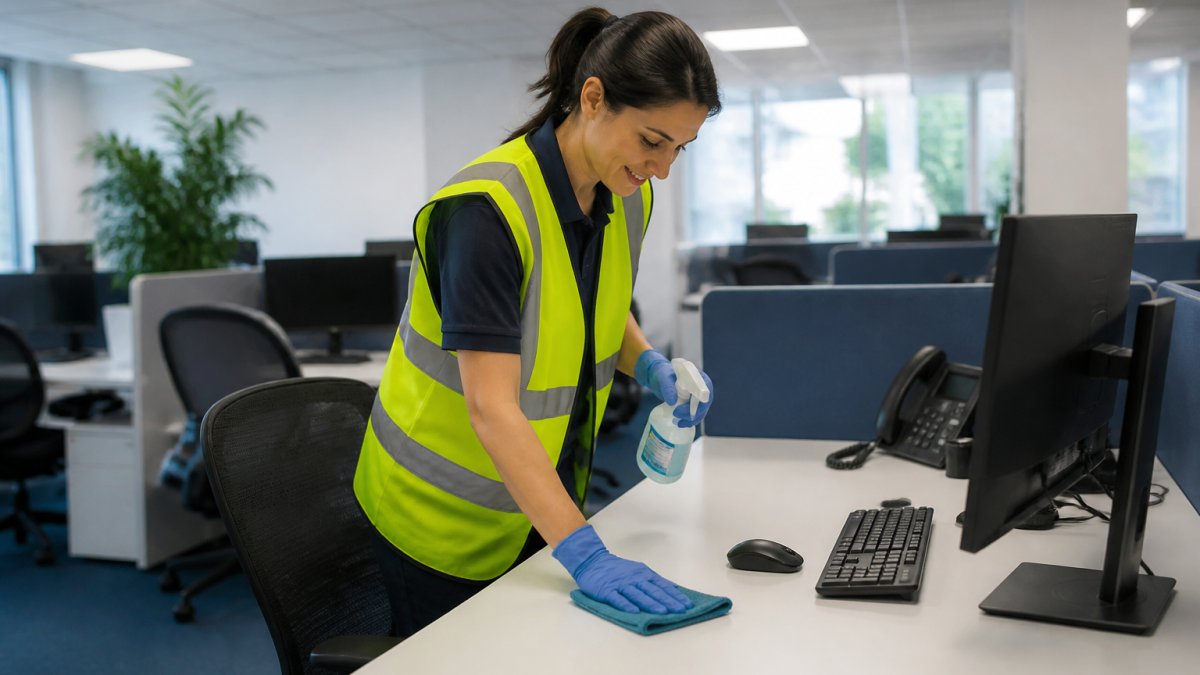
Janitorial work is the baseline: emptying bins, cleaning toilets, mopping floors, wiping surfaces, vacuuming, and restocking supplies. It’s maintenance, not restoration.
A janitor works to a checklist, knows which areas need daily attention, and spots problems early, reporting a blocked toilet or addressing a slippery floor before someone slips.
Typical janitorial services include:
- Daily toilet and washroom cleaning: sanitising, restocking, and odour control
- Floor maintenance: sweeping, mopping, and spot cleaning
- Bin emptying and waste management: daily or twice-daily depending on volume
- Surface wiping: desks, tables, handrails, and light switches
- Vacuuming: carpeted areas and entrance mats
- Supply restocking: soap, paper towels, toilet roll, and bin liners
For schools, janitorial staff often work before children arrive and after they leave, plus during the day for spills and toilets. For offices, they visit early morning or evening.
Janitorial services are usually contracted daily, three times weekly, or weekly depending on foot traffic and facility type, you’re paying for regular presence and consistent maintenance.
Janitorial-only contracts often miss the deep cleaning that prevents buildup. Carpets get dirtier over time. Grout in toilets discolours. Windows stay streaky. Plan for commercial cleaning at least quarterly to address what daily janitorial work cannot.
Commercial Office Cleaning: Scope and Frequency
Commercial office cleaning in Chester and surrounding areas follows a different rhythm than schools or retail, with consistent occupancy, predictable hours, and specific areas needing attention.
The scope of commercial office cleaning depends on office size, type of work, and foot traffic.
Frequency determines cost and results. Weekly commercial cleaning keeps carpets fresh and surfaces polished; monthly is the minimum for most offices, and anything less shows degradation by week three.
Most offices in Chester operate a split model:
- Daily janitorial: emptying bins, cleaning toilets, wiping desks and surfaces, mopping floors
- Weekly commercial cleaning: carpet extraction, window cleaning, deep kitchen cleaning, and floor treatment
- Quarterly specialist cleaning: pressure washing exterior areas, deep upholstery cleaning, or HVAC duct cleaning
The frequency you choose depends on budget and standards. A premium-look office books weekly or fortnightly commercial cleaning; a standard office might manage with monthly. Below that, standards slip visibly.
For commercial office cleaning to work well, the janitorial team and commercial cleaning crew must coordinate: the janitor reports what needs attention, the commercial crew tackles the deep work. Without communication, you get gaps.
School Cleaning Services and Staffing Requirements
Schools face unique cleaning challenges: high foot traffic, shared toilets, spill-prone kitchens and dining halls, and rapid turnaround between events all demand a specific staffing and scheduling approach.
A typical primary school with 200 children and 30 staff might employ 2-3 cleaners on split shifts: one before school opens, one during the day for spills and toilets, and one in the evening to deep clean.
Secondary schools and larger primaries need more: a school with 600+ pupils might employ 4-5 cleaners plus a supervisor to manage rotas, coordinate with catering, and keep standards consistent.
School cleaning services must cover:
- Toilets and washrooms: multiple times daily, especially during lunch and break times
- Dining halls and kitchens: deep clean after each meal service, plus daily sanitising
- Classrooms: vacuuming, wiping surfaces, and removing debris
- Corridors and communal areas: high-traffic zones that show dirt quickly
- Specialist areas: science labs, art rooms, and PE changing rooms with specific cleaning needs
The challenge for many schools is recruitment and retention. Cleaning roles are physically demanding, often part-time, and attract high turnover.
This is where managed services make a difference. Instead of recruiting and managing cleaning staff directly, schools contract a provider who handles recruitment, training, scheduling, and quality assurance, consistent staffing without the HR burden.
Schools should define cleaning standards in writing before hiring or contracting. What does “clean” mean for your school? How often should toilets be checked? What products are acceptable? A clear specification prevents misunderstandings and makes it easier to enforce standards.
Cleaning Staff Cover for Sickness and Continuity
One of the biggest operational challenges for schools and offices is a cleaner calling in sick. With a small in-house team, a single absence can leave toilets uncleaned and floors unmaintained.
Many facilities hire a permanent cleaner, build a routine around them, then face chaos when illness forces them off-site.
The traditional solution is a relief cleaner on occasional shifts, but finding someone reliable at short notice is difficult.
A managed cleaning service builds cover into the contract.
For schools, this matters enormously. Parents expect daily cleanliness; a closed toilet or dirty corridor damages trust and can trigger complaints to governors. Reliable cover prevents that.
For offices, cover is less critical but still valuable, an absence means a slightly less polished office, but operations aren’t affected the same way.
The best managed services guarantee cover within 24 hours, often same-day for urgent situations, so your facility stays clean regardless of staff absences.
Schools with 100+ pupils and offices with 50+ staff should prioritise cover arrangements. The cost of a single day without cleaning (complaints, reduced morale, potential health issues) often exceeds the cost of a cover guarantee.
Creating a Commercial Cleaning Checklist for Your Facility
A commercial cleaning checklist is your operational blueprint, defining what gets cleaned, how often, and to what standard. Without one, cleaning becomes subjective, one cleaner strips and seals floors quarterly, another never does. Standards drift.
A good checklist is specific and measurable. Instead of “clean the kitchen,” it says “wipe stainless steel surfaces, empty the grease trap, sanitise the food prep area, and sweep and mop the floor.”
Start by mapping your facility room by room:
- Entrance and reception: daily sweeping, mopping, and surface wiping; weekly window cleaning
- Toilets and washrooms: daily sanitising and restocking; weekly deep clean of grout and tiles
- Offices and workspaces: daily vacuuming and surface wiping; weekly deep clean of carpets
- Kitchen and dining areas: daily sanitising of prep surfaces and equipment; weekly deep clean of appliances
- Corridors and communal areas: daily mopping and sweeping; weekly deep clean of skirting boards and light switches
- Specialist areas: define cleaning protocols for labs, studios, or storage areas based on their specific needs
For each area, specify:
- Frequency: daily, weekly, monthly, or quarterly
- Task: exactly what cleaning work is required
- Products: which cleaning products to use (important for schools with allergies or sensitivities)
- Time estimate: how long the task should take
- Responsibility: who does this work, janitorial staff or commercial cleaning crew
Once you have a checklist, share it with your cleaning provider or team. They use it as their standard. You use it to audit quality. If a task isn’t on the checklist, it probably won’t happen.
A commercial cleaning checklist for a typical school or office in Chester might run 2-3 pages, detailed but not overwhelming, and specific enough to prevent misunderstandings.
A written cleaning checklist prevents standards from drifting. It’s your contract with your cleaning team: here’s what we expect, here’s how we’ll measure it, here’s how often it happens.
Choosing Between Commercial Cleaning and Janitorial Services
The choice isn’t either/or. Most facilities need both. The question is how to combine them for your specific needs.
Start by asking yourself three questions:
1. What does your facility look like at the end of a typical day?
If it’s clean and presentable, you likely have adequate janitorial coverage.
2. How much foot traffic and use does your facility get?
High-traffic facilities (schools, busy offices, public buildings) need daily janitorial work plus regular commercial cleaning.
3. What’s your budget?
Janitorial services are the baseline cost; commercial cleaning adds to that.
For schools in Chester, a common model is:
- Daily janitorial work: one cleaner in the morning before children arrive, one during the day to handle toilets and spills, one in the evening to deep clean
- Weekly commercial cleaning: a crew to handle carpet extraction, floor treatment, and deep kitchen cleaning
- Quarterly specialist cleaning: pressure washing or upholstery cleaning as needed
For offices, a typical model is:
- Daily or three-times-weekly janitorial: morning or evening cleaning of toilets, floors, and surfaces
- Weekly commercial cleaning: carpet extraction and floor treatment
- Monthly or quarterly specialist services: window cleaning or deep upholstery work
Combining both services usually costs less than two separate providers. A managed service provider coordinates everything and offers better value through efficient scheduling.
Facilities that choose only janitorial services to save money end up frustrated: within months carpets look dull, grout discolours, and the building feels tired.
Booking only commercial cleaning without janitorial support leaves daily maintenance gaps, the building looks great on day one but slips by day 20.
The right balance depends on your facility, budget, and standards.
Choosing the right cleaning approach means matching service levels to your actual needs.
Frequently Asked Questions
What is the difference between commercial cleaning and janitorial services?
Commercial cleaning services handle deep cleaning, specialist tasks, and one-off projects like carpet shampooing, window cleaning, and post-construction debris removal. Janitorial services provide routine daily or weekly maintenance, including vacuuming, dusting, bin collection, and restocking supplies. Commercial cleaning is project-based or periodic; janitorial is ongoing and preventative.
Which cleaning service is best for a school?
Schools typically need both. Janitorial services maintain daily hygiene and safety across classrooms, corridors, and facilities. Commercial cleaning handles deeper tasks like floor stripping, window cleaning, and end-of-term deep cleans. Many schools benefit from a managed provider who can supply both, plus cover when staff are absent due to illness or leave.
What does a commercial cleaning checklist include?
A commercial cleaning checklist covers areas specific to your facility: high-touch surfaces, toilets, staff rooms, carpeted and hard floors, windows, and specialist zones. For offices, this includes desk sanitisation and keyboard cleaning. For schools, it includes playground equipment and dining areas. A tailored checklist ensures nothing is missed and quality remains consistent.
How quickly can a provider supply cleaning staff cover for sickness?
Response time varies by provider and location. Established managed-service providers can typically arrange same-day or next-day cover through their own staff pool or vetted temporary workers. Having a pre-agreed cover arrangement is essential for schools and offices that cannot afford cleaning gaps, especially during term time or busy business periods.