Last Updated: November 4, 2026
Quick Summary
Managed services lift workplace productivity by cutting downtime, speeding up fixes and keeping daily operations running smoothly. Proactive monitoring resolves many faults outside core hours, so staff arrive to working systems. Planned cleaning cover likewise stops small gaps from disrupting the working day.
- Continuous monitoring catches issues, such as a failing backup or full disk, before users notice.
- Track mean time to detect and mean time to resolve before and after switching providers.
- Check that contracts set response times by severity and report them regularly.
- Daily cleaning of shared surfaces and high-touch points supports focus and reduces sickness absence.
- Agree cover arrangements for holidays and sickness before choosing a cleaning provider.
Table of Contents
- What Managed Services Are and How They Work
- How Downtime and IT Interruptions Drain Output
- Faster Fixes Through Proactive Monitoring and Specialist Access
- Keeping Offices Running: Commercial Office Cleaning in Chester
- Office Cleaning Best Practices That Support Focus
- Covering Absence Without Disrupting Daily Work
- Booking a Managed Cleaning Review for Your Site
- Frequently Asked Questions
Managed services can lift workplace productivity by cutting downtime, speeding up fixes and keeping daily operations running smoothly. For Nirvana Managed Services LTD, the question is not whether support matters but how much time it returns to staff. Office managers often find that clean, well-run spaces and reliable systems go hand in hand.
What Managed Services Are and How They Work
Managed services are ongoing, outsourced support arrangements where a provider takes responsibility for a defined set of tasks. The provider monitors, maintains and responds on an agreed schedule, rather than waiting for something to break.
A typical arrangement includes:
- Scheduled maintenance that prevents problems before they start
- A defined response process so staff know who to contact
- Regular reporting on what was done and what is coming next
- Cover arrangements for when in-house people are unavailable
In practice, the value comes from predictability. Instead of one busy person handling every issue, the workload is shared across a team with set responsibilities.

How Downtime and IT Interruptions Drain Output
Every interruption costs more than the minutes it lasts. Staff stop, switch tasks, and often lose the thread of what they were doing.
Common sources of lost time include:
- Systems that fail without warning
- Slow responses to support requests
- Repeat faults that nobody has traced to a root cause
- Waiting on one person who is out of the office
Many offices find that small, frequent interruptions add up more than one large outage. A managed approach aims to reduce both, so staff spend more time on the work they were hired to do.
Faster Fixes Through Proactive Monitoring and Specialist Access
Proactive monitoring is not simply watching for failures. It involves a set of automated checks and alerts that run continuously, often every few minutes, against servers, networks, endpoints and cloud services. When a threshold is breached, such as disk space dropping below 10%, a backup job failing, or a service becoming unresponsive, the provider receives an alert and can act before users notice.
The practical effect on productivity is that many issues are resolved outside core working hours. For example, a failed update or a full mailbox can be fixed overnight, so staff arrive to a working system.
Specialist access matters because diagnosis speed varies enormously by expertise. A generalist may spend hours on a complex network fault that a certified engineer resolves in minutes.
To measure whether faster fixes are actually improving productivity, track these metrics before and after switching to a managed service:
- Mean time to detect (MTTD): how long it takes to become aware of an issue
- Mean time to resolve (MTTR): how long from detection to full fix
- Ticket volume per user per month: whether problems are becoming less frequent
- User-reported downtime minutes per week: the time staff lose waiting for IT
A managed provider should report these figures regularly. If they do not, ask why.
Watch out: Faster response only helps if service levels are clearly defined. Check that the contract specifies response times by severity (e.g., critical issues responded to within 15 minutes, standard requests within 4 hours) and that these are measured and reported, not just promised.
Keeping Offices Running: Commercial Office Cleaning in Chester
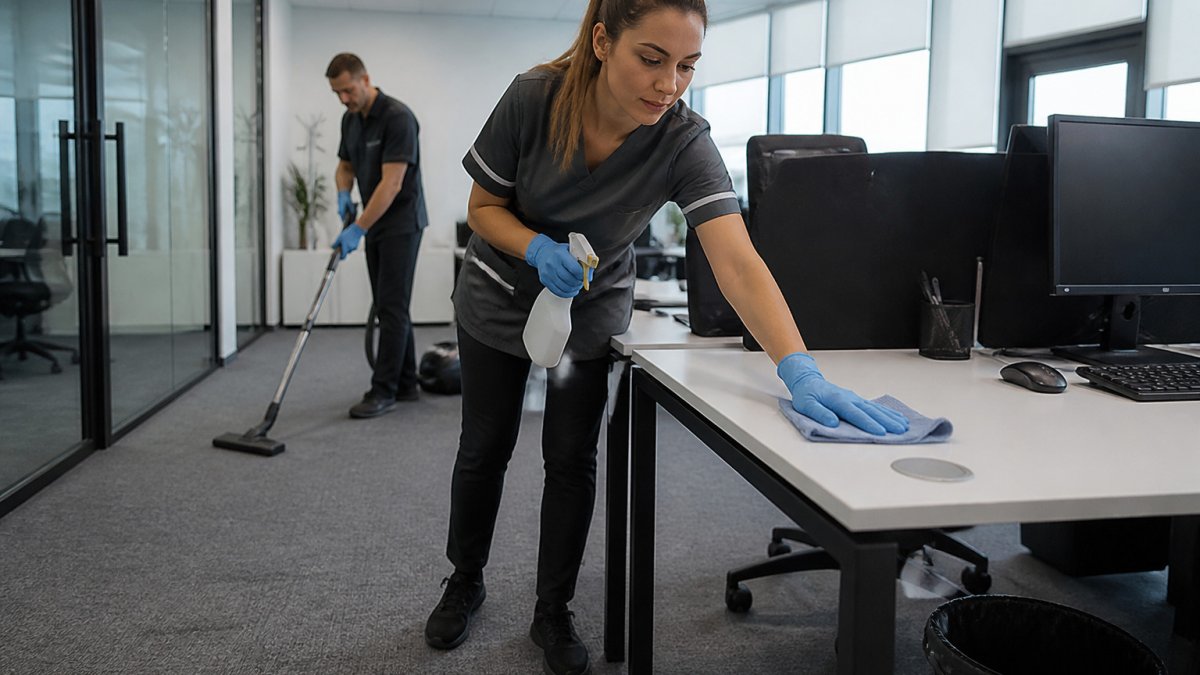
Workplace productivity is not only about technology. A clean, orderly office supports focus, and commercial office cleaning in Chester is a core part of keeping a building ready for work each day.
Outsourced cleaning works in a similar way to managed IT. A contractor follows an agreed schedule, reports on standards and steps in when something is missed. You can compare managed cleaning contract options for business to see how these arrangements are structured. Businesses looking for this kind of support can explore how outsourcing office cleaning works to see how a local service is delivered.
Office Cleaning Best Practices That Support Focus
A clean office is not just about appearance; it directly affects how well people can concentrate and how much time they lose to avoidable distractions.
First, clutter and dirt create visual noise that competes for attention. A tidy desk policy, enforced by a cleaning team that clears shared surfaces daily, reduces the mental load on staff. Second, high-touch areas, door handles, lift buttons, shared keyboards, kitchen taps, are hotspots for germs. Regular disinfection reduces sickness absence, which directly protects productivity. Third, clean kitchens and toilets signal that management cares about employee wellbeing, which improves morale and retention.
Best practice for office cleaning that supports focus includes:
- Daily cleaning of shared surfaces (meeting tables, kitchen counters, printer areas) before staff arrive
- Twice-daily wipe-down of high-touch points in busy offices, or at least once daily in smaller sites
- **
- Waste removal at least daily, with recycling separated to avoid overflow
- Restocking of supplies (soap, paper towels, toilet paper) on a fixed schedule, not when someone complains
To measure whether cleaning is supporting productivity, track sickness absence rates, employee satisfaction scores (especially around office environment), and the number of cleaning-related complaints. A good provider will welcome these metrics and use them to adjust the schedule.
Watch out: Consistency matters more than intensity. A daily routine that is actually followed is better than an ambitious schedule that gets skipped when staff are absent. Check that the provider has a clear cover arrangement for holidays and sickness, and that standards are audited regularly, not just self-reported.
The article sets out the practices that matter most, along with how often each should happen.
| Practice | Frequency | Why it matters |
|---|---|---|
| Clean shared surfaces | Daily, before staff arrive | Reduces visual clutter |
| Wipe high-touch points | Twice daily in busy offices, once daily in smaller sites | Limits germ spread |
| Remove waste | At least daily | Stops overflow and separates recycling |
| Restock supplies | Fixed schedule | Avoids shortages |
Covering Absence Without Disrupting Daily Work
When a cleaner or caretaker is off sick, the gap can quickly show. Planned cover stops small absences from becoming visible problems.
Before choosing a provider, check:
- How quickly cover can be arranged
- Whether the provider manages recruitment and contracts, not just labour
- How standards are kept consistent between different staff members
Find out how to find reliable office cleaning cover if absence is a regular concern for your site.
Booking a Managed Cleaning Review for Your Site
Every office has different needs, so the right arrangement depends on your building, your team and your schedule. A short review is the simplest way to see what would make the biggest difference.
Nirvana Managed Services LTD can talk through your requirements for commercial office cleaning and cover when staff are away. For current pricing, contact the team directly for a quote, as costs depend on the size of the site and the services needed. You can also read how to choose managed office cleaning providers before booking a review.
Frequently Asked Questions
How can managed services improve workplace productivity?
Managed services cut the time staff lose to technical problems by monitoring systems before they fail and by giving staff a single point of contact for support requests. When a laptop, network or shared drive stops working, a managed provider typically responds faster than an in-house team stretched across other duties. Fewer interruptions mean people spend more of their working day on their actual tasks. Productivity gains are easiest to see when you track how many support tickets are raised, how long they take to close and how many hours staff lose to outages each month.
What are managed services in a workplace?
Managed services are ongoing services delivered by an external provider under an agreed scope, rather than one-off jobs. In a workplace this can include IT support, system monitoring, maintenance, and in some cases soft services such as commercial office cleaning and caretaking. The provider takes responsibility for keeping services running to an agreed standard, usually through a service-level agreement that sets response times and reporting. Pricing depends on the scope, site size and service frequency, so request a tailored quote from Nirvana Managed Services LTD via its website.
How can commercial office cleaning support employee productivity?
Clean, well-maintained offices reduce distractions and help staff feel settled at their desks. Regular cleaning of shared kitchens, toilets, desks and high-touch surfaces also lowers the chance of staff being away through illness. Consistent scheduling matters as much as the cleaning itself, because a site that is tidied at the same times each day feels predictable. A managed cleaning contract makes it easier to set clear standards and check that they are met on a regular basis.
How can managed services help cover staff absence?
When a member of cleaning or caretaking staff is off sick, a managed service can supply cover so that the site is not left unattended or visibly neglected. This avoids the scramble of finding someone at short notice, which often falls to office managers who already have full workloads. Ask any provider how quickly they can arrange cover and what their process is for keeping standards consistent when a replacement is on site.
Managed support, whether for IT or for the physical environment, gives staff back the time they lose to avoidable interruptions. Get in touch with Nirvana Managed Services LTD to arrange a managed cleaning review and see how a dependable, consistent service could support your workplace.


