Last updated: 20 November 2026
Quick Summary
Essential cleaning equipment for educational facilities is the core set of machines, tools and consumables needed to keep classrooms, corridors and washrooms hygienic, safe and presentable every day. Specify it zone by zone: flat microfibre mops, HEPA vacuums and colour-coded cloths for teaching zones, scrubber dryers and sweepers for circulation zones, and dedicated disinfectants and colour-coded cloths for washrooms.
- Split every school clean into teaching, circulation and hygiene zones, each needing different equipment.
- Flat mops reach under desks and around chair legs far faster than string mops.
- Run sweepers before scrubbers and empty collection bins at the end of every shift.
- Walk-behind scrubber dryers suit corridors and classroom wings; ride-on machines cover halls faster.
- Maintenance runs daily, weekly, monthly and termly, and most failures trace back to skipped filter cleaning.
Table of Contents
- What Counts as Essential Cleaning Equipment for Educational Facilities
- School Cleaning Equipment by Zone: Classrooms, Corridors and Washrooms
- School Floor Cleaning Machines: Scrubber Dryers, Sweepers and Vacuums
- A Classroom Cleaning Checklist That Keeps Standards Consistent
- Commercial Office Cleaning Equipment: What Transfers from a School Setting
- Buying, Hiring or Outsourcing: Total Cost of Ownership for Schools
- Safe Storage, Staff Training and Equipment Maintenance Schedules
- Planning Your Next Equipment Review with Nirvana Managed Services
- Frequently Asked Questions
What Counts as Essential Cleaning Equipment for Educational Facilities
Essential cleaning equipment for educational facilities is the core set of machines, tools and consumables a school needs to keep classrooms, corridors and washrooms hygienic, safe and presentable every day. The kit list is rarely the problem for most schools; the specification behind it is. Below, we break the list into three zones and show where buying, hiring or outsourcing makes sense, including commercial office cleaning equipment that transfers directly.
The three zones of a school cleaning specification
Every school clean splits into three zones, each needing different equipment:
- Teaching zones: classrooms, libraries and shared teaching spaces. Dust control, desks, touchpoints and hard floors.
- Circulation zones: corridors, halls, entrances and sports halls. Volume cleaning, large floor areas and high-traffic soil.
- Hygiene zones: washrooms, changing rooms and food areas. Disinfection, colour-coded cloths and consumables.
Specify zone by zone. A single list for the whole site always overbuys in some areas and underbuys in others.
How to read a supplier list without overbuying
Supplier catalogues are written to sell breadth, not to serve as a specification. Start from your floor surfaces, room count and daily footfall, then pick the smallest kit that covers them. If a line item cannot be tied to a zone and a task, leave it off the order.
School Cleaning Equipment by Zone: Classrooms, Corridors and Washrooms
A zone-by-zone specification separates a kit list that looks thorough on paper from one that actually gets used. Map each zone to its dominant floor surface, touchpoint density and daily footfall, then choose the smallest set of tools that covers all three. Below we flag where schools tend to over- or under-specify.
Classrooms and shared teaching spaces
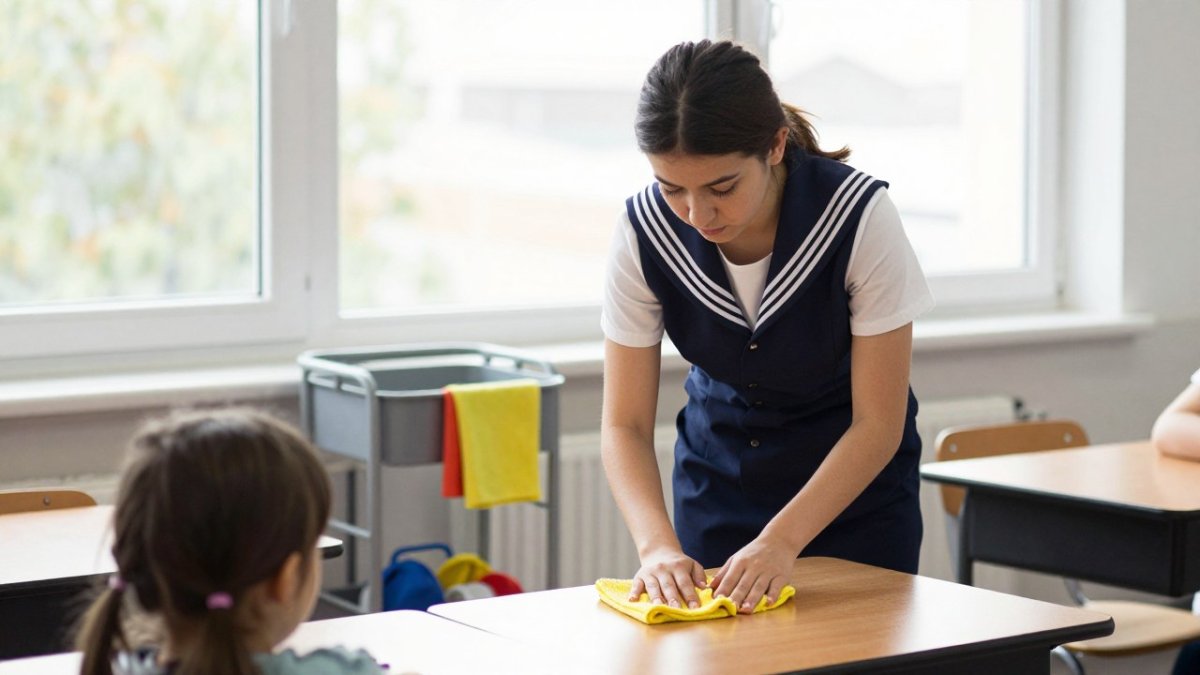
Classrooms are touchpoint-heavy and surface-mixed. Many classrooms run a combination of hard floor, carpet and soft furnishings. That mix drives the kit list:
- Hard floors: a flat microfibre mop with a swivel head for daily damp mopping, plus a spray-and-wipe system for spot spills. Flat mops reach under desks and around chair legs far faster than string mops.
- Carpets and soft furnishings: a HEPA-filter vacuum with a crevice tool and an upholstery brush. HEPA filtration matters because fine dust and allergens are easily re-suspended by lower-grade machines.
- Touchpoints: colour-coded microfibre cloths, one colour per task, plus a multi-surface cleaner and a disinfectant for desks, door handles, light switches and shared equipment. Colour coding is a useful control against cross-contamination between teaching and washroom zones.
HSE guidance on cleaning and disinfection sets out the clean-before-disinfect principles that should shape staff training, and it is worth building those principles into the classroom checklist rather than assuming staff already know them.
Watch out: flat mops and microfibre cloths lose effectiveness quickly if they are laundered with fabric conditioner, which clogs the fibres, specify a conditioner-free wash routine from day one.
Corridors, halls and sports halls
Circulation zones are volume work, and the equipment choice turns on floor area and surface finish rather than room count.
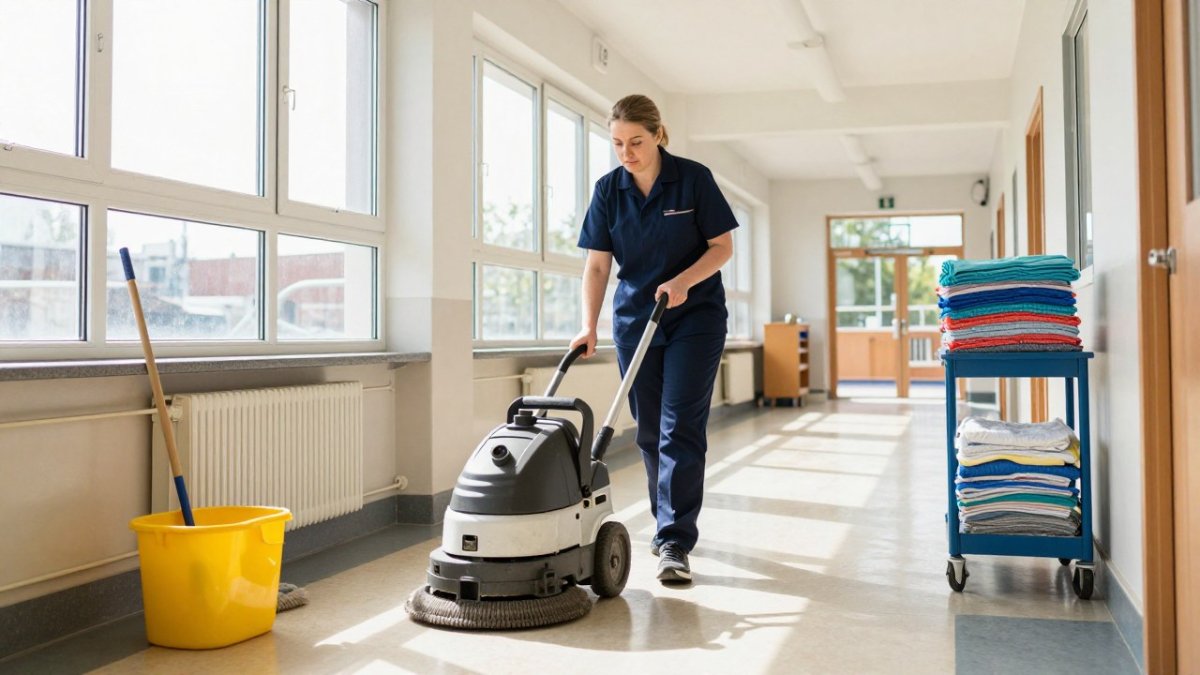
- Vinyl and laminate corridors: a walk-behind scrubber dryer with a cylindrical brush is the workhorse, it washes and dries in one pass, so corridors are back in use within minutes between lessons. Pair it with a wide sweeper or lobby broom for entrance grit.
- Sealed timber and sports surfaces: a rotary or orbital machine with the correct pad grade, and a scrubber dryer set to low moisture. Too much water swells timber at the seams; too aggressive a pad dulls the finish.
- Synthetic sports floors: a scrubber dryer with a soft brush and a neutral sports-floor cleaner. Rubber crumb and scuff marks need a matched pad, not a heavier brush.
Run sweepers before scrubbers, and empty collection bins at the end of every shift. Corridor cleaning failures often trace back to grit being scrubbed into the floor rather than swept up first.
Washrooms and hygiene areas
Washrooms carry the highest hygiene risk and the highest consumable turnover. The equipment list is short but the discipline around it is what matters:
- Toilets and urinals: a dedicated toilet cleaner and a non-abrasive bowl brush; avoid mixing acidic descalers with chlorine-based products.
- Surfaces and touchpoints: a dedicated disinfectant and colour-coded cloths kept physically separate from teaching-zone cloths, ideally stored in a labelled washroom caddy that never leaves the zone.
- Hand hygiene and consumables: hand soap, paper towels, toilet rolls and refuse bags. Specify dispensers that lock and are compatible with your chosen consumable range to avoid staff improvising refills.
Matching equipment to facility type and floor surface
List every distinct floor surface on site and confirm at least one tool covers it. Most schools in the Wrexham and Chester area run four to six surface types: vinyl, laminate, carpet, sealed timber, synthetic sports floor and entrance matting. A gap against any of those is where cleaning standards will slip first.
Local sourcing, delivery and servicing in Chester and Wrexham
Equipment specification is only half the job; the other half is keeping machines running. Schools are often served by cleaning-equipment suppliers offering delivery, on-site demonstration and servicing, but lead times and coverage vary. Ask three questions: what is the call-out response time for a scrubber dryer breakdown, do they stock consumables such as pads, brushes and squeegees, and can they train your staff at delivery.
School Floor Cleaning Machines: Scrubber Dryers, Sweepers and Vacuums
School floor cleaning machines fall into three families: scrubber dryers for washing and drying hard floors in one pass, sweepers for dry debris, and vacuums for carpet and detail work. The right mix depends on floor area, surface type and staff hours available.
Walk-behind versus ride-on scrubber dryers
Walk-behind machines suit corridors, classroom wings and tight turns. Ride-on machines cover halls and large open areas faster but need clear routes and trained operators. As PUPN’s guide to selecting floor cleaning equipment for schools notes, productivity and operator safety should be weighed alongside the machine itself.
| Machine | Best For | Watch Out For | Staff Time |
|---|---|---|---|
| Walk-behind scrubber dryer | Corridors, classroom wings, canteens | Slower on large halls | Moderate |
| Ride-on scrubber dryer | Sports halls, large open floors | Needs clear routes and training | Lower per square metre |
| Sweeper | Entrances, halls, dry debris | Not a substitute for washing | Low |
| HEPA vacuum | Carpets, soft furnishings, dust control | Slower than sweeping hard floors | Moderate |
HEPA vacuums and sweepers for high-traffic areas
HEPA filtration traps fine dust that standard vacuums push back into the air, which matters in classrooms and anywhere with allergy-sensitive pupils. Sweepers handle grit and debris at entrances before it spreads. Run sweepers first, then scrubbers, and empty collection bins at the end of every shift.
A Classroom Cleaning Checklist That Keeps Standards Consistent
A classroom cleaning checklist turns a kit list into consistent daily practice. It should name each surface, the product and the frequency, so cover staff and new starters deliver the same standard without supervision.
- Desks and tables wiped with multi-surface cleaner
- Chairs, door handles and light switches disinfected
- Whiteboards and sills dusted
We publish a full room-by-room version in our guide to building a school cleaning checklist for classrooms and toilets, which you can adapt for your own site. For dust and allergen control in classrooms, see our guidance on reducing classroom dust and allergens.
Commercial Office Cleaning Equipment: What Transfers from a School Setting
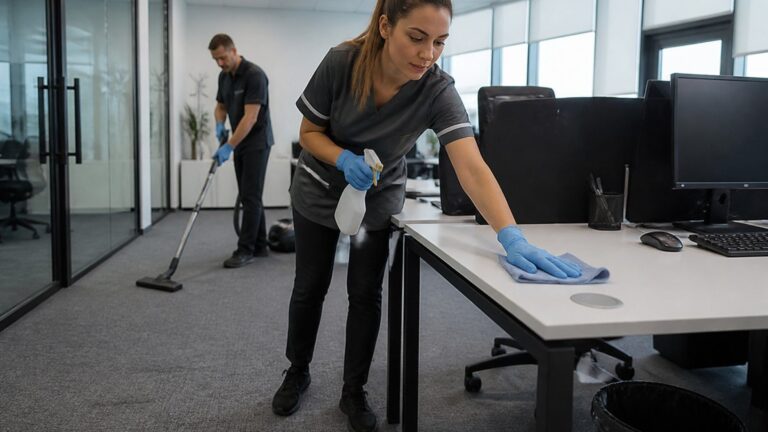
Most commercial office cleaning equipment transfers directly from a school specification, but the differences matter once you move from a classroom wing to an open-plan office. Offices share the same hard floors, washrooms and touchpoints, but typically run more carpet, a denser touchpoint pattern around desks and shared equipment, and lower corridor footfall, which changes the equipment mix and procurement priorities.
What transfers unchanged
- Colour-coded microfibre cloths and flat mops, the same cross-contamination control applies, and the same conditioner-free laundering routine keeps them effective.
- HEPA vacuums, fine dust and allergen control matters just as much in offices, particularly in carpeted areas and around soft seating.
- Multi-surface cleaner and disinfectant, desks, door handles, light switches and shared equipment remain the touchpoint priority.
What changes for offices
The floor mix is the biggest shift. Offices often run more carpet and less vinyl, so vacuum capacity and carpet care matter more than scrubber capacity.
Touchpoints concentrate differently too. In a school, desks are cleaned around pupils; in an office, shared equipment, printers, photocopiers, kitchen taps, fridge handles and meeting-room tables, becomes the priority.
Equipment for commercial office cleaning by area
- Open-plan and private offices: HEPA vacuum for carpet, microfibre cloths and multi-surface cleaner for desks and shared equipment, and a flat mop for any hard-floor breakout areas.
- Meeting rooms: touchpoint-focused kit; glass cleaner for tables and screens; a HEPA vacuum for chairs and soft furnishings.
- Kitchens and tea points: dedicated colour-coded cloths, a food-safe sanitiser, and a separate mop head for the kitchen floor.
Procurement and servicing for office sites
Office cleaning contracts often run on tighter service-level agreements than school contracts, so equipment reliability and response times matter. When specifying for an office site in Chester, Wrexham or the wider region, confirm your supplier or managed-service provider can demonstrate machine servicing turnaround, consumable stock availability and staff training at handover.
If you are weighing up buying equipment and running cleaning in-house versus handing the whole operation to a managed service, our comparison of outsourcing versus in-house cleaning sets out the trade-offs.
Buying, Hiring or Outsourcing: Total Cost of Ownership for Schools
Total cost of ownership for school cleaning equipment is the purchase price plus servicing, pads and brushes, chemicals, storage, staff training time and downtime. The purchase price is rarely the biggest line. Hillyard’s guidance on justifying a cleaning machine budget makes the same point: compare models and brands on whole-life value, not sticker price.
When purchase makes sense and when hire does
Purchase suits machines used daily on a stable site. Hire suits short bursts: deep cleans, exam periods, building work or a machine covering for one in repair. Outsourcing can suit schools that cannot recruit or retain caretaking and cleaning staff.
The staff time cost competitors rarely mention
Every machine carries a hidden labour line. Scrubber dryers need filling, emptying and pad changes; ride-on machines need trained operators. If recruitment is already stretched, the real question is not which machine to buy but who will run it. That is where a managed service can change the sums.
Safe Storage, Staff Training and Equipment Maintenance Schedules
Safe storage, training and maintenance keep equipment working and staff protected. Chemicals belong in a locked, ventilated store with safety data sheets to hand, and no cleaning chemical should be decanted into unlabelled bottles.
Maintenance should run to a written schedule:
- Daily: empty bins, rinse pads, check cables and batteries
- Weekly: clean filters, inspect brushes and squeegees
- Monthly: service scrubber dryers, check HEPA seals
Our guide to reducing chemical exposure in school cleaning covers storage and dilution in more detail. In practice, most equipment failures we see trace back to skipped filter cleaning, not worn machines.
Planning Your Next Equipment Review with Nirvana Managed Services
An equipment review can start with a walk of the site rather than a catalogue.
If you want to see how a managed service holds standards before committing to an equipment review, read our guide to maintaining high cleaning standards in educational facilities.
Recruiting and retaining caretaking and cleaning staff is the constraint that shapes every equipment decision.
Frequently Asked Questions
What cleaning equipment does a school need as a minimum?
A workable minimum for most schools covers four groups: floor care (a scrubber dryer or mop system plus a HEPA vacuum), washroom supplies (toilet cleaner, disinfectant, colour-coded cloths, paper products), classroom items (multi-surface cleaner, wipes, bin liners) and safe storage (locked cupboard, labelled containers). The exact list depends on floor surfaces and building size. Start from a zone-by-zone audit rather than a supplier catalogue, because catalogues sell bundles that include items your site may never use.
What is the best equipment for cleaning school floors?
For large hard-floor areas such as halls and corridors, a scrubber dryer cuts labour compared with mopping. Walk-behind models suit tighter routes and smaller sites; ride-on models cover more square metres per hour in large buildings. For carpets and mats, a HEPA vacuum captures fine dust rather than redistributing it. The right choice depends on your floor mix, storage space and who will operate the machine, so compare models on cleaning width and tank capacity before deciding.
How should schools store cleaning equipment safely?
Keep equipment in a dedicated, lockable store away from pupil access, with chemicals on lower shelves and never above eye level. Store mops and buckets dry and inverted so they do not breed bacteria, and keep colour-coded cloths separated by zone. Charge scrubber dryer batteries in a ventilated area and follow the manufacturer’s instructions. A simple wall chart listing what goes where makes it easier for cover staff to follow the same system when regular cleaners are absent.
How often should school cleaning equipment be checked or replaced?
Build a weekly check into the caretaking routine: inspect brushes and pads for wear, test batteries and chargers, and confirm chemical containers are labelled and in date. Replace worn floor pads and scrubber brushes when cleaning performance drops rather than waiting for failure. Machines usually last longer with scheduled servicing, and keeping a simple log of faults helps you decide whether repair or replacement is the better value at each review point.
What cleaning equipment is needed for commercial office cleaning?
Commercial office cleaning equipment overlaps heavily with school kit: a scrubber dryer or mop system for hard floors, a HEPA vacuum for carpets and soft furnishings, colour-coded cloths, multi-surface cleaner, disinfectant and washroom supplies. Offices often add glass-cleaning kit for partition walls and a dedicated vacuum for IT areas. If you already run a school cleaning specification, most of the same equipment logic transfers, which is why a single managed provider can cover both sites.