
Table of Contents
- The Case for Managed Cleaning in Primary Schools
- In-House vs Outsourced School Cleaning: A Direct Comparison
- DBS Requirements for School Cleaning Staff and Compliance
- Staffing Continuity and Absence Cover
- Commercial Office Cleaning Services Chester and Beyond
- Realistic Cost Considerations and Budget Impact
- Is Managed Cleaning Right for Your School?
- Frequently Asked Questions
Last Updated: September 28, 2026
The Case for Managed Cleaning in Primary Schools
When a cleaner calls in sick and your school has no backup, the impact hits hard. Classrooms don’t clean themselves, and parents notice when standards slip. This is where the question of whether managed cleaning is worth it for primary schools becomes urgent, not theoretical. At Nirvana Managed Services LTD, we’ve worked with schools that face exactly this pressure: stretched budgets, recruitment challenges, and the constant risk of service gaps.
Managed cleaning services handle recruitment, vetting, contract management, and guaranteed absence cover all under one arrangement. The real question isn’t whether managed cleaning exists, it does. The question is whether outsourcing this function actually saves money and stress compared to managing staff in-house.
The answer depends on your school’s size, budget flexibility, and tolerance for service disruption. For most primary schools, managed cleaning removes administrative burden and eliminates the risk of being without cover. But it requires a formal contract and isn’t always cheaper than keeping staff on your own payroll.
Managed cleaning works best for schools struggling with recruitment or frequent staff absences. It removes the hiring burden but requires commitment to a contract-based model.
In-House vs Outsourced School Cleaning: A Direct Comparison
Running your own cleaning team gives you direct control but demands active management. You hire, train, schedule, and cover absences yourself. When a cleaner leaves, you advertise, interview, and onboard their replacement. This approach works if you have the administrative capacity and a reliable local talent pool.
Outsourced cleaning transfers all that responsibility to a provider. They handle recruitment, vetting, scheduling, and absence cover. Your school pays a monthly fee and gets a guaranteed service level. The trade-off is less direct control and a contractual commitment.
| Aspect | In-House Cleaning | Managed Cleaning Service |
|---|---|---|
| Recruitment burden | You manage hiring and onboarding | Provider handles all recruitment |
| Absence cover | You arrange temporary staff or go without | Provider guarantees cover |
| Training and standards | You set and monitor standards | Provider manages quality and consistency |
| Contract flexibility | Hire/fire as needed | Fixed contract term, formal agreement |
| Cost predictability | Variable (depends on staff turnover) | Fixed monthly fee; contact for pricing |
| Administrative overhead | High (scheduling, payroll, compliance) | Low (provider manages operations) |
| Staff continuity | At risk if staff leave | Managed by provider; continuity assured |
In-house cleaning suits schools with stable, experienced staff and strong management capacity. Outsourced cleaning suits schools where recruitment is difficult, turnover is high, or absence cover is a recurring problem.
The real cost difference depends on your current staff wages, turnover rate, and how often you go without cover. Many schools find that the administrative time saved alone justifies outsourcing, even if the monthly cost seems higher at first glance.
If you switch to managed cleaning, expect a transition period. The new provider needs time to understand your school’s specific needs, layout, and standards. Plan for 4-6 weeks of closer oversight before settling into routine.
DBS Requirements for School Cleaning Staff and Compliance
Every person who cleans a primary school must pass a Disclosure and Barring Service (DBS) check. This is non-negotiable. The DBS vetting process confirms that staff have no criminal convictions or safeguarding concerns that would make them unsuitable to work around children.
If you manage cleaning in-house, you’re responsible for arranging DBS checks for every team member. You submit applications, wait for results (typically 2-4 weeks), and maintain records. New starters can’t work unsupervised until their DBS clearance comes through.
When you use a managed cleaning service, the provider handles DBS vetting as part of their recruitment process. This removes a significant compliance burden from your school. However, you should verify that the provider’s DBS processes meet your expectations and that they maintain up-to-date records.
According to UK government guidance on DBS checks for schools, enhanced DBS clearance is required for anyone with regular, unsupervised access to children. Your cleaning staff fall into this category. The provider you choose must demonstrate that all their staff hold valid enhanced DBS clearance before they work at your school.
Managed cleaning providers typically include DBS vetting in their service model. This is a key advantage: you get vetted staff without doing the paperwork yourself. Ask any potential provider for proof of their DBS processes and how they handle updates when staff leave or join.
Staffing Continuity and Absence Cover
The biggest operational advantage of managed cleaning is guaranteed absence cover. When your regular cleaner is ill, a managed service sends a replacement. Your school isn’t left scrambling to find someone or doing without.
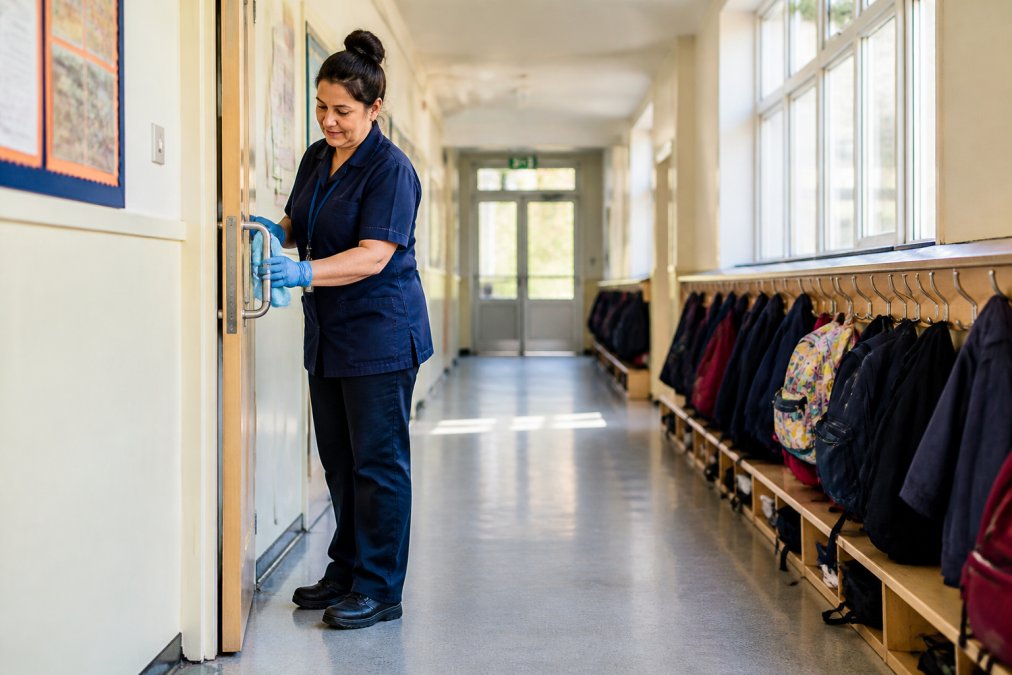
In-house cleaning often fails here. If your one or two cleaners are absent, you have no backup. You either ask existing staff to work extra hours (creating burnout) or the school operates below standard until they return. Over time, this pattern damages morale and increases turnover.
Managed cleaning providers maintain a pool of trained staff. When someone is absent, they deploy a replacement from that pool. The service continues. Your school’s cleanliness standards don’t drop because one person is ill.
This continuity has a hidden cost benefit: fewer disruptions mean fewer complaints from parents and staff. It also reduces the stress on your existing team, who don’t have to cover absences themselves.
For schools with high staff turnover or frequent absences, this alone can justify the cost of managed cleaning. You’re not just paying for cleaning, you’re paying for reliability.
When evaluating a managed cleaning provider, ask specifically how they handle absence cover. What’s their response time? Do they guarantee same-day cover, or is it next-day? This detail matters more than you might think.
Commercial Office Cleaning Services Chester and Beyond
While the focus here is primary schools, the same logic applies to commercial office cleaning. Offices face identical challenges: recruiting reliable cleaners, managing absences, maintaining standards, and handling the administrative overhead.
Commercial office cleaning operates under the same principles as school cleaning. You can hire in-house or outsource to a managed service. Offices often choose outsourcing because the benefit is clearer: a clean office affects client perception and employee morale directly, and the cost is easier to justify as a business expense.
Managed cleaning for offices typically includes daily cleaning, floor care, waste management, and sometimes specialised services like carpet cleaning or window cleaning. The provider handles scheduling, staffing, and quality control.
For schools considering managed cleaning, the commercial office model offers a useful comparison. Many providers, including Nirvana Managed Services LTD, serve both sectors. They understand the specific demands of educational environments and commercial spaces.
If your school is part of a larger trust or shares facilities with other organisations, you might find that a provider experienced in commercial office cleaning can handle your school’s needs more flexibly.
Realistic Cost Considerations and Budget Impact
Managed cleaning requires a budget commitment. Pricing depends on school size, facility condition, cleaning frequency, and the provider’s local market rates. Rather than guessing, contact providers directly for a quote based on your specific needs.
-
Recruitment and vetting of staff
-
Training and quality oversight
-
Absence cover and staff replacement
-
Contract management and compliance
-
Guaranteed service levels
-
Time spent recruiting, interviewing, and onboarding
-
Payroll administration and tax compliance
-
Training and supervision
-
The cost of absences (either paying for temporary cover or accepting lower standards)
-
Staff turnover and the cost of replacing people who leave
Small primary schools (under 30 staff) with recruitment challenges or frequent cleaner absences. Managed cleaning removes the hiring burden without requiring a large team to justify.
Is Managed Cleaning Right for Your School?
Managed cleaning is worth it if any of these apply to your school:
- You struggle to recruit and retain reliable cleaners
- Your current cleaners are frequently absent and you have no backup
- You don’t have dedicated staff to manage cleaning recruitment and scheduling
- Your school has grown and your current in-house team can’t keep up
- You want guaranteed service levels and don’t want to manage staffing yourself
Managed cleaning is less suitable if:
- You have a stable, long-serving cleaning team with low turnover
- You have strong internal management capacity for recruitment and scheduling
- Your school is very small and one or two in-house cleaners meet your needs reliably
- You require complete control over cleaning processes and prefer direct employment
Frequently Asked Questions
What are the main benefits of outsourcing cleaning services for primary schools?
Outsourced managed cleaning removes the burden of recruitment, training, and staff management from school leaders. Your school gains guaranteed absence cover when staff fall ill, ensuring classrooms and communal areas stay clean and hygienic. You also benefit from professional vetting, including DBS checks and compliance with school safeguarding requirements. The service handles contract management and quality oversight, freeing your leadership team to focus on education rather than soft services administration.
How do managed cleaning services handle DBS requirements for school cleaning staff?
Managed cleaning providers handle all DBS (Disclosure and Barring Service) vetting before staff work in your school. They recruit, screen, and verify each team member to meet the UK’s safeguarding standards for anyone working with children. This removes the administrative responsibility from your school. You receive documented evidence of DBS clearance for every person on site, and the provider manages renewals and compliance updates. This is essential because school cleaning staff have regular unsupervised access to children’s areas.
Is it cheaper to hire in-house cleaners or use a managed cleaning service?
This depends on your school’s size and current staffing situation. In-house hiring involves recruitment costs, ongoing salary, National Insurance contributions, holiday pay, sick cover arrangements, and training. Managed services shift these overheads to the provider. For small primary schools struggling with recruitment, managed services often cost less overall because you avoid the hidden costs of staff turnover, temporary cover during absences, and the time bursars spend on hiring. Larger schools with stable in-house teams may find their existing arrangements competitive, but managed services offer flexibility and reduced administrative burden.
What happens to your school if a managed cleaning provider fails to show up?
This is where managed services differ from hiring individual staff. A reputable provider guarantees absence cover, meaning if a team member is ill, they send a replacement rather than leaving your school uncovered. You have a contractual commitment to service continuity. If they fail to meet this standard, you have recourse through your contract. This is a significant advantage over in-house cleaning, where staff illness often leaves you scrambling to find cover or asking other employees to work extra hours.