
Table of Contents
- School vs Office Cleaning Services: What Sets Them Apart
- DBS Checked Cleaning Staff and Recruitment Challenges
- School Cleaning Contract Management: Continuity and Compliance
- Commercial Office Cleaning: Standards and Service Delivery
- Key Differences in Cleaning Protocols and Equipment
- Choosing the Right Service for Your Facility
- Frequently Asked Questions
Last Updated: September 28, 2026
School vs Office Cleaning Services: What Sets Them Apart
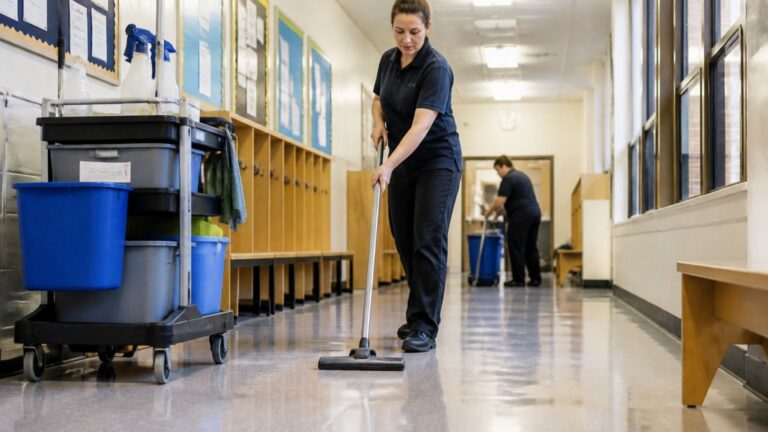
The difference in school vs office cleaning goes far deeper than just the type of building. At Nirvana Managed Services LTD, we’ve worked with both educational institutions and commercial offices across Chester and the surrounding region, and the challenges are fundamentally different. Schools require DBS-checked staff, tighter compliance schedules, and protocols designed around child safety. Offices demand different equipment, faster turnarounds, and continuity across multiple sites. Understanding these distinctions is critical before you commit to any cleaning provider.
This guide breaks down exactly what separates school cleaning from office cleaning services, and why choosing the wrong approach can cost you time, money, and credibility.
DBS Checked Cleaning Staff and Recruitment Challenges
School cleaning demands a level of vetting that commercial office cleaning simply doesn’t. Every person entering a school environment must hold a valid Disclosure and Barring Service (DBS) check. This isn’t optional, it’s a safeguarding requirement under the Education (Independent School Standards) Regulations 2014. The DBS process takes time, typically 4-6 weeks, and adds cost to recruitment.
This is where many schools struggle. Finding reliable DBS-checked cleaning staff through traditional recruitment channels is genuinely difficult. Schools often face high turnover, last-minute absences, and the constant pressure of filling gaps quickly. A cleaner calling in sick on a Monday morning leaves you scrambling, and temporary cover that doesn’t have DBS clearance isn’t an option.
Commercial office cleaning doesn’t carry this requirement. Office staff aren’t working with children, so standard employment checks suffice. This makes recruitment faster and cheaper for office-based cleaning providers.
The recruitment challenge for schools extends beyond DBS checks. Schools need staff who understand the unique demands of educational environments: working around school hours, avoiding disruption during lessons, and maintaining standards in spaces that see heavy foot traffic from hundreds of children daily. It’s a specific skill set, and finding people willing to do it reliably is harder than it sounds.
When evaluating cleaning providers for schools, ask specifically about their DBS recruitment process and how they handle emergency cover. A provider who can’t explain their vetting timeline or backup staffing plan is likely to leave you exposed.
School Cleaning Contract Management: Continuity and Compliance
School cleaning contracts operate under stricter governance than office cleaning. Schools must comply with Health and Safety at Work etc. Act 1974 standards, maintain detailed cleaning schedules, and document everything. Inspectors expect to see evidence of who cleaned what, when, and to what standard.
Continuity is critical. If your cleaning team changes every few months, standards slip. Parents notice. Ofsted inspectors notice. The school’s reputation takes a hit. This is why contract stability matters so much in educational settings.
A managed cleaning service handles the administrative burden. Instead of managing individual cleaners, recruiting replacements, and chasing compliance paperwork, you hand that responsibility to a provider who owns the process. They manage DBS checks, handle sick cover, maintain cleaning logs, and ensure standards stay consistent even when individual staff members leave.
For schools in Chester and the broader region, this approach eliminates the constant recruitment headache. You get a dedicated team, consistent quality, and documented compliance, all managed by a single point of contact.
School cleaning contracts require stability and documented compliance. A provider who can’t guarantee continuity and provide audit trails isn’t meeting your actual needs.
Commercial Office Cleaning: Standards and Service Delivery
Office cleaning is faster, more straightforward, and less regulated. There’s no DBS requirement, no child safeguarding protocols, and no Ofsted inspections. The focus shifts to efficiency: getting the space clean quickly, maintaining professional appearance, and minimising disruption to working hours.
Commercial offices often prefer cleaning outside business hours, early mornings or late evenings. This keeps the team out of the way and lets staff work in a clean environment when they arrive. The cleaning schedule is typically more flexible and easier to adjust based on occupancy or seasonal needs.
Equipment and chemical use can be more intensive in offices. Carpeted areas, glass partitions, and hard floors all need different approaches. Office cleaning providers often specialise in these environments and have optimised their processes accordingly.
The staffing model for office cleaning is also different. Cleaners don’t need DBS checks, recruitment is faster, and temporary cover is straightforward. This means office cleaning providers can respond quickly to staffing changes and often offer more flexible scheduling.
However, consistency still matters. An office that looks dirty damages client perception and staff morale. The best office cleaning providers maintain quality standards through regular supervision, training, and accountability, not through regulatory compliance, but through professional standards and reputation.
Key Differences in Cleaning Protocols and Equipment
School and office cleaning use different protocols because the environments demand it.
School cleaning protocols focus on hygiene, allergen control, and child safety. Cleaning teams must avoid harsh chemicals in areas where children play, use hypoallergenic products where needed, and follow strict protocols around toilets, kitchens, and shared spaces. Equipment is often lighter-duty because the priority is safety over speed. Cleaning typically happens outside school hours to avoid disruption.
Office cleaning protocols prioritise appearance and efficiency. Teams use commercial-grade equipment, stronger cleaning agents, and work quickly through larger floor areas. The focus is on carpets, glass, hard floors, and common areas. Cleaning often happens early morning or evening to avoid interrupting work.
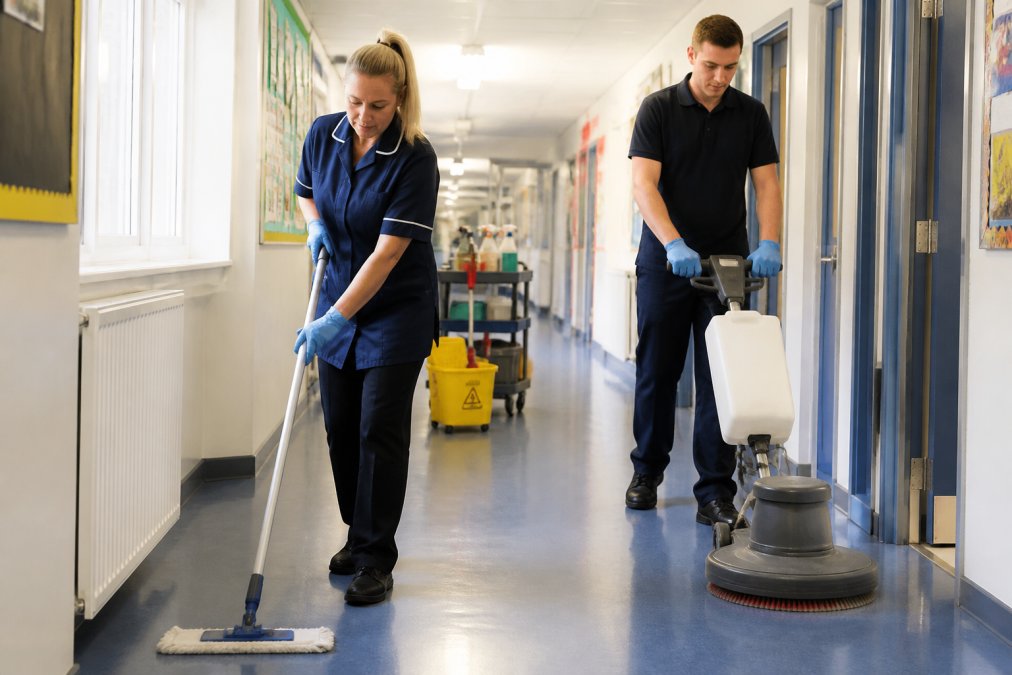
Equipment differences are significant. Schools often need:
- Lightweight, quiet equipment to avoid noise during school hours
- Hypoallergenic or child-safe cleaning products
- Specialist tools for classroom furniture and learning spaces
- Equipment that can be stored safely away from children
Offices typically require:
- Commercial-grade carpet cleaning machines
- High-powered floor buffers for hard surfaces
- Industrial vacuum systems
- Ladder access for high-reach areas like ceiling tiles and vents
The staffing model reflects these differences too. School cleaners need patience, attention to detail, and understanding of child safeguarding. Office cleaners need speed, efficiency, and the ability to work independently in larger spaces.
Choosing the Right Service for Your Facility
The decision between school cleaning and office cleaning services comes down to understanding your actual needs.
Choose school cleaning services if:
- You’re an educational institution with DBS requirements
- You need consistent staffing and continuity of service
- Compliance documentation is essential
- You require child-safe cleaning protocols
- You need flexible scheduling around school hours
Choose office cleaning services if:
- You operate a commercial office or business space
- You need cleaning outside working hours
- Speed and efficiency are priorities
- You require industrial-grade cleaning equipment
- Your team changes frequently and flexibility matters
For facilities in Chester and the surrounding region, the choice often depends on whether you’re managing an educational institution or a commercial space. Schools benefit from providers who understand safeguarding, compliance, and continuity. Offices benefit from providers who optimise for efficiency and appearance.
Nirvana Managed Services LTD works with both. We provide DBS-checked recruitment and managed contracts for schools, alongside commercial office cleaning solutions for businesses across the region. Whether you need school cleaning with guaranteed continuity or office cleaning with flexible scheduling, the key is finding a provider who understands your specific environment and can deliver consistent quality.
| Aspect | School Cleaning | Office Cleaning |
|---|---|---|
| DBS Requirement | Mandatory | Not required |
| Staffing Continuity | Critical for compliance | Flexible, can change frequently |
| Cleaning Schedule | Around school hours, set timetable | Early morning or evening, flexible |
| Equipment Type | Lightweight, child-safe | Commercial-grade, industrial strength |
| Primary Focus | Hygiene, safety, allergen control | Appearance, efficiency, carpet/floor care |
| Compliance Documentation | Detailed records essential | Standard employment records |
| Response to Absences | Requires pre-vetted DBS cover | Temporary staff acceptable |
Choosing between school cleaning and office cleaning services comes down to understanding your facility’s specific needs. Schools require DBS-checked staff, documented compliance, and continuity to meet safeguarding standards. Offices need efficiency, flexible staffing, and commercial-grade equipment. Nirvana Managed Services LTD provides both, with dedicated teams for schools across Chester and the surrounding region, plus commercial office cleaning solutions that keep your workspace professional and clean. Contact us for a consultation about your specific requirements, we’ll match you with the right service for your facility.
Frequently Asked Questions
What is the difference between commercial office cleaning and educational facility cleaning?
School cleaning requires specialist protocols around child safety, allergen control, and play area sanitation. Office cleaning focuses on desk sanitisation, carpet care, and restroom hygiene for adult workplaces. Schools often need more frequent deep cleans of soft furnishings and toys; offices prioritise high-touch surfaces and meeting room turnover. Staffing also differs, school cleaning staff need DBS clearance and training in safeguarding awareness, whilst office cleaners need health and safety compliance.
How does DBS checking impact school cleaning recruitment?
DBS (Disclosure and Barring Service) checks are mandatory for anyone working unsupervised in schools. This requirement narrows the recruitment pool significantly, as candidates must pass enhanced vetting. Many recruitment agencies struggle to supply DBS-cleared staff quickly, leaving schools short-staffed. Managed service providers with existing vetted pools can fill gaps faster and handle the administrative burden of DBS management, reducing recruitment delays and ensuring compliance.
Do cleaning companies in Chester and Wrexham provide cover for staff sickness?
Not all cleaning providers offer sickness cover. Ad-hoc cleaners or small local firms may leave you without coverage when staff are absent. Managed service providers maintain backup staff and can deploy replacements within hours, ensuring your facility stays clean even during unexpected absences. This is especially critical for schools, where poor cleanliness on a Monday morning directly affects parents’ perception and pupil wellbeing.
What should I look for when evaluating cleaning providers for my school or office?
Assess these factors: DBS clearance (schools only), staff training in your sector’s standards, response time for sickness cover, contract flexibility, quality assurance processes, and experience with similar-sized facilities. Ask for references from comparable organisations. Verify that the provider has insurance and understands your specific compliance requirements, schools need safeguarding awareness; offices need COSHH compliance. Request a site visit and sample cleaning schedule before committing.