
Table of Contents
- What You’ll Need Before You Start
- Step 1: Set Out Your School Cleaning Standards in Writing
- Step 2: Build a School Cleaning Checklist Template for Every Area
- Step 3: Set Cleaning Schedules and Frequency by Area
- Step 4: Meet Your COSHH Regulations for School Cleaning Duties
- Step 5: Train, Supervise and Monitor Your Cleaning Team
- Step 6: Outsourcing School Cleaning Services Without Losing Control
- Step 7: Apply the Same Discipline to Commercial Office Cleaning Standards
- Frequently Asked Questions
Last Updated: September 17, 2026
What You’ll Need Before You Start
Maintaining school cleaning standards is the practice of setting written specifications, schedules, and checks that keep every area of a school consistently clean, safe, and audit-ready. At Nirvana Managed Services LTD, we work with schools and office facilities, and the pattern is always the same: sites with written standards hold their quality, and sites without them drift within a term.
Before you write a single checklist, gather these:
- A floor plan marked with every room, toilet block, and circulation route
- Your current cleaning specification, if one exists
- COSHH safety data sheets for every chemical on site
- Staffing rota, including cover arrangements for absence
- A named person accountable for cleaning quality
Miss any of these and you will spend the first month firefighting instead of managing. The Health and Safety Executive guidance on COSHH is the right starting point for the chemical side.
Step 1: Set Out Your School Cleaning Standards in Writing
Written standards are the single biggest difference between a school that stays clean and one that lurches from complaint to complaint. A standard says what “clean” means, who checks it, and how often, so a caretaker on Monday and a contractor on Friday deliver the same result.
Your document needs four things:
- Scope, every area, from classrooms to bin stores
- Frequency, daily, weekly, termly, annual tasks
- Method, what product, what equipment, what sequence
- Acceptance criteria, what “done” looks like
Cleaning, Sanitising and Disinfecting: Know the Difference
These three words get used interchangeably and they should not be. Cleaning removes visible dirt and organic matter using detergent and mechanical action. Sanitising reduces the number of bacteria on a surface to a safe level. Disinfecting kills a high proportion of microorganisms on a surface after it has already been cleaned.
The order matters. Disinfectant applied to a dirty desk does almost nothing, because soil shields the organisms underneath. Clean first, then sanitise or disinfect where the risk justifies it. High-touch surfaces in a school, door handles, light switches, toilet flush plates, and shared keyboards, justify disinfecting as part of the daily routine.
Skipping the cleaning stage and going straight to disinfectant is a common mistake. It wastes chemical, wastes labour, and leaves surfaces that look treated but are not hygienic.
Step 2: Build a School Cleaning Checklist Template for Every Area
A school cleaning checklist template is a per-area task list that a cleaner ticks off each visit and a supervisor signs off each week. Build one template per area type rather than one giant list, because a toilet block and a science lab have almost nothing in common.
Set your template up like this:
| Area | Daily Tasks | Weekly Tasks | Termly Tasks |
|---|---|---|---|
| Classrooms | Desks, floors, bins, door handles | Skirting, windows (internal) | Carpets, high dusting |
| Toilets | Full clean, restock, disinfect touch points | Descaling, deep clean cubicles | Machine scrub floors |
| Hall and dining | Floors, tables, bins | Chairs, ledges | Floor stripping |
| Offices | Desks, bins, floors | Vents, glass | Carpet clean |
| Corridors | Floors, handrails, door plates | Walls spot-clean | High-level dusting |
Classrooms, Toilets and High-Touch Surfaces
Toilets deserve more attention than they usually get. They are the area parents, staff, and inspectors judge first, and they carry the highest cross-infection risk in the building. Build in a mid-day check as well as the main clean, and log restocking so you can prove it happened.
High-touch surfaces in classrooms are easy to overlook: whiteboard pens, shared tablets, door edges, and the backs of chairs. Add them to the daily list and your absence rates will thank you.
Step 3: Set Cleaning Schedules and Frequency by Area
Frequency should follow risk, not habit. Areas used by the youngest children, food preparation areas, and toilets need more frequent attention than a staff office used by three people.
A workable pattern for most schools:
- Daily: toilets, classrooms, corridors, dining areas, entrance glass
- Weekly: internal windows, vents, waste bin deep clean
- Half-termly: high-level dusting, carpet spot treatment
- Termly: deep clean of toilets, floor machine work, kitchen extract checks
- Annually: full deep clean, including behind fixed furniture
Write the schedule into the contract or job description so it is enforceable. A schedule that lives only in someone’s head disappears the day they leave.
Step 4: Meet Your COSHH Regulations for School Cleaning Duties
COSHH regulations for school cleaning require you to assess every hazardous substance on site, store it correctly, provide safety data sheets, and train staff in safe use. The HSE’s COSHH essentials for cleaning sets out the assessment process step by step.
What this means in practice:
- Keep a COSHH folder with a sheet for every chemical
- Store chemicals locked, away from food and pupil access
- Provide the correct dilution equipment, never guess by eye
- Train every cleaner on the substances they actually use
- Record the training with dates and signatures
Buying ready-to-use products rather than concentrates removes a whole category of risk, at a slightly higher unit cost. For most schools, that trade is worth it.
Photograph your chemical store when it is set up correctly and pin the photo inside the door. New starters match the photo, and it takes seconds to spot when something has been put back in the wrong place.
Step 5: Train, Supervise and Monitor Your Cleaning Team
Training is not a one-off induction. It is an induction, a refresher each term, and a short toolbox talk whenever a method or product changes.
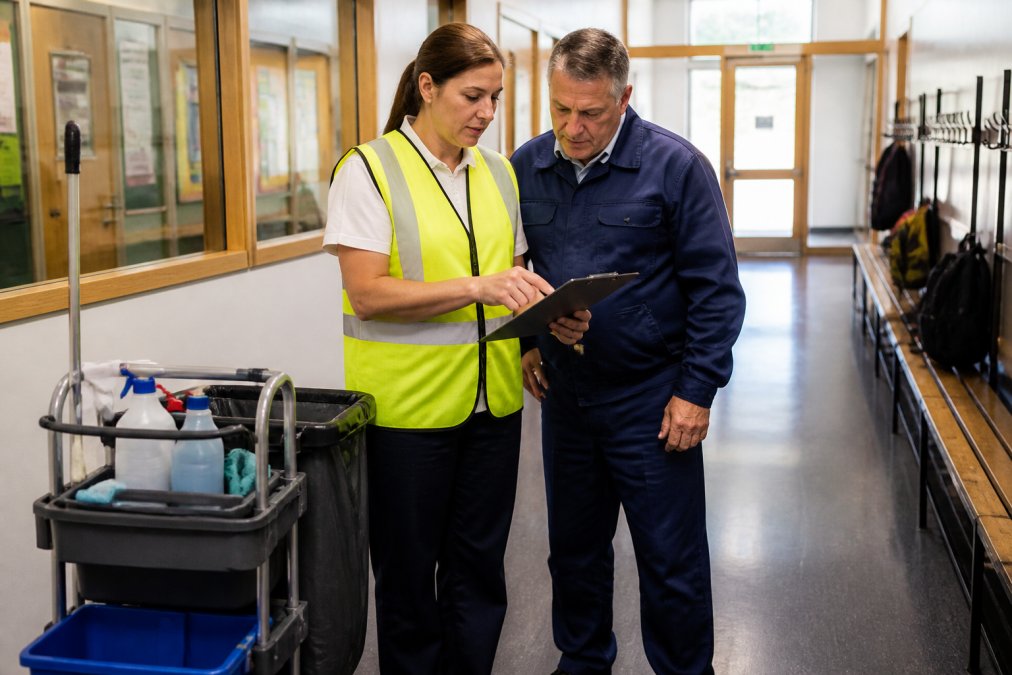
Supervision is where most schools fall down. A supervisor who walks the building weekly with the checklist in hand catches small problems before they become complaints. Record what you find, even when it is good.
Monitoring needs a standard. Use a simple scoring sheet: pick ten checkpoints at random, score each pass or fail, and track the score week on week. A score that slips two weeks running tells you something before a headteacher does.
Step 6: Outsourcing School Cleaning Services Without Losing Control
Outsourcing school cleaning services works best when you keep ownership of the standard and hand over the delivery. Write the specification, keep the audit, and let the provider handle recruitment, rotas, and cover.
The three things that go wrong with outsourced contracts:
- The specification is vague, so quality arguments become opinion
- Nobody audits, so standards slide quietly
- Absence cover is not guaranteed, so the site looks neglected on the worst possible day
Ask any provider exactly how they cover a sick call, how quickly someone is on site, and who your named contact is. If the answer is vague, that is your answer.
Keep the standard, outsource the delivery. A provider that welcomes your audit is a provider that expects to pass it.
Step 7: Apply the Same Discipline to Commercial Office Cleaning Standards
Commercial office cleaning standards follow the same logic as schools: written specification, risk-based frequency, trained staff, and a monitoring routine. The differences are in emphasis rather than principle.
Offices tend to have more shared technology, more client-facing space, and less tolerance for a messy reception. Kitchens and washrooms carry the same hygiene risk as their school equivalents. Add meeting room turnaround to the daily list, because a room booked at 9am needs clearing before it, not after.
If you run both a school and an office portfolio, standardise the paperwork. One specification format, one audit sheet, one COSHH folder structure. It halves the admin and makes it obvious when a site is out of step.
Frequently Asked Questions
What are the statutory requirements for school cleaning in the UK?
Schools must maintain a clean, safe environment under the Health and Safety at Work etc. Act 1974 and the Management of Health and Safety at Work Regulations 1999. There is no single cleaning frequency law, but you must assess risks, keep premises clean, and control substances under COSHH. Ofsted also expects a clean, hygienic setting. Document your standards, schedules and monitoring so you can show compliance during inspections and to your governing body.
How often should high-touch surfaces be cleaned in classrooms?
High-touch surfaces such as door handles, light switches, shared desks and taps should be cleaned at least once a day, and more often during cold and flu season or outbreaks. A school cleaning checklist template should list these surfaces separately from general floors and walls so cleaners do not skip them. Build the frequency into your schedule and have supervisors spot-check them, because these are the points that drive cross-infection between classes.
What are the benefits of outsourcing school cleaning services?
Outsourcing school cleaning services gives you cover when staff are absent, access to trained cleaners, and a single contract for recruitment, management and standards. You avoid the cost and time of advertising, vetting and covering sickness. A managed provider can also bring commercial office cleaning standards into your school, with documented checklists and supervision. Pricing depends on site size, frequency and scope, so request a quote rather than estimating.
How do you monitor cleaning standards in an educational environment?
Use a written standard, a signed-off checklist and regular visual inspections. Supervisors should walk the site daily, score each area, and log issues for correction within a set time. Gather feedback from teachers and site staff, and review cleaning audits monthly. Keep records of COSHH training and equipment checks. If you outsource, ask for the same monitoring evidence and a named contact who can resolve problems quickly.
Recruitment and absence cover are the two problems that break cleaning standards faster than anything else, and they are exactly what Nirvana Managed Services LTD was built to solve. We provide fully managed soft services for schools and commercial offices, including recruitment, contract management, and guaranteed cover when your own cleaner or caretaker calls in sick. Get started with Nirvana Managed Services LTD and keep your site inspection-ready every day of term.