Last Updated: 1 November 2026
Quick Summary
School cleaning contracts transfer daily cleaning, hygiene and caretaking duties to an external provider who supplies trained, vetted staff, equipment and management. The benefits include consistent infection control, absence cover that holds the standard, and recruitment handled for you. You gain a contractual standard you can hold someone to, rather than hoping a hard-to-fill vacancy stays filled.
- A written schedule with a supervisor checking it stops low-visibility tasks being skipped.
- Colour-coded cloths and a two-stage clean for toilets help prevent cross-contamination.
- Confirm absence cover in writing, including response times, before you sign.
- Walk the site monthly with the provider’s supervisor, not after them.
- Running school and office sites through one managed provider removes a layer of admin.
Table of Contents
- Why School Cleaning Contracts Solve More Than Dirt
- Health, Hygiene and the Spread of Illness on School Premises
- Your School Cleaning Contract Checklist Before You Sign
- School Cleaning Staff Recruitment Without the Recruitment Headache
- School Cleaning Staff Absence Cover That Holds the Standard
- How to Assess Contract Performance Month by Month
- Commercial Office Cleaning Services for the Sites You Also Manage
- Book a Site Walkthrough and Build Your Cleaning Specification
- Frequently Asked Questions
Why School Cleaning Contracts Solve More Than Dirt
School cleaning contracts are agreements that transfer the responsibility for daily cleaning, hygiene and caretaking duties on school premises to an external provider, who supplies trained staff, equipment and management. At Nirvana Managed Services LTD, we see the real value land somewhere less obvious: a school stops running a recruitment agency in its spare time.
Bursars and business managers often describe the same pattern: the advert goes out, a few people apply, and the role is hard to keep filled.
Below, we break down the practical benefits of professional school cleaning contracts, from infection control to absence cover, plus a checklist you can use before signing anything. Most guides stop at “cleaner buildings are nicer.” That misses the point entirely.
Health, Hygiene and the Spread of Illness on School Premises
Fewer illness outbreaks start with better hand and surface hygiene. High-touch surfaces such as door handles, light switches, shared tablets and toilet taps are where infection control efforts earn their keep, and a structured cleaning schedule keeps those surfaces from being missed on busy days.
The UK Health Security Agency guidance on infection prevention and control sets out the principle schools work to: consistent, scheduled cleaning of frequently touched surfaces reduces the spread of illness. For a deeper look at how this plays out room by room, see our guide to school hygiene and infection control best practices.
A contract matters here because consistency is the whole product. In-house teams stretched thin skip the low-visibility tasks first. A contracted team with a written schedule and a supervisor checking it does not get that option.
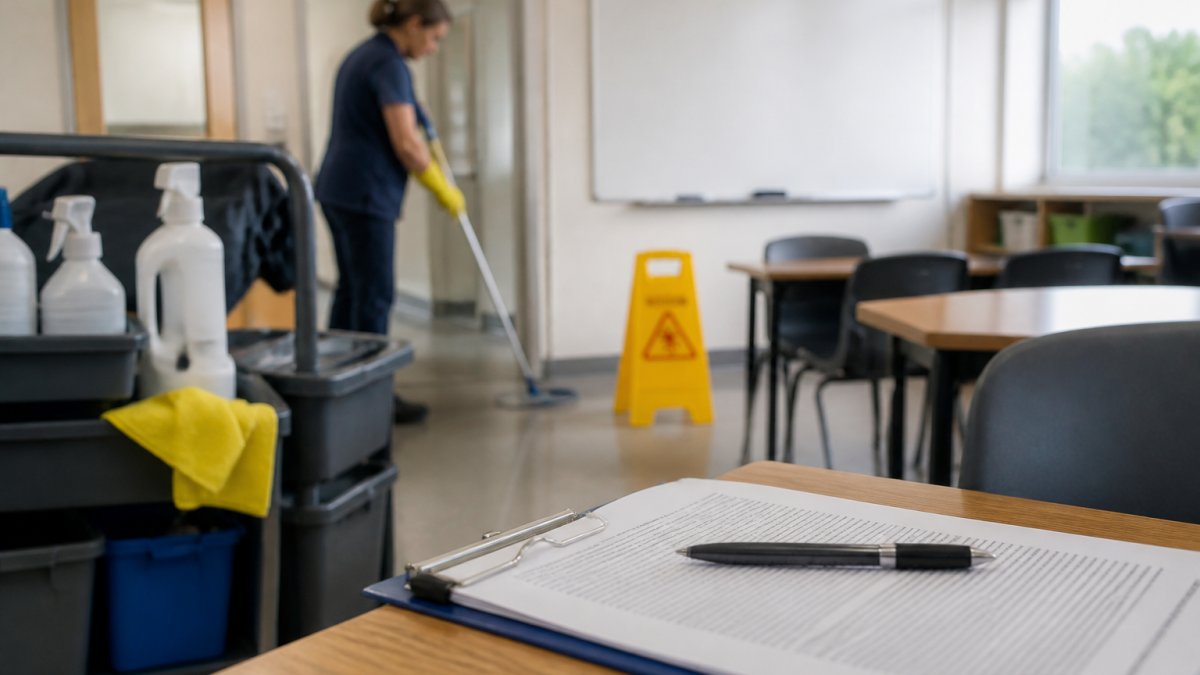
What separates a professional contract from a basic cleaning rota is the detail behind the schedule. A school cleaning provider working to a school-specific specification may typically:
- Colour-code cloths and equipment by area (for example, separate colours for toilets, classrooms and food areas) to prevent cross-contamination
- Use a two-stage clean for toilets and high-risk areas: a detergent clean followed by a disinfectant step with the correct contact time
- Keep a written schedule for periodic tasks such as deep cleaning of carpets, curtains and soft furnishings during holiday periods
- Record completion of high-touch surface cleaning so that any gap is visible before it becomes an outbreak
School buildings often mix older stock with newer extensions, which can mean different floor types, different ventilation and different cleaning needs in the same corridor. A specification that names those variations is better placed to keep standards consistent than one that applies a single method everywhere.
Ask any prospective provider to show you a sample cleaning schedule for a school building similar to yours. If they cannot produce one that names specific areas and frequencies, the specification is probably generic.
Safeguarding also sits alongside hygiene. Cleaning staff working during school hours should be vetted to the same standard as other adults on site, with enhanced DBS checks where the role involves regulated activity, and clear site-access procedures.
Your School Cleaning Contract Checklist Before You Sign
A good school cleaning contract names the scope, the frequency, the standards and the price in writing, with no room for “we assumed that was extra.” Use this checklist before you commit:
- Scope of work listed room by room or area by area, including toilets, halls, staff rooms and reception
- Cleaning frequency stated for each area, not just “daily cleaning” as a blanket phrase
- Cleaning standards described in measurable terms, with a named person accountable
- Absence cover confirmed in writing, including response times
- Staff vetting confirmed, including DBS checks for anyone on site during school hours
- Product safety confirmed, with safety data sheets supplied for every chemical used
- Contract pricing broken into components so you can see what drives the total
- Review and exit terms setting out notice periods and how performance is reviewed
Watch out: the most common mistake is signing on a low headline figure without checking what happens when a cleaner is off sick. That clause is where cheap contracts quietly become expensive. For a fuller method, read our guide on how to evaluate school cleaning contracts.
Here is the checklist in brief, so you can see what a contract should name in writing before you commit.
| Checklist item | What to confirm |
|---|---|
| Scope of work | Listed room by room or area by area |
| Cleaning frequency | Stated for each area, not a blanket phrase |
| Cleaning standards | Measurable terms, with a named accountable person |
| Absence cover | Confirmed in writing, including response times |
| Staff vetting | DBS checks for anyone on site during school hours |
| Product safety | Safety data sheets for every chemical used |
| Contract pricing | Broken into components to show what drives the total |
| Review and exit terms | Notice periods and how performance is reviewed |
School Cleaning Staff Recruitment Without the Recruitment Headache
Recruiting cleaners and caretakers is where school budgets and school calendars collide. Term-time pressure, split shifts and pay bands that struggle to compete with other local work can make soft services roles hard to fill and harder to keep filled.
A managed contract moves that problem to the provider. The provider recruits, trains, vets and manages the team, and the school deals with one account contact instead of six individual employment relationships. That is the model we built Nirvana Managed Services LTD around, and it is why we combine recruitment, contract management and sickness cover in a single service rather than selling them separately.
The honest limitation: you lose some direct control over who is in the building day to day. What you gain is a contractual standard you can hold someone to, which is a stronger position than hoping the one applicant who replied stays past October.
School Cleaning Staff Absence Cover That Holds the Standard
Absence cover is the benefit that separates a real contract from a rota with a phone number attached. When a cleaner calls in sick, the standard should hold: the same areas cleaned, the same schedule followed, no visible gap for parents doing the school run.

Most competitors mention absence cover as a bullet point. Few explain how it actually works. A credible provider will have a named cover pool, a written mobilisation process and a response time that is agreed in the contract rather than promised verbally.
Ask any provider these questions before signing:
- How quickly can cover be on site for a morning absence reported before 7.00 am?
- Who covers the cover if two or more people are off at once?
- Are cover staff inducted on your site, or are they arriving cold with no knowledge of the building?
- What is the escalation route if cover cannot be provided, and what credit or remedy applies?
A provider that answers all four clearly is more likely to have a defined system. One that says “we’ll sort it” does not.
The practical mechanism to look for is a mobilisation plan.
Our guide to managing cleaning staff absence in schools walks through how to build that expectation into the contract itself, including the wording to use for response times and remedies.
The most common failure point is not the first absence but the second one in the same week. Ask specifically what happens when the cover pool is already deployed elsewhere.
For schools, the response time question is particularly important. A provider with a local team and a local supervisor is better placed to hold the standard than one mobilising from outside the area.
How to Assess Contract Performance Month by Month
Performance assessment should be routine, documented and boring. A monthly review that compares completed work against the agreed schedule, checks a sample of areas against the written standard, and logs any complaints with their resolution keeps a contract honest without turning it into a confrontation.
Three habits make this work:
- Walk the site monthly with the provider’s supervisor, not after them
- Score a rotating sample of areas against the written standard
- Keep a simple log of issues raised and how fast they closed
If the numbers drift for two consecutive months, that is a conversation, not a crisis. Our step-by-step method for auditing school cleaning standards gives you a scoring sheet you can adapt.
Commercial Office Cleaning Services for the Sites You Also Manage
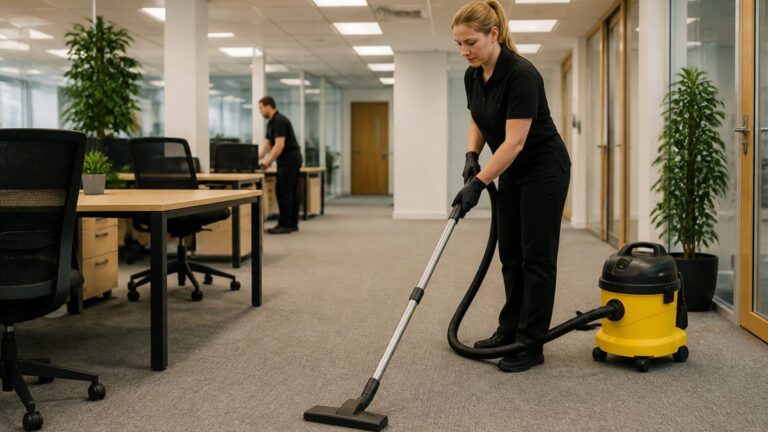
Many of the people who ask us about school contracts also manage commercial office space, and the two problems rhyme. Commercial office cleaning services run on the same logic: a defined specification, a vetted team, cover for absence and a monthly review that keeps standards from sliding.
For a trust or property team overseeing a school and an office building, running both through one managed provider removes a layer of admin. One contact, one standard, one monthly review covering every site. Our guide to managed cleaning contracts for business covers how that works across mixed portfolios.
If you are searching for school cleaning contracts near me in the Chester or Wrexham area, the practical test is the same: ask how cover works, ask to see the specification, and ask what happens in month four when the novelty has worn off.
Book a Site Walkthrough and Build Your Cleaning Specification
The gap between a contract that works and one that quietly fails is almost always the specification. A walkthrough turns a vague conversation into a written schedule, with areas, frequencies and standards you can hold a provider to.
Nirvana Managed Services LTD provides school cleaning and soft services staffing, combining recruitment, contract management and absence cover in one managed service. We also handle commercial office cleaning for the sites you manage alongside your schools.
Get started with Nirvana Managed Services LTD and build a cleaning specification that still holds up in February.
Frequently Asked Questions
What are the benefits of a professional school cleaning contract?
A contract gives you a defined scope, a cleaning schedule and a named person accountable for standards. That means classrooms, toilets and high-touch surfaces are cleaned to an agreed frequency rather than when someone has time. It also removes the burden of recruiting, training and covering cleaning staff from your business manager, and it gives you documented evidence of cleaning for governors, parents and inspectors. The practical result is more consistent hygiene and fewer mornings spent chasing a missing cleaner.
What should a school cleaning contract checklist include?
Start with the scope: which rooms, how often, and what counts as done. Add the cleaning schedule for daily, routine and deep cleaning, plus who supplies equipment and products. Confirm safeguarding arrangements, including vetting and how staff are inducted on site. Set out absence cover response, escalation contacts, quality checks and how you end the contract. Finally, ask for costs broken down by area and frequency so you can compare quotes on the same basis.
How can a cleaning contract help cover staff sickness and absence?
The contract should state how quickly cover is provided when a cleaner calls in sick, and who arranges it. With a managed provider, the cover comes from their pool of trained cleaners rather than your existing staff working extra hours. Ask what happens on same-day absence, whether the replacement is inducted on your site, and how you are told. Put the response time and escalation route in writing so you are not relying on goodwill during a busy term.
Can one provider support both school and commercial office cleaning services?
Yes, where the provider runs both. Schools and offices need different schedules, safeguarding arrangements and out-of-hours access, but the underlying disciplines are the same: trained cleaners, agreed specifications, supervision and quality checks. Using one provider across a school and an office portfolio can simplify contract management and invoicing. Ask for the specification to be written per site, because a school timetable and an office cleaning window rarely match.