
Last Updated: 12 November 2026
Quick Summary
Office cleaning continuity means your premises stay clean, safe and presentable every working day, even when staff are absent or demand changes. It is achieved by writing a contingency plan that ranks priority areas, covers disruption scenarios and sets clear escalation routes.
- Rank building areas by importance so temporary cleaners know where to focus first.
- Agree a named replacement within a set time when a regular cleaner is absent.
- Turn continuity promises into measurable service levels with monthly reporting.
- Review the contingency plan after every disruption and at least every six months.
- Check that the service agreement defines scope, cover, quality and exit terms before signing.
Table of Contents
- Why Office Cleaning Continuity Matters to Your Business
- Outsourced Cleaning Compared With In-House Provision
- Building an Office Cleaning Contingency Plan
- Cleaner Sickness Cover and Replacement Procedures
- Commercial Office Cleaning Standards and Quality Monitoring
- Office Cleaning Checklist and Service Agreement Essentials
- Putting Your Continuity Plan Into Practice With Nirvana Managed Services
- Frequently Asked Questions
Why Office Cleaning Continuity Matters to Your Business
Office cleaning continuity means your premises stay clean, safe and presentable every working day, even when staff are absent or demand changes. A missed clean can quickly affect client meetings, staff wellbeing and your reputation.
Many business managers only think about cleaning when something goes wrong. A cleaner calls in sick on a Monday, a contract lapses, or a single person holds all the knowledge about the building.
Continuity planning shifts the focus from reacting to problems to preventing them. It sets out who does what, how cover is arranged, and how quality is checked.
Outsourced Cleaning Compared With In-House Provision
Outsourced cleaning means a specialist contractor supplies the cleaning team, equipment and supervision under a service agreement. In-house provision means you employ cleaners directly and manage them yourself. Both can work, but they carry different risks.
The table below summarises the main differences for office settings.
| Factor | In-house cleaners | Outsourced provider |
|---|---|---|
| Absence cover | Relies on your own staff or ad hoc agency bookings | Provider arranges replacement under contract |
| Recruitment and training | Your responsibility | Provider’s responsibility |
| Equipment and products | Usually funded by you | Usually included in the service |
| Quality monitoring | Managed internally | Governed by the service agreement |
| Management time | Higher, including rotas and payroll | Lower, managed through a single contact |
Pros of outsourcing
- Cover is built into the contract, so absences are less disruptive
- Recruitment, vetting and training are handled by the provider
- Equipment and specialist products are typically included
- One named contact simplifies day-to-day management
Cons of outsourcing
- You depend on the provider’s standards, so the agreement must be specific
- Changes to scope can cost more if the contract does not allow for them
- Less direct control over individual cleaners
Most businesses find the decision turns on how much management time they can spare and how much continuity risk they can accept.
Building an Office Cleaning Contingency Plan
An office cleaning contingency plan is a short, written document that tells everyone what happens when normal cleaning cannot take place. It should be simple enough to use under pressure, yet specific enough to remove guesswork. Here is a practical, step-by-step plan you can adapt for your office.
Step 1: Identify priority areas and minimum service levels
Start by listing every area of the building and ranking it by how much a lapse would matter. For a typical commercial office, the order usually looks like this:
- Washrooms and kitchens – hygiene-critical, cleaned daily even during disruption
- Reception and client-facing meeting rooms – presentability matters for visitors
- Main circulation areas and lift lobbies – high footfall, visible to staff and guests
- Individual workstations and private offices – can be reduced to alternate days if necessary
- Storerooms and low-traffic back-of-house areas – lowest priority, may be deferred
Record this ranking in the plan so that a temporary cleaner knows exactly where to focus if time is short. Define a minimum service level for each tier – for example, washrooms cleaned and restocked daily, workstations cleaned at least three times per week.
Step 2: Define disruption scenarios and fallback actions
A plan that only covers sickness is incomplete. Work through the following scenarios and agree the response with your provider in advance:
- Cleaner absence (sickness or leave): Provider confirms replacement within an agreed time (e.g. by 7am for a morning clean). Replacement receives a site pack with access codes, priority areas and safety information.
- Severe weather (snow, flooding, high winds): Agree a trigger (e.g. a recognised severe weather warning for your area) that activates a reduced service. Priority areas only, with a recorded decision on which tasks are deferred.
- Supplier failure or contract termination: Identify a backup provider or an interim arrangement. Keep a copy of the site pack and key contact list with your facilities manager so a new provider can mobilise quickly.
- Building access restrictions (power cut, security incident, road closure): Nominate a deputy keyholder and agree how the provider will be notified. Have a fallback cleaning window (e.g. evening instead of morning) written into the plan.
- Equipment breakdown (e.g. floor scrubber failure): Confirm whether the provider carries spare equipment or can arrange hire. For critical areas, manual methods should be listed as a fallback.
- Sudden hygiene incident (e.g. bodily fluid spill, outbreak): Specify the response time (e.g. within 2 hours) and the disinfection procedure, including which products are approved.
For each scenario, name the person responsible for activating the response, the person who authorises any extra cost, and the person who communicates with staff.
Step 3: Set escalation and communication routes
Define clear escalation timings. For example: if a replacement is not confirmed within 30 minutes of the absence being reported, the provider’s supervisor is contacted; if not resolved within 2 hours, the account manager; if still unresolved, your facilities lead invokes the backup arrangement. Put names, mobile numbers and email addresses in the plan – not just job titles.
Communication works both ways. Staff should know who to tell if a clean is missed, and the provider should know who to call if they cannot gain access. A shared contact list, reviewed quarterly, prevents the plan failing because one person is on holiday.
Step 4: Document and review
Store the plan where the wider team can reach it – a shared drive or a printed copy in the facilities office. Review it after every disruption, however small, and at least every six months. Record what happened, whether the response met the agreed times, and what needs changing. This review log becomes evidence of continuous improvement and helps justify the arrangement to senior management.
Watch out: a plan that exists only in one manager’s head fails the first time that manager is away. Assign a deputy and make sure they have access to the same document.
Cleaner Sickness Cover and Replacement Procedures
Sickness is the most common reason a scheduled clean does not happen. A sound replacement procedure removes the need for improvisation.
The procedure should specify:
- The time by which the provider confirms a replacement
- The information the replacement needs, such as access codes, site rules and priority areas
- A brief induction on site safety and the building layout
- How the regular cleaner is informed of changes on their return
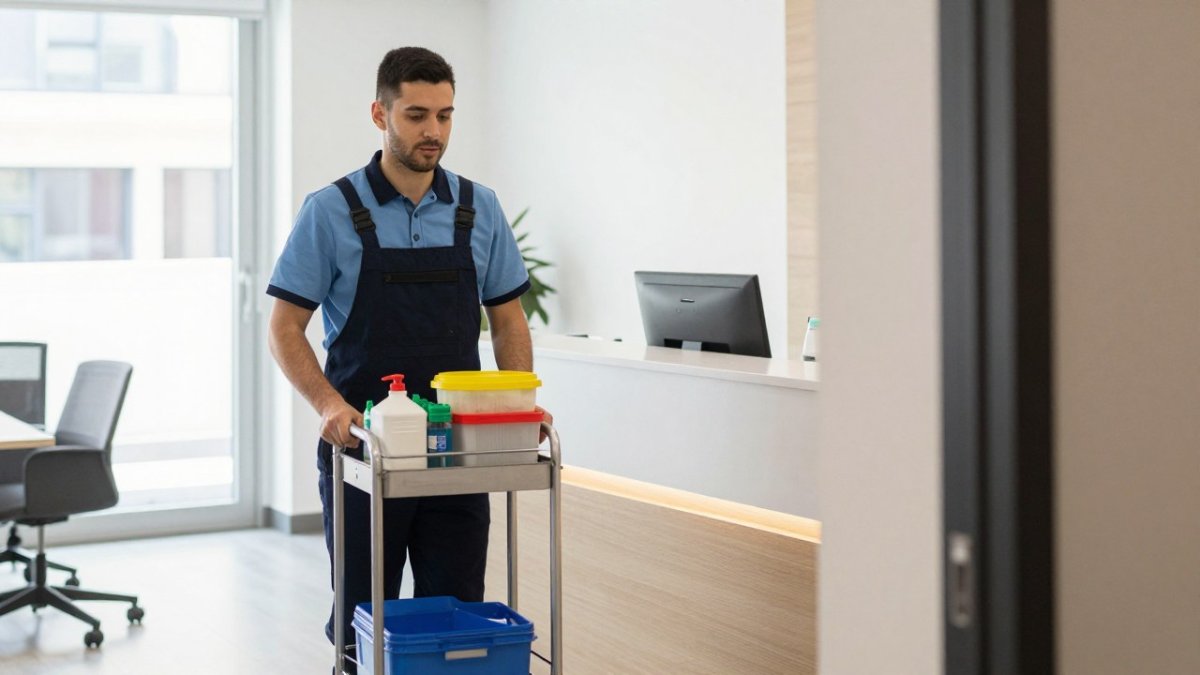
A cleaning operative in uniform arriving with a trolley and equipment at a bright, modern office reception is what good cover looks like in practice. The aim is that the building looks the same whoever is on shift.
Where the cover arrangement is part of a managed contract, the provider owns this process. Where you use a standalone contractor, confirm in writing how replacements will be sourced.
Commercial Office Cleaning Standards and Quality Monitoring
Good standards are only useful if they are measured. Define what a satisfactory clean looks like before the contract starts, then check it regularly.
Useful measures include:
- Inspection checklists completed at agreed intervals
- Response times for reported problems
- Feedback from staff and visitors
- Records of missed or late cleans
A monthly review meeting, supported by a simple inspection log, can help keep standards consistent without creating heavy administration. Ask your provider how their quality checks are recorded and who sees the results.
Health and safety and hygiene expectations also belong in the agreement. Confirm which products are used, how they are stored, and how the provider handles safety data and training.
Office Cleaning Checklist and Service Agreement Essentials
A clear service agreement prevents most disputes, but a checklist alone does not make continuity enforceable. The strongest contracts turn continuity promises into measurable service-level agreements (SLAs) with defined response times, cover commitments and quality targets. Use the checklist below as a starting point, then add the measurable elements that let you verify performance.
Core checklist for any office cleaning contract
- Scope of service, listing each area and task
- Frequency of cleaning for each area
- Named contact and out-of-hours escalation route
- Absence cover commitment and response time
- Quality standards and how they are measured
- Equipment and cleaning products supplied
- Health and safety responsibilities for both parties
- Notice period, review dates and exit terms
Turning continuity into measurable SLAs
For each continuity-critical item, agree a specific, measurable commitment. Examples that work well in Wrexham office settings:
- Absence cover response: Replacement cleaner on site within 2 hours of a reported absence for priority areas (washrooms, kitchens, reception). For non-priority areas, cover by the next scheduled clean.
- Attendance: 98% of scheduled cleans completed on the agreed day, measured monthly.
- Issue resolution: Reported cleaning issues acknowledged within 1 hour and resolved within 4 working hours.
- Inspection scores: Monthly inspection using an agreed checklist; minimum pass mark of 90%, with a written action plan for any score below that.
- Emergency hygiene response: Attendance within 2 hours for spill or outbreak incidents, with disinfection completed within 4 hours.
- Reporting: Monthly performance report showing attendance, cover activations, inspection scores and issue logs.
Whatever service levels you agree, the principle is that every continuity commitment in the contract should have a measurable figure attached to it. Without measures, you cannot check whether the provider is delivering.
Review and exit provisions
Agree a quarterly review meeting where SLAs are checked against the monthly reports. Include a right to escalate persistent underperformance and a clear exit process: how much notice, what records must be handed over (site pack, key register, cleaning schedules, COSHH assessments), and how keys and access cards are returned.
Use this checklist and SLA framework when comparing proposals. A lower price is not a saving if the agreement leaves cover and quality undefined, or if the provider cannot show how performance will be measured.
Putting Your Continuity Plan Into Practice With Nirvana Managed Services
A continuity plan only works when it is put into action. Start by writing down your priority areas, your cover expectations and your quality measures. Then ask potential providers to show how they would meet each point.
Nirvana Managed Services LTD provides fully managed soft services, including recruitment, contract management and cover when a member of staff is off sick.
Pricing depends on the size of the site, the frequency of cleaning and the services included. Please visit the Nirvana Managed Services LTD website or contact the team directly for current prices or a quote tailored to your premises.
Frequently Asked Questions
What is continuity planning for outsourced office cleaning?
Continuity planning for outsourced office cleaning is the set of arrangements that keep your premises cleaned to an agreed standard when things go wrong. That includes staff absence, equipment failure, or a sudden change in building use. A good plan names who covers each scenario, how quickly cover arrives, how the provider reports problems, and how service is restored. Reviewing the plan each year, and after any incident, keeps it realistic for your offices in Chester or Wrexham.
How can a business maintain cleaning cover when a cleaner is off sick?
The most reliable approach is a managed provider with trained replacement operatives already familiar with the site. Your service agreement should state how quickly a replacement is expected to attend and who you contact to raise it. Keep a simple site brief, with access details and priority areas, so cover staff can start work without delay. Ask your provider how absence cover is managed before you sign.
What should an office cleaning continuity plan include?
A practical plan covers scope of service, cleaning frequencies, priority areas such as kitchens and washrooms, staff absence cover, escalation routes and contact points. It should also set out how standards are checked, how complaints are logged and resolved, and how the service is recovered after a disruption. Writing these points down in your office cleaning service agreement turns a general intention into something you can enforce.
Can outsourced cleaners support business continuity in Chester and Wrexham?
Yes, provided the contract is built around continuity. A provider serving offices in Chester and Wrexham can offer local cover, dedicated account management and scheduled quality checks. Confirm the response times, the cover process and the reporting you will receive before committing. Continuity depends on those specifics rather than on the provider’s size alone.


