Last Updated: November 12, 2026
Quick Summary
A school cleaning checklist turns vague instructions into named daily, weekly and termly tasks with owners and sign-off. Start with high-touch areas such as desks, door handles, toilets and taps, then work outwards to floors, bins and less-used rooms. Keep a signed record so the school can show what was done and when.
- Start with high-traffic areas like desks, door handles, toilet cubicles and taps.
- Use colour-coded cloths so washroom cloths never touch classroom desks.
- Check washrooms at least twice during the school day, including at lunchtime.
- Sort tasks into daily, weekly, half-termly and termly groups with named owners.
- Review completed sign-off sheets each week to spot tasks that are regularly missed.
Table of Contents
- Why a School Cleaning Checklist Matters for Classrooms and Toilets
- Daily Classroom Cleaning Checklist: Desks, Doors and High-Touch Surfaces
- School Toilet Cleaning Checklist: Toilets, Urinals, Sinks and Taps
- School Cleaning Schedule Template: Daily, Weekly and Deep Clean Frequencies
- School Cleaning Equipment and Chemical Safety
- Task Ownership, Sign-Off and Audit Records
- Keeping Your Cleaning Checklist Running When Staff Are Absent
- Getting Your Cleaning Checklist Set Up for Your School
- Frequently Asked Questions
Why a School Cleaning Checklist Matters for Classrooms and Toilets
Without a written checklist, cleaning depends on memory. One caretaker knows the staffroom door handle gets missed; a new member of staff does not.
A good school cleaning checklist does four jobs:
- Sets out clear tasks so nobody has to guess what “clean” means in a classroom or washroom
- Sets frequencies so daily, weekly and termly work is not mixed up
- Assigns ownership so every task has a named person or role
- Creates a record so the school can show what was done and when
The record matters as much as the task. When a parent, inspector or governor asks how a classroom is kept clean, a signed checklist gives a straight answer.
Start with the highest-traffic areas. Classroom desks, door handles, toilet cubicles and taps carry the most germs each day, put those at the top and build outwards to floors, bins and less-used rooms.
Daily Classroom Cleaning Checklist: Desks, Doors and High-Touch Surfaces
Daily classroom cleaning focuses on the surfaces pupils and staff touch most: desks, tables and chairs first, then door handles and light switches.
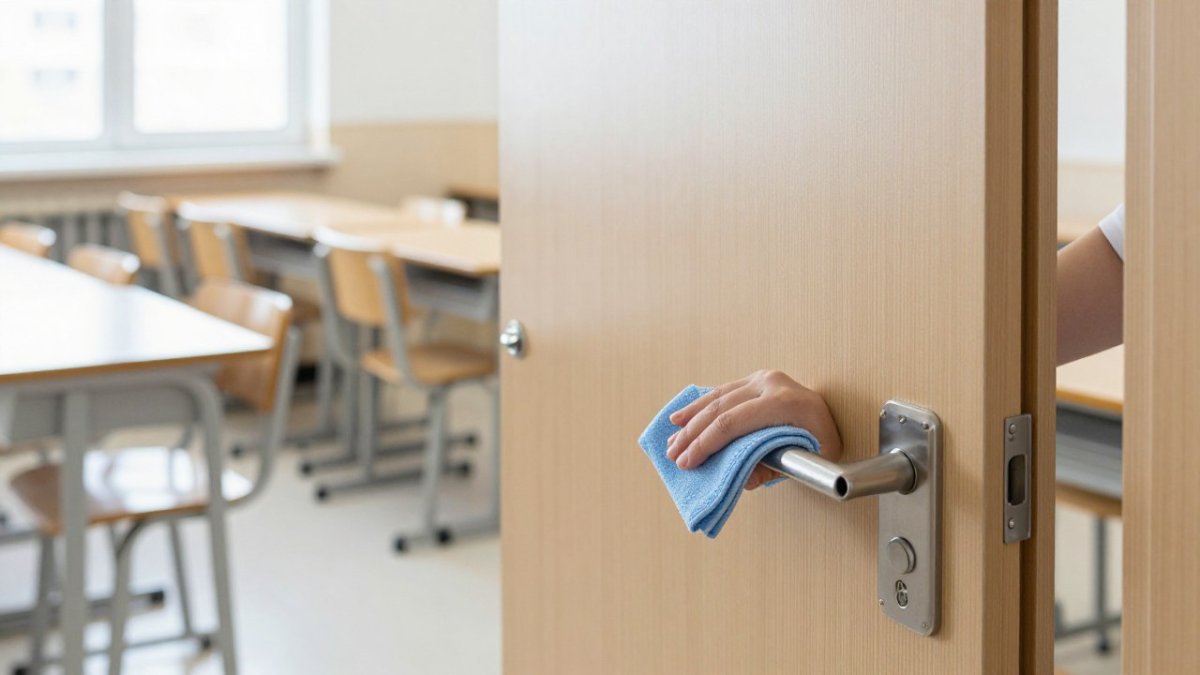
Use a simple daily list for each classroom:
- Wipe down desks and tables with a cloth and an approved cleaner
- Wipe chair backs and seats where pupils rest their hands
- Clean door handles on both sides of the door
- Wipe light switches, window catches and cupboard handles
- Wipe whiteboards, chalkboards and shared teaching aids
- Vacuum or sweep the floor, paying attention to corners
- Empty waste bins and replace the bin liners
- Check that hand sanitiser and tissues are topped up
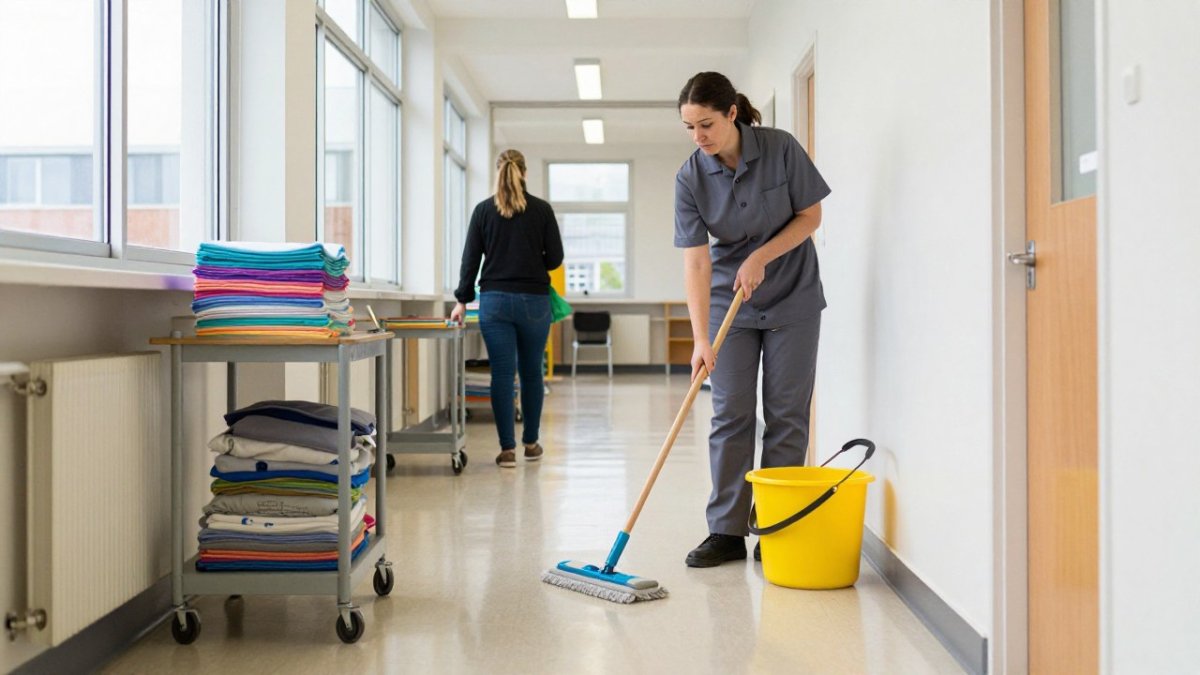
Floors need the most thought: vacuum or sweep before mopping, or you spread the dirt around. Use separate cloths for different areas so grime never travels from floor to desk.
Watch out: Mixing cloths between the classroom and the toilets is a common mistake.
Make the checklist easy to tick off.
School Toilet Cleaning Checklist: Toilets, Urinals, Sinks and Taps
Washrooms need a separate list because the tasks and risks are different.
Use this daily washroom list:
- Clean and disinfect toilet bowls, seats and lids
- Clean urinals and check for blockages or leaks
- Wipe sinks, taps and soap dispensers
- Clean the outside of toilet cubicles, including door locks and handles
- Clean mirrors and wipe down splashed surfaces
- Mop floors with a cleaner suited to washroom tiles
- Check and refill soap, paper towels and toilet paper
- Empty sanitary bins and replace liners
Taps and soap dispensers are often missed.
Check the washroom at least twice during the school day. A lunchtime check catches spills, empty dispensers and blocked sinks before they become a problem.
Keep a separate sheet for washroom checks so anyone can see at a glance whether consumables were checked and cleaning was signed off.
School Cleaning Schedule Template: Daily, Weekly and Deep Clean Frequencies
Not every task happens every day.
Use the template below as a starting point, then adjust each row using the risk factors that follow.
| Frequency | Example tasks | Typical owner | Sign-off |
|---|---|---|---|
| Daily | Desks, door handles, toilets, sinks, bins, floors, tap and soap checks | Cleaning team | Initials and time on room sheet |
| Weekly | Skirting boards, light fittings, cupboard fronts, internal glass, radiator covers | Cleaning team or supervisor | Supervisor initials |
| Half-termly | Carpet deep clean, upholstery, high-level dusting, window frames, gym and changing room deep clean | Contractor or caretaker | Dated job sheet |
| Termly | Full washroom descale, sanitary bin deep clean, store cupboard audit, equipment condition check | Contractor or caretaker | Signed audit record |
Risk factors that should change the frequency
- Pupil numbers and room occupancy. A classroom used by 30 pupils for five lessons a day needs desks and floors cleaned more often than a room used twice a week. High-occupancy rooms belong at the top of the daily list and should be checked again at lunchtime where staffing allows.
- Age group. Early years and key stage 1 rooms usually need more frequent floor cleaning and surface wiping because of snack times, toileting accidents and floor-based learning. Secondary science and design technology rooms need separate risk assessments for chemical and dust exposure.
- Illness outbreaks. During a norovirus or respiratory illness outbreak, increase high-touch surface cleaning to at least twice daily and review the washroom check frequency. Follow current UK government guidance on cleaning and disinfection during outbreaks rather than inventing a separate protocol.
- Room use. Food technology, art, science and sports changing rooms carry different soils and risks from a standard classroom, give each a separate line on the schedule.
- Seasonal pressure. Winter brings more wet floors, mud and illness absence; summer brings sports fixtures and end-of-year events. Build these peaks into the schedule rather than treating every week as identical.
How to build the schedule in practice
- List every room and area in the school, including classrooms, washrooms, corridors, halls, kitchens, changing rooms and offices.
- Assign each area a use category: standard classroom, high-touch washroom, practical room, sports area or low-use space.
- Set daily, weekly, half-termly and termly tasks for each category.
- Name a person or role against every task.
- Add a sign-off column with date, time and initials.
- Review the schedule each term using the completed sheets, not memory.
Plan deep cleans for holidays and half-term breaks where possible, keeping the work away from pupils and giving the team time to finish properly.
Watch out: A schedule that is never reviewed becomes a document nobody trusts.
School Cleaning Equipment and Chemical Safety
Good equipment and safe chemicals protect both the cleaning team and the pupils. In a school, chemical safety is governed by the Control of Substances Hazardous to Health Regulations 2002 (COSHH), which require the employer to assess and control exposure (Control of substances hazardous to health (COSHH)).
A basic school cleaning kit
- Colour-coded microfibre cloths and mops, one colour per area, with washroom cloths kept separate from classroom cloths
- A vacuum cleaner suitable for classroom floors, with a HEPA filter where dust is a concern
- Buckets labelled by use, never shared between washroom and classroom tasks
- A disinfectant with a proven contact time, used on washroom and high-touch surfaces
- A general-purpose cleaner for desks and other surfaces
- Gloves and eye protection for handling concentrated products
- A spill kit and a first aid kit kept close to the cleaning cupboard
What a COSHH assessment should cover
A COSHH assessment does not need to be long, but it does need to be specific to the product and the task. For each cleaning chemical, record:
- The product name and the supplier’s safety data sheet
- The hazard classification and the hazard pictograms on the label
- Who is at risk, including pupils and pregnant staff
- The dilution rate and the contact time required for the product to work
- The PPE required, such as gloves, eye protection or apron
- Ventilation requirements, especially in small washrooms and store cupboards
- First aid measures and spill procedures
- Storage arrangements, locked away from pupils and away from food
Dilution and contact time
Most cleaning failures in schools come from two mistakes: using a product stronger than the label states, and wiping it off before it has had time to work. Follow the dilution rate on the label and safety data sheet. If a disinfectant needs a one-minute contact time, the surface must stay wet for that minute, wiping immediately after spraying may look clean but does not disinfect.
Never mix cleaning products
Bleach and acidic descalers react to release chlorine gas. Bleach and ammonia-based cleaners produce chloramine vapours. Both are serious risks in a confined washroom.
Cleaning during occupied hours
Where cleaning has to happen while pupils are on site, use the lowest-hazard product that will do the job, ventilate the area, and keep pupils away from wet floors and freshly treated surfaces.
Spill and exposure procedure
Watch out: A common pattern in schools is a cleaning cupboard that has accumulated products from several suppliers over years, some without safety data sheets.
Task Ownership, Sign-Off and Audit Records
A checklist only works if someone is responsible for each task and someone checks it was done.
Set up your records in three simple steps:
- Assign owners for each area, such as classrooms, washrooms and corridors
- Record completion with the date, time and initials on the checklist
- Review the records each week to spot tasks that are regularly missed
Keep completed checklists on file for a set period, so the school can show what was done if questions arise.
Audit records also help you spot patterns. If toilet checks are always signed off at 8am but never at lunchtime, that tells you where the gap is.
Keeping Your Cleaning Checklist Running When Staff Are Absent
Absence is one of the biggest threats to a cleaning routine. When a team member is off sick, tasks slip and the checklist gets left blank. Plan for this before it happens.
Try these steps:
- Name a cover person for every area, so someone knows to take over
- Keep the checklists in one shared place that anyone can find
- Write short, plain instructions for each task, so cover staff can start straight away
- Keep a list of trained relief staff or a contractor who can step in at short notice
- Check the cover person has access to the cleaning cupboard and chemicals
Nirvana Managed Services LTD provides cover for soft services staff when a member of the team is off sick. You can also find out how to hire professional office cleaners in Wrexham if you need outside help.
Getting Your Cleaning Checklist Set Up for Your School
Start with one classroom and one washroom. Write the daily, weekly and deep clean tasks, assign owners and run the checklist for two weeks.
Once the first version works, roll it out to the rest of the school. Keep the sheets short, print them clearly and display them where staff will see them every day.
Pricing depends on the size of the school, the number of areas covered and how often the work is needed.
Frequently Asked Questions
What should be included in a school classroom cleaning checklist?
A classroom cleaning checklist should cover desks, tables and chairs, door handles and other high-touch surfaces, whiteboards and interactive screens, waste bins with fresh liners, and floors that are vacuumed, swept or mopped. Split the tasks into daily, weekly and termly sections so each one has a clear frequency. Add a sign-off column so the person who completed each task can be recorded. Review the list each term, because the needs of a reception class and a sixth form room can differ considerably.
How often should school toilets be cleaned?
School toilets, urinals, sinks and taps should be cleaned at least once every school day, with a mid-day check on busy washrooms. Consumables such as soap, paper towels and toilet tissue should be checked at the same time. Deeper cleaning, including descaling and cleaning cubicles, tiles and walls, is usually scheduled weekly or termly depending on use. Frequency should rise with pupil numbers and occupancy, so review the schedule if your roll changes.
What is the difference between daily and deep cleaning in schools?
Daily cleaning keeps spaces safe and presentable through routine tasks such as wiping high-touch surfaces, emptying bins, cleaning toilets and restocking soap and paper. Deep cleaning is less frequent and covers jobs that daily routines do not reach, such as cleaning behind equipment, washing walls, descaling taps and sinks, and cleaning under furniture. Deep cleaning is usually planned around holidays or half-terms so it does not disrupt lessons.
How should school cleaning tasks be recorded and signed off?
Record each completed task with the date, the initials or name of the person who did it, and a short note on anything that needs attention. Keep the records in a simple log, whether on paper or in a shared spreadsheet, so the school can show that tasks were completed. Assign a named owner for each area and have a senior member of staff review the log at set intervals. Regular records make it easier to spot gaps and to respond quickly if standards slip.


