Table of Contents
- What Good Hygiene Actually Looks Like in a Wrexham Primary School
- The Primary School Cleaning Checklist That Covers Every Risk Area
- Building a School Cleaning Schedule That Survives a Busy Term
- School Cleaning Quality Checks That Prove Standards Are Being Met
- Cleaning Staff Absence Cover for Schools: Keeping Standards on Sick Days
- Working With a Wrexham Cleaning Provider Without Losing Control of Standards
- Conclusion
- Frequently Asked Questions
Last Updated: 13 October 2026
What Good Hygiene Actually Looks Like in a Wrexham Primary School
Improving hygiene standards in Wrexham primary schools starts with one clear idea: hygiene is a routine, not a deep clean you do twice a year. A school that looks tidy at 9am can still spread illness by lunchtime if shared surfaces go untouched. This guide from Nirvana Managed Services LTD breaks down the checklist, schedule and quality checks that keep standards steady across a full term.
Primary school hygiene is the routine cleaning and disinfection of shared surfaces, toilets and food areas to reduce the spread of infection among pupils and staff. In practice, that means daily attention to the things everyone touches, plus a clear plan for who cleans what and when.
Most schools do not have a hygiene problem. They have a consistency problem. The cleaning happens, but nobody can prove when, where or how well. We see this often across Wrexham and the wider region, and it is fixable.
Below, we show you exactly how to build a checklist, a schedule and a set of quality checks that hold up on a busy Monday morning. First, here is what most guides get wrong.
Hygiene standards hold up when they are written down, timed and checked. A clean school with no records is one illness outbreak away from a problem nobody can explain.
The Primary School Cleaning Checklist That Covers Every Risk Area
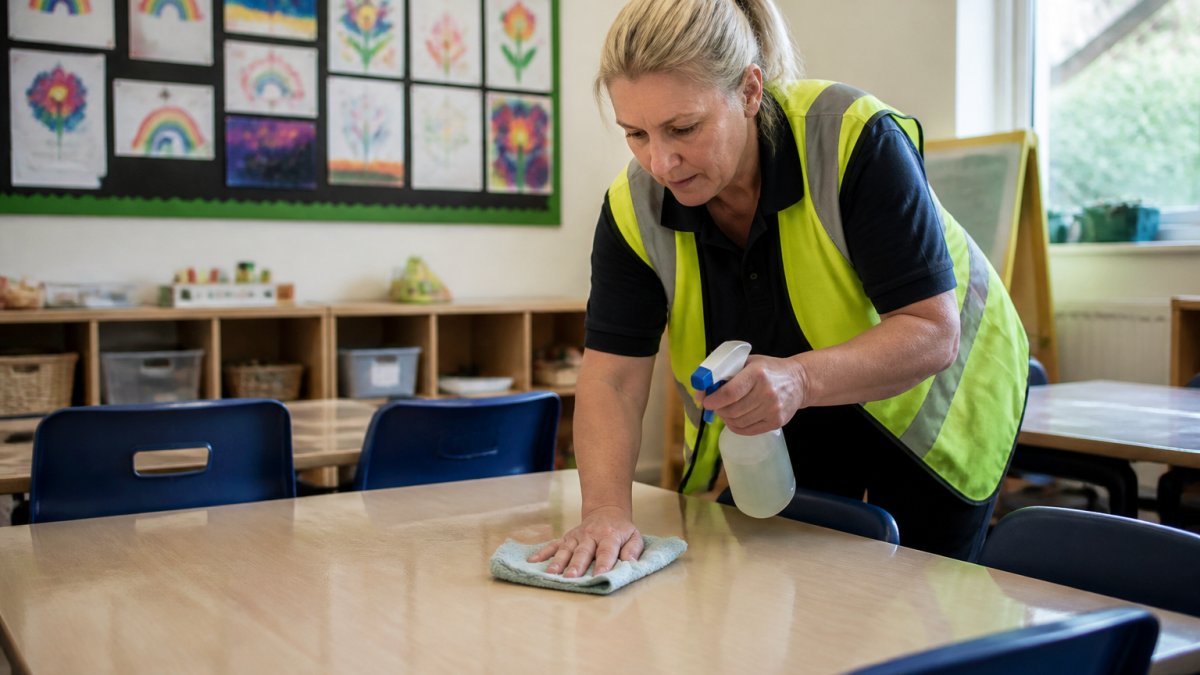
A primary school cleaning checklist should cover every shared touchpoint, not just floors and bins. The checklist is the backbone of improving hygiene standards, because it turns “clean the school” into a list a person can actually follow.
Daily, Weekly and Termly Checklist Items
Split the work by how often it needs doing. This stops the daily jobs from swallowing the bigger tasks.
- Daily: toilets and sinks, door handles, light switches, shared desks, dining tables, bin lids, staff room surfaces
- Weekly: deep clean of toilet floors, chair backs, keyboards and tablets, PE equipment, radiator covers
- Termly: carpets and soft furnishings, blinds, vents, store cupboards, sports hall floors, outdoor play equipment
High-Touch Surfaces Pupils and Staff Share
High-touch surfaces spread more illness than floors ever will. Think door handles, taps, handrails, shared pencils and the dining hall tables where every year group sits.
Give these surfaces their own line on the checklist. Clean them more than once a day where you can, especially in winter.
Cleaning a surface with a dirty cloth just moves germs around. If the same cloth wipes ten desks without a rinse, you are spreading contamination, not removing it. Colour-code cloths and change them often.
Building a School Cleaning Schedule That Survives a Busy Term
A school cleaning schedule only works if it fits around lessons, lunch and clubs. Build it around the school day, not against it, and it will survive to half term.
Timing Cleaning Around Lessons, Lunch and After-School Clubs
Match each task to a window when the room is free. Here is a simple way to map it.
| Time window | Best tasks | Why it works |
|---|---|---|
| Before 8am | Toilets, entrances, dining hall set-up | Quiet building, high-impact areas first |
| Morning break | Toilet check, bin empty, spill response | Rooms empty, quick turnaround |
| Lunch | Dining tables, toilets, corridor sweep | Heaviest footfall happens here |
| After 3:15pm | Classrooms, desks, deep clean tasks | Full access, no pupils in the way |
| After clubs | Final toilet check, bins, lock-up | Leaves the site ready for morning |
A rota that ignores the timetable will always fall behind. Build the schedule around the bells, and cleaners stop working around children.
School Cleaning Quality Checks That Prove Standards Are Being Met
School cleaning quality checks turn a promise into evidence. A headteacher should be able to show an inspector, a parent or a governor exactly what was cleaned and when.
Simple Scoring and Reporting for Headteachers and Bursars
Use a short scoring sheet. Keep it to a handful of areas and score each one out of five.
- Toilets: clean, stocked, no smells
- Classrooms: desks, floors, bins
- High-touch points: handles, switches, taps
- Dining area: tables, floors, serving area
- Site overall: entrances, corridors, bins
Score weekly, note any failures, and log the fix. A one-page report beats a folder nobody reads.
Photograph the same three spots every week: the worst toilet, the busiest corridor and the dining hall. A dated photo trail settles any argument about standards far faster than a written report.
Cleaning Staff Absence Cover for Schools: Keeping Standards on Sick Days
Cleaning staff absence cover for schools is what separates a steady standard from a slide. When one cleaner calls in sick, the daily checklist does not shrink. Someone still has to do it.
The usual mistake is to spread the missing work across the remaining team. That works for a day. It fails for a week, and standards drop quietly in the areas nobody checks.
Plan cover before you need it:
- Keep a named contact for emergency cover
- Hold a short induction pack so a replacement knows the site
- Prioritise toilets, dining and high-touch surfaces when time is short
- Log every absence and how it was covered
A school that can cover a sick day without panic is a school that keeps its hygiene standards intact.
Working With a Wrexham Cleaning Provider Without Losing Control of Standards
Working with a cleaning provider should not mean handing over control. You set the standard, and the provider meets it. That is the whole point of a managed service.
At Nirvana Managed Services LTD, we help schools with recruitment for soft services like cleaning and caretaking staff, and we provide a fully managed service with contract management and cover when your own staff are off sick. That same service covers commercial office cleaning, so the approach carries over to trust offices and business sites.
If you are searching for a school cleaning provider in your area, the questions matter more than the logo on the van. Ask:
- Who covers a sick day, and how fast?
- How do you prove standards, week by week?
- Can we keep our own checklist and scoring?
- What happens if quality slips?
Get clear answers in writing. A good provider will welcome the scrutiny.
Conclusion
Keeping hygiene standards steady through a full term is hard when staff are off, budgets are tight and the timetable never stops. The fix is a clear checklist, a schedule built around the school day, honest quality checks and reliable absence cover.
Nirvana Managed Services LTD handles recruitment for cleaning and caretaking staff, manages the contract, and provides cover when your team is short, with the same fully managed approach for commercial office cleaning. Get started with Nirvana Managed Services LTD and keep your school clean, covered and inspection-ready, term after term.
Frequently Asked Questions
How can primary schools improve hygiene standards without a bigger budget?
Start with a written checklist and a schedule that names who cleans what and when. Risk-based cleaning, which means giving more time to toilets, dining halls and high-touch surfaces, usually improves hygiene standards more than simply adding hours. Review your current contract or in-house rota to find gaps, and consider a managed provider that supplies cover during staff absence so standards do not slip. Small changes, such as handwashing routines at set times of day, also make a measurable difference.
What should a school cleaning schedule include?
A workable school cleaning schedule sets out daily tasks (toilets, sinks, door handles, dining tables), weekly tasks (skirting boards, bins, cloakroom areas) and termly tasks (carpets, high-level dusting, deep cleans). It should name the person responsible, the time of day the work happens, and the products used. Build in a short buffer for unexpected messes, and record when each task is completed so you have evidence for governors, parents or an Estyn visit.
How often should classrooms and shared areas be cleaned?
Classrooms need a daily clean of desks, chairs, door handles and floors, with shared areas such as halls, corridors and dining rooms cleaned at least once a day and more often at peak times. Toilets should be checked and cleaned several times during the school day. High-touch points like light switches and handrails benefit from a mid-day wipe. A clear schedule with signed-off checks gives you proof that these tasks are happening.
How can schools maintain hygiene when cleaning staff are absent?
Plan for absence before it happens. Keep a short list of trained cover staff or work with a provider that guarantees replacement cleaners, ideally on the same day. Cross-train two or three existing staff on priority tasks such as toilet cleaning and bin emptying so the basics are covered. A written priority list, agreed with your headteacher, tells cover staff exactly what to do first when time is short.