
Table of Contents
- What Professional Site Maintenance for Offices Includes
- Creating an Office Cleaning Checklist That Works
- Building an Effective Office Cleaning Schedule
- Office Hygiene Best Practices for Commercial Spaces
- Outsourcing vs In-House Site Maintenance: What Works Best
- Commercial Office Cleaning in Chester and Beyond
- Why Consistency and Cover Matter in Professional Maintenance
- Frequently Asked Questions
Last Updated: October 10, 2026
What Professional Site Maintenance for Offices Includes
Professional site maintenance for offices encompasses far more than a quick sweep and empty bins. It’s the backbone of a workplace that functions properly, where staff feel comfortable and clients see a business that takes standards seriously. At Nirvana Managed Services LTD, we’ve learned that true professional site maintenance for offices requires a structured approach covering cleaning, hygiene, responsive staffing, and consistent oversight.
The core components break down into several distinct areas. Daily cleaning tasks include vacuuming carpets, wiping down desks and communal surfaces, sanitising toilets, and removing waste. Weekly deep cleans target areas that daily routines miss: skirting boards, light fittings, window frames, and behind furniture. Monthly and quarterly maintenance addresses carpet shampooing, floor stripping and waxing, upholstery cleaning, and deep kitchen or break room sanitisation.
Beyond the physical cleaning sits staffing reliability. When a cleaner or caretaker calls in sick, your office doesn’t stop needing maintenance. That’s where cover arrangements matter. Professional site maintenance for offices also includes contract management, quality checks, and the ability to deploy trained cover staff within hours when your regular team can’t be there.
Creating an Office Cleaning Checklist That Works
A solid office cleaning checklist is your first line of defence against inconsistency. Without one, cleaning standards drift. Staff work from memory or habit rather than a defined standard, and corners get cut when things get busy.
Start by documenting what “clean” actually means in your space. Don’t write “clean the office.” Write specific tasks: “Vacuum all carpeted areas including under desks and chairs,” “Wipe down all light switches with a microfibre cloth,” “Empty all bins and replace liners,” “Sanitise the coffee machine group head and portafilter.” Specificity removes ambiguity.
Your office cleaning checklist should separate daily, weekly, and monthly tasks clearly. Daily items are non-negotiable: restrooms, high-traffic areas, desks in open-plan spaces, and communal surfaces. Weekly tasks might include vacuuming under furniture, deep cleaning kitchen appliances, or sanitising door handles and railings. Monthly tasks cover carpet shampooing, window cleaning, or stripping and rewaxing hard floors.
Include checkboxes or sign-off spaces. When staff initial a task, they’re accountable. It also creates a paper trail showing what’s been done and when. Many offices that switched to signed checklists reported fewer quality complaints within the first month.
| Task | Frequency | Duration | Responsible |
|---|---|---|---|
| Vacuum carpets and rugs | Daily | 45 mins | Day cleaner |
| Sanitise desks and keyboards | Daily | 30 mins | Day cleaner |
| Clean toilets (toilets, sinks, mirrors) | Daily | 40 mins | Day cleaner |
| Empty all bins and replace liners | Daily | 20 mins | Day cleaner |
| Deep clean kitchen appliances | Weekly | 60 mins | Weekly deep clean |
| Wipe skirting boards and baseboards | Weekly | 45 mins | Weekly deep clean |
| Carpet shampoo (high-traffic areas) | Monthly | 120 mins | Specialist contractor |
Document your checklist in a shared format, printed sheets, a digital app, or a simple spreadsheet. Make it accessible to whoever is working. A checklist nobody sees is useless.
Building an Effective Office Cleaning Schedule
Timing matters as much as the tasks themselves. A professional site maintenance for offices schedule balances thoroughness with minimal disruption to your business operations.
Most commercial offices benefit from a split approach: light daily cleaning during or after working hours, and deeper cleans outside peak times. If your office closes at 5 p.m., a team arriving at 5:30 p.m. can work undisturbed for two to three hours. For offices with evening staff or shift work, early morning cleaning (6 a.m. to 8 a.m.) often works better.
Frequency depends on foot traffic and industry standards. A busy open-plan office with 50+ staff typically needs daily cleaning of communal areas, restrooms, and high-touch surfaces. Smaller offices with 10-15 staff may manage with daily light cleaning plus a weekly deep clean. Healthcare facilities, food preparation areas, and customer-facing spaces need more frequent sanitisation than back-office environments.
Weekly deep cleans should be scheduled for the same day and time each week. Consistency helps staff plan around the work and ensures nothing gets skipped. Many offices in Chester schedule their deep clean for Friday evening or Saturday morning, leaving the space pristine for Monday.
Consider seasonal adjustments. Autumn and winter bring more mud and moisture into offices. Spring might require more intensive window cleaning and carpet work. A flexible schedule that adapts to these changes prevents standards from slipping during busy seasons.
Avoid scheduling all deep cleaning on the same day your office hosts client meetings or events. A wet floor or chemical smell during a presentation undermines the whole point of professional maintenance.
Office Hygiene Best Practices for Commercial Spaces
Office hygiene has become non-negotiable. Staff expect clean restrooms, sanitised shared surfaces, and reliable waste disposal. Clients notice when a reception area or meeting room feels neglected. Professional site maintenance for offices means embedding hygiene into daily practice, not treating it as an afterthought.
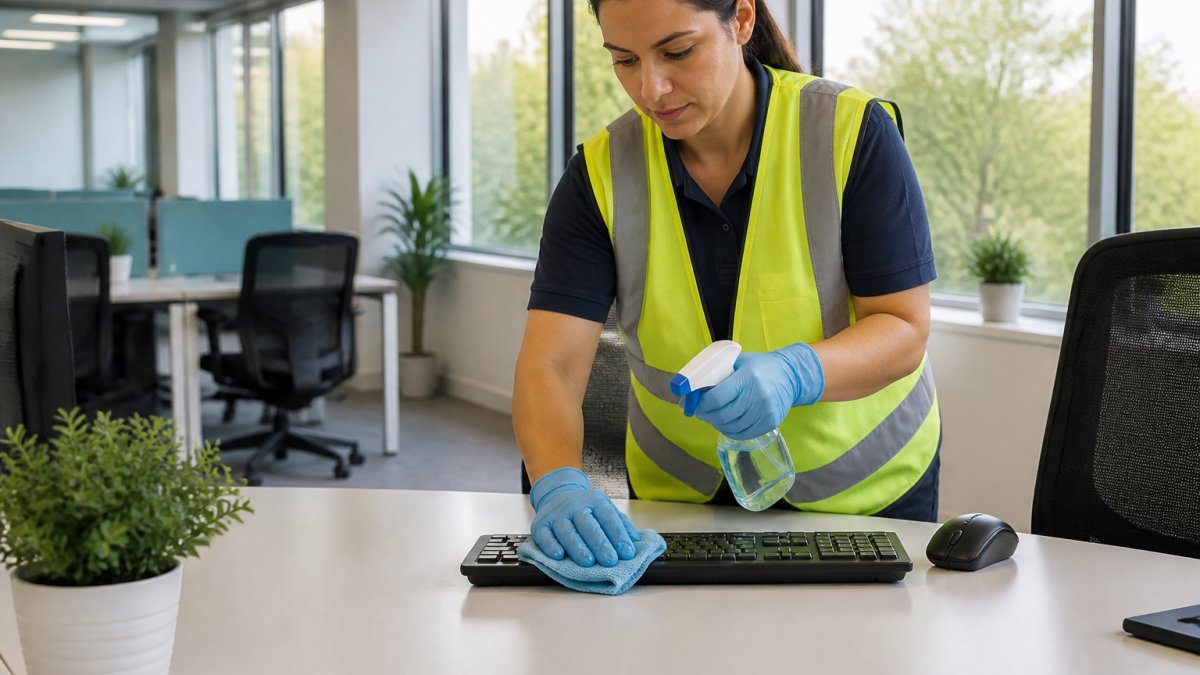
Start with high-touch surfaces. Door handles, light switches, keyboard and mouse, desk phones, and lift buttons accumulate bacteria and viruses throughout the day. These should be sanitised at least once daily, ideally twice in high-traffic areas. Use EN-certified disinfectants or hospital-grade sanitiser wipes.
Washrooms require special attention. Toilets, sinks, taps, and mirrors should be cleaned and sanitised multiple times daily in busy offices. Soap and paper towel dispensers should be checked and refilled regularly. A restroom that runs out of soap or towels sends a poor message about standards.
Kitchen and break room hygiene often gets overlooked. Shared appliances, kettles, microwaves, fridges, coffee machines, harbour bacteria. Wipe down these surfaces daily. Empty the fridge weekly and remove expired food. Clean the microwave interior after spills.
Carpet and upholstery trap dust, allergens, and bacteria. Professional carpet shampooing every three to six months (more often in high-traffic areas) keeps air quality higher and extends carpet life. Upholstered chairs and sofas in meeting rooms or lounges should be vacuumed weekly and deep cleaned quarterly.
Waste management is part of hygiene too. Bins should be emptied daily, with liners replaced. Recycling and general waste should be separated clearly to avoid contamination. Overflowing bins create odours and attract pests, a clear sign of poor maintenance.
Outsourcing vs In-House Site Maintenance: What Works Best
The choice between managing professional site maintenance for offices in-house or outsourcing it shapes your budget, control, and consistency.
In-house teams give you direct control. You hire, train, and manage staff directly. You set the standards and can respond immediately to issues. However, recruitment is hard. Cleaning and caretaking roles have high turnover, and finding reliable, trained staff in Chester or Wrexham takes time and effort. When your cleaner is sick, you scramble for cover.
Outsourced services shift recruitment and cover to a specialist provider. You contract with a company that handles staffing, training, quality control, and cover when someone is absent. You get consistent standards because the provider has systems and oversight in place. You’re not managing individual staff members. However, you lose some direct control, and quality depends on the provider’s commitment. Switching providers mid-contract can be disruptive.
The financial picture varies. In-house teams can seem cheaper initially, you pay only for the hours worked. But once you factor in recruitment costs, training time, payroll administration, and the cost of emergency cover when staff are absent, the total cost often rises. Outsourced providers charge a set fee, which is predictable and typically includes cover for absences.
For schools and educational institutions struggling with soft services recruitment, outsourcing often makes sense. Nirvana Managed Services LTD provides trained cleaning and caretaking staff, manages contracts, and ensures cover is available when your regular team can’t work. The school focuses on education; we handle the maintenance.
For commercial offices, the decision depends on size and complexity. A small office with five staff might manage in-house. A 100-person office with multiple floors, client meetings, and 24/7 access requirements benefits from outsourced professional site maintenance for offices.
Outsourcing works best when you value consistency, reliability, and peace of mind over direct control. In-house works best when you have the bandwidth to manage recruitment and training yourself.
Commercial Office Cleaning in Chester and Beyond
Chester’s business district has distinct cleaning challenges. Historic buildings with older carpets and fixtures require specialist knowledge. Modern office parks with large open-plan spaces need different approaches than converted Victorian properties. Professional site maintenance for offices means understanding these local variations.
Many offices are located in city-centre buildings shared with other businesses. That means coordinating cleaning schedules with neighbouring tenants, managing shared lobby and stairwell cleaning, and working around multiple businesses’ hours. A provider familiar with the office landscape knows how to navigate these constraints.
Commercial office cleaning also requires understanding local regulations. Building access, waste disposal, and parking for cleaning vehicles can be restricted in the city centre. A provider with local experience knows where to park, how to access buildings outside business hours, and how to manage waste responsibly.
Wrexham’s office spaces tend to be newer, purpose-built facilities with modern systems. The cleaning challenges differ, HVAC systems need careful maintenance, modern flooring requires specific products, and larger car parks mean different waste management needs. Professional site maintenance for offices means adapting to these newer environments.
Both Chester and Wrexham benefit from providers who understand local business culture. Relationships matter. A cleaning provider who knows the area, respects local businesses, and delivers consistent service becomes part of your operation.
Why Consistency and Cover Matter in Professional Maintenance
Consistency is where professional site maintenance for offices separates adequate from excellent. A space cleaned to high standards one week and neglected the next creates confusion and frustration. Staff lose confidence in the maintenance team. Clients notice the inconsistency.
Consistency requires three things: clear standards, trained staff, and accountability. The checklist defines standards. Regular training ensures staff know what’s expected. Sign-offs and spot checks create accountability.
Cover arrangements are equally critical. When your cleaner is ill, a professional provider has trained staff available to maintain standards. That means your office is clean Monday morning regardless of who was sick Friday. Without reliable cover, absences create gaps.
Many schools and offices have experienced the disruption of cover gaps. A member of staff calls in sick, and nobody is available to cover. The office opens looking neglected. Parents or clients form negative impressions. A professional site maintenance for offices provider solves this by maintaining a pool of trained cover staff.
This is where outsourcing to a specialist provider like Nirvana Managed Services LTD makes sense. We manage recruitment, training, and cover. Your office maintains standards regardless of absences. You’re not managing staff; you’re managing a service agreement with a provider accountable for consistency.
Professional site maintenance for offices isn’t a luxury, it’s a foundation. A clean, well-maintained office signals competence, respect for staff and clients, and attention to detail. Whether you manage cleaning in-house or outsource to a specialist, the principles remain the same: clear standards, trained staff, reliable cover, and consistent execution.
At Nirvana Managed Services LTD, we work with schools, offices, and facilities to deliver exactly this. We handle recruitment challenges, provide trained staff, manage contracts, and ensure cover is available when your regular team can’t work.
Frequently Asked Questions
What does professional site maintenance for offices include?
Professional site maintenance covers daily cleaning (desks, floors, bathrooms, kitchens), waste removal, window cleaning, carpet care, and sanitisation of high-touch surfaces. Many services provide emergency cover when staff are absent, ensuring standards remain consistent regardless of staffing changes. The scope depends on your office size and specific requirements.
How often should an office be cleaned?
Daily cleaning is standard for most commercial offices, typically performed outside working hours (early morning or evening). High-traffic areas, toilets, and kitchens need daily attention. Weekly deep cleaning covers carpets, windows, and less-used spaces. Your office cleaning schedule should reflect foot traffic, industry standards, and employee expectations. A professional cleaning service can tailor frequency to your building’s specific needs and occupancy levels.
What should be included in an office cleaning checklist?
An effective office cleaning checklist covers: desks and workstations, floors and carpets, bathrooms (toilets, sinks, mirrors), kitchens and break rooms, bins and recycling, door handles and light switches, windows, and high-touch surfaces. A detailed checklist ensures nothing is missed and provides accountability. Professional providers use standardised checklists adapted to your building layout and requirements.
How can offices maintain hygiene in shared areas?
Shared areas require frequent sanitisation, especially kitchens, toilets, and meeting rooms where germs spread easily. Provide hand sanitiser dispensers, antibacterial soap, and paper towels. Clean high-touch surfaces (door handles, light switches, lift buttons) multiple times daily. Encourage staff to report spills or issues immediately. A professional cleaning service ensures consistent hygiene standards in shared spaces and can respond quickly to problems, protecting employee health and reducing sick leave.