Last Updated: November 5, 2026
Quick Summary
A school cleaning contingency plan is a short written document that names who covers cleaning and caretaking when staff are absent, how fast cover must arrive and who makes the call. Schools should list their core daily tasks, rank at least three cover sources by speed, agree a minimum standard and test the plan once a term.
- Name one decision-maker, such as the bursar, site manager or headteacher, to call cover on the day.
- Aim for cover arriving within two hours of the first call, so the building is ready before lessons.
- Rank cover sources by speed, and keep at least three vetted options rather than relying on one.
- Run a short drill once a term and time how long the first call takes to get an answer.
- Give every cover worker a written site induction covering fire exits, lock codes and chemical storage.
Table of Contents
- Why School Cleaning Needs a Written Contingency Plan
- Mapping Your Cleaning and Caretaking Roles
- Building Your Cover Arrangements Step by Step
- Managing Cleaning Staff Absence in Schools Day to Day
- A Commercial Office Cleaning Contingency Plan Template
- Common Mistakes to Avoid When Planning Cover
- Arranging Your School’s Cleaning Cover With Nirvana
- Frequently Asked Questions
Why School Cleaning Needs a Written Contingency Plan
When a cleaner calls in sick at 6:30 on a Monday morning, the school still has to open. Corridors need clearing, toilets need checking and classrooms need to be ready before pupils arrive. A written school cleaning contingency plan turns that panic into a routine. It sets out who covers the work, how fast cover arrives and who makes the call.
Schools and offices often face the same problem again and again. Schools often have no written plan at all. Cover depends on one caretaker who is already stretched, or on a phone call to a supply agency that may or may not answer.
A plan does three useful things:
- It names the person who makes the decision on the day.
- It sets a response time for getting cover on site.
- It shows the team what standard the school expects, even when the usual routine breaks.
Watch out: A plan that exists only in someone’s head disappears the moment that person is off sick too.
Mapping Your Cleaning and Caretaking Roles
Start by listing every task that keeps the site clean and safe, since each one should appear in your school cleaning contingency arrangements. Cleaning covers the obvious jobs: classrooms, halls, toilets, kitchens and common areas. Caretaking adds lockups, minor repairs, bins, grounds and the first response to spills or breakages. Write each task down, then note who does it today.
Next, sort the tasks into three groups:
- Daily core tasks: opening, lockup, toilet checks, bin runs and spill response.
- Weekly tasks: deep cleaning, floor care, window cleaning and stock checks.
- Periodic tasks: carpet cleaning, equipment servicing and deep sanitising.
Core daily tasks need cover first. Periodic tasks can wait a few days without harm. This simple split tells you where cover matters most when someone is absent.
A school with a contracted provider should check how responsibilities divide between in-house staff and the external team. See how school cleaning contracts divide roles to compare your arrangement with what is typical. Confirm who owns each task on paper, not just in conversation.
Building Your Cover Arrangements Step by Step
Work through these steps in order:
- List your current cover sources. These might include an in-house relief cleaner, a neighbouring school, a supply agency or a managed service provider.
- Rank them by speed. Note how long each source usually takes to put someone on site.
- Agree a minimum standard. Decide what “cover” means. A reduced clean of the core areas may be enough for one day.
- Name a decision-maker. One person, usually the bursar, site manager or headteacher, decides when to call in cover.
- Write the call-out steps. Include phone numbers, email addresses, out-of-hours contacts and the sign-in process for a new person on site.
- Test the plan. Run a short drill once a term. Time how long the first call takes to get an answer.
Keep the written plan short enough to read in five minutes. A long document that nobody opens is no use on a bad morning.
Setting Response Times and Escalation Points
Decide how fast cover must arrive before the school is at risk. For many schools, the target is within two hours of the first call, so the building is ready before the first class. Write this figure into the plan.
Set escalation points too. Learn the risks of outsourced school cleaning and how to manage them before you finalise your cover arrangements. For example:
- Within 30 minutes: the site manager tries the in-house relief cleaner.
- Within one hour: if no cover is confirmed, the decision-maker calls the managed provider or agency.
- Before 8:00 am: if the building is still not covered, the headteacher is informed.
Clear escalation stops people waiting too long before they act.
The six steps below set out the order in which to build your cover arrangements.
| Step | What to do | Timing or frequency |
|---|---|---|
| List cover sources | Include in-house relief, neighbouring schools, supply agencies or managed providers | Before building the plan |
| Rank by speed | Note how long each source takes to get someone on site | Before building the plan |
| Agree minimum standard | Decide what a reduced clean of core areas must cover | Before building the plan |
| Name a decision-maker | Usually bursar, site manager or headteacher | Before building the plan |
| Write call-out steps | Include phone numbers, out-of-hours contacts and sign-in process | Before building the plan |
| Test the plan | Run a short drill and time the first call to get an answer | Once a term |
Managing Cleaning Staff Absence in Schools Day to Day
Absence rarely arrives at a convenient time. Staff ring in sick late, or a long-term absence turns into weeks without a clear end date. Day to day, the aim is to keep the rota visible and the handover simple, while addressing the unique pressures faced by school cleaning staff.

School cleaners and caretakers often work alone or in small teams, carrying out physically demanding tasks such as mopping, buffing, and lifting. This isolation can make absence feel more disruptive, as there is no immediate colleague to step in.
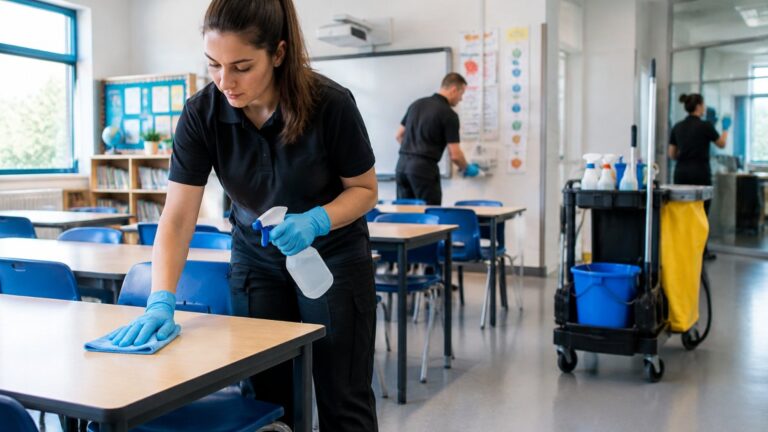
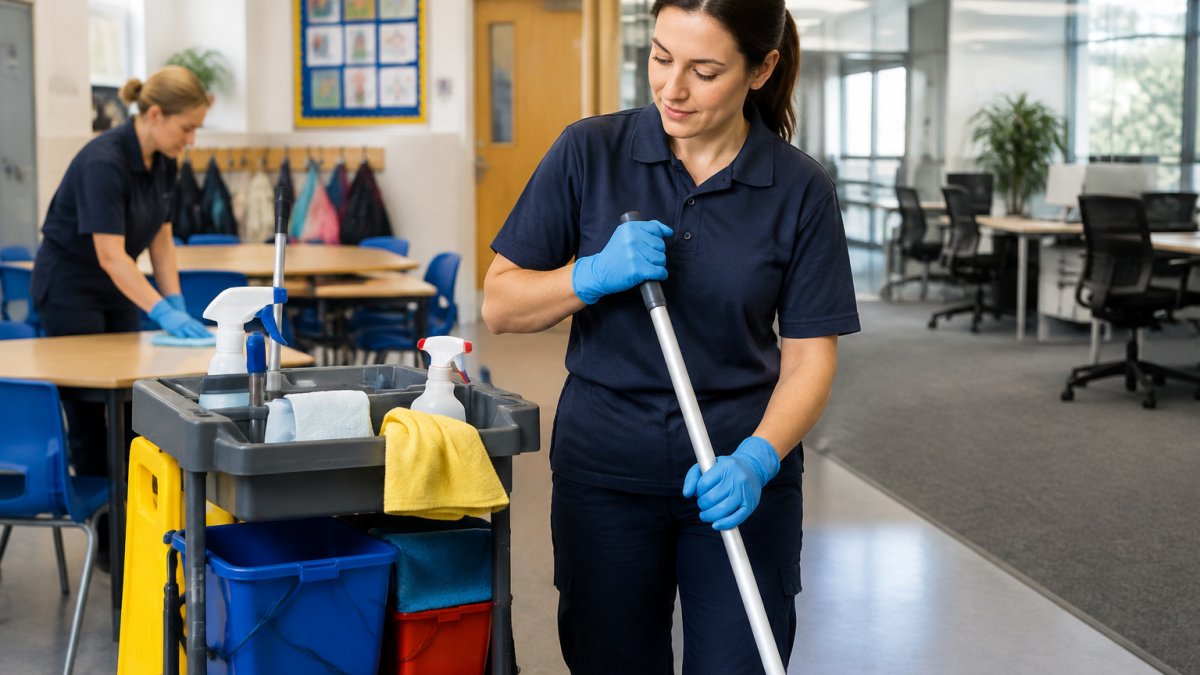
Keep a shared rota that the site team can see at a glance. A caretaker and cleaning supervisor reviewing the printed rota together, with mops and trolleys nearby, is a common sight in schools that run this well. When the rota is on paper and on the shared drive, nobody has to guess who is covering which corridor.
Use a short handover note for every change. It should cover the areas done, the areas missed and any urgent issues. Keep it to five lines so it gets read.
Watch out: Do not leave cover staff without a site induction. Fire exits, lock codes and chemical storage rules must be explained on arrival. Employers must ensure the health and safety of all workers, including temporary cover (Your health, your safety). A written induction checklist signed by the cover staff member provides evidence of compliance.
Track absence patterns over a term. If the same member of staff is off every Monday, that is a management conversation, not a cover problem. Use return-to-work interviews to identify underlying issues, such as musculoskeletal strain from repetitive tasks. Investing in ergonomic equipment, such as lightweight mops and ride-on scrubbers, can reduce physical strain and absenteeism. Where school buildings are older or have challenging layouts, such equipment can make a significant difference.
For commercial office cleaning, the same principles apply, but the pressure to maintain a presentable image for clients means cover must be seamless. Offices often require early-morning cleaning before staff arrive, so contingency plans should prioritise rapid response for reception areas, meeting rooms and washrooms.
A Commercial Office Cleaning Contingency Plan Template
The same planning logic works for commercial office cleaning. Offices have different pressures, mainly a need for clean desks, kitchens and meeting rooms before staff arrive. Use this template as a starting point:
Site: [Building name and address]
Decision-maker: [Name, role, mobile]
Core daily tasks: [Reception, toilets, kitchen, meeting rooms, bin runs]
Cover source 1: [Name, contact, expected response time]
Cover source 2: [Name, contact, expected response time]
Escalation point: [Time at which the decision-maker calls the second source]
Minimum standard for cover: [What must be clean before 9:00 am]
Handover note location: [Shared drive or site log]
Last tested: [Date of last drill]
Fill in each field, then store the completed plan where both the site team and the office manager can reach it.
Common Mistakes to Avoid When Planning Cover
Most cover plans fail for a handful of reasons. Watch for these, especially in the school and commercial office cleaning sectors:
- One source only. If that single cleaner or agency is unavailable, the plan collapses. It is tempting to rely on one familiar name. Instead, build a list of at least three vetted sources, including local agencies and neighbouring schools that may share cover arrangements.
- No written standard. Without a minimum standard, cover staff do not know what to prioritise. For schools, the standard might specify that all toilets and main circulation areas must be cleaned before 8:30 am. For commercial offices in Wrexham, the focus may be on reception, meeting rooms and washrooms before 9:00 am.
- Out-of-date contacts. Phone numbers change. Review the contact list every term and update it on the shared drive and printed copies.
- No induction for cover staff. New people on site are a safety risk without a briefing. Employers must provide adequate health and safety training to all workers, including temporary staff. A simple checklist covering fire exits, chemical storage and reporting procedures is essential.
- Never testing the plan. A plan you have never tried is a guess. Run a drill once a term, timing how long it takes to confirm cover. Use the results to refine escalation points. If someone is absent right now, read our practical guide to emergency cleaning cover for schools.
- Ignoring local labour challenges. Plan ahead for peak periods when competition for workers is higher.
- Overlooking commercial office needs. If your site includes commercial office cleaning, ensure the contingency plan covers the specific requirements of office environments, such as secure document disposal and maintaining a professional appearance for clients.
Review the plan after every incident. Ask what worked, what did not and what would have saved time. Keep a log of lessons learned and share it with the site team.
Arranging Your School’s Cleaning Cover With Nirvana
If your school struggles to find reliable cleaning and caretaking cover, Nirvana Managed Services LTD can take that load off your team. We recruit and manage soft services staff for schools, handle contract management, and provide cover when a member of staff is off sick. Our service also covers commercial cleaning for offices.
Get in touch through the Nirvana Managed Services LTD website to talk through your current arrangements and what a fully managed service would look like for your site. You can also request commercial cleaning staff cover solutions directly. Our team can help you put a contingency plan in place that works on the difficult mornings as well as the quiet ones.
Frequently Asked Questions
What should be included in a school cleaning contingency plan?
A school cleaning contingency plan should list every cleaning and caretaking role, name who covers each task when someone is absent, and set out how quickly cover must arrive on site. It should also record which tasks are essential each day, such as washroom hygiene, kitchen areas and entrances, and which can wait. Keep contact details for backup staff and your outsourced provider up to date, and review the plan each term so it reflects current staffing and site use.
How do you manage cleaning staff shortages in schools?
Start by identifying the tasks that cannot be missed and the staff who can cover them, including trained support staff who can be redeployed for short periods. Where internal cover runs out, use a managed service that supplies and supervises replacement staff. Track absence patterns so you can spot recurring gaps, and agree clear escalation steps with your headteacher and bursar so decisions are made quickly on the day.
Can a managed service provide emergency cleaning cover for a school in Wrexham?
Yes, Nirvana Managed Services LTD provides managed cleaning and caretaking cover, including emergency cover when a member of staff is off sick. For current availability and to discuss your site, contact Nirvana Managed Services LTD directly through its website for a quote tailored to your school’s size and requirements.
What is a commercial office cleaning contingency plan template?
A commercial office cleaning contingency plan template is a simple document that sets out the cleaning tasks for each area, the named cover person for each task, and the steps to follow when a cleaner cannot attend. Include access arrangements, out-of-hours contacts and a checklist for reporting issues. Adapt the template to your building’s floor plan and occupancy so it reflects how the space is actually used.