
Last Updated: 6 November 2026
Quick Summary
School cleaning recruitment works best as a six-stage workflow: write the job description and hours before advertising, screen against set criteria, interview for reliability and attention to detail, complete enhanced DBS and right-to-work checks, induct and train on site, then review at 4 and 12 weeks. The stages most schools skip are screening and the review, and those decide whether a hire lasts.
- State hours, shift patterns and term-time weeks in the advert, not at interview.
- No cleaner should be on site unsupervised until the enhanced DBS check is back and references confirmed.
- Score interview answers 1 to 5 against set criteria so gut feel cannot override a clear gap.
- Build a cover list with two trained bank staff who know the building before absence hits.
- Allow 2 to 4 weeks for DBS checks and references when planning your timeline.
Table of Contents
- Building a Compliant School Cleaning Recruitment Workflow
- Writing a School Cleaner Job Description That Attracts the Right People
- Safer Recruitment: DBS Checks and Safeguarding Before Day One
- School Cleaner Interview Questions That Test More Than Speed
- School Cleaning Staff Retention: Why Good Cleaners Leave
- School Cleaning Absence Cover Without Panic
- Hiring for Commercial Office Cleaning Alongside School Contracts
- Planning Your Next Recruitment Round
- Frequently Asked Questions
Building a Compliant School Cleaning Recruitment Workflow
School cleaning recruitment is the process of finding, checking and hiring people who can clean classrooms, shared areas and high-touch surfaces to a consistent standard. Get it right and cover holds through term time.
Across schools in Chester and the wider region, we see the same pattern. Recruitment is treated as an advert and an interview. It is really a workflow with six stages, and each one protects the next.
Here is the sequence we would run for any school cleaning recruitment round:
- Write the job description and hours before you advertise
- Screen applications against set criteria, not gut feel
- Interview for reliability and attention to detail
- Complete an enhanced DBS check and right-to-work checks
- Induct and train on site before day one
- Review at 4 and 12 weeks
The stages most schools skip are two and six. Those are the ones that decide whether a hire lasts.
Writing a School Cleaner Job Description That Attracts the Right People
A school cleaner job description is a written summary of duties, hours, pay terms and the standards a cleaner must meet. It should read like a task list, not a personality profile.
Most adverts fail because they describe a type of person rather than a set of tasks. Applicants cannot picture the job, so the wrong ones apply and the right ones scroll past. A second common failure is leaving the terms vague, which attracts candidates whose availability does not match the shift and wastes everyone’s time at interview.
Duties, Hours and Term-Time Terms to Spell Out
Be specific about what the role covers each day. A clear cleaning specification removes guesswork at interview.
- Classrooms: desks, floors, bins and display surfaces
- Shared areas: halls, corridors, toilets and staff rooms
- High-touch surfaces: doors, handrails, light switches and taps
- Waste removal and disposal to the agreed point
- Deep cleaning during school holidays
Then state the terms plainly: cleaning hours, shift patterns, whether the role is term-time only or all year, and how holiday pay works. Spell out the pay grade and the pay period.
Pay, hours and term-time contracts
Pay for school cleaners is usually set against a local authority grade or a school’s own pay scale, and it varies by region and by whether the role is term-time only.
Term-time contracts need explaining, not just naming.
Split shifts are common in schools, an early-morning clean before the gates open and an afternoon clean after they close. If the role is split, say so in the advert.
Inclusive and accessible advertising
A wider candidate pool starts with an advert more people can read and respond to. Use plain English, short sentences and a clear list of duties. State the essential criteria and separate them from the desirable ones, so applicants are not put off by a list they think they cannot meet. Offer the advert in alternative formats on request, and say who to contact for adjustments.
Watch out: leaving hours vague is a common reason a new cleaner leaves early. State the hours, the shift pattern and the term-time weeks in the advert, not at interview.
Safer Recruitment: DBS Checks and Safeguarding Before Day One
Safer recruitment means checking everyone who works in a school before they start, not after. For cleaning staff, that means an enhanced DBS check, identity checks, right-to-work checks and two references.
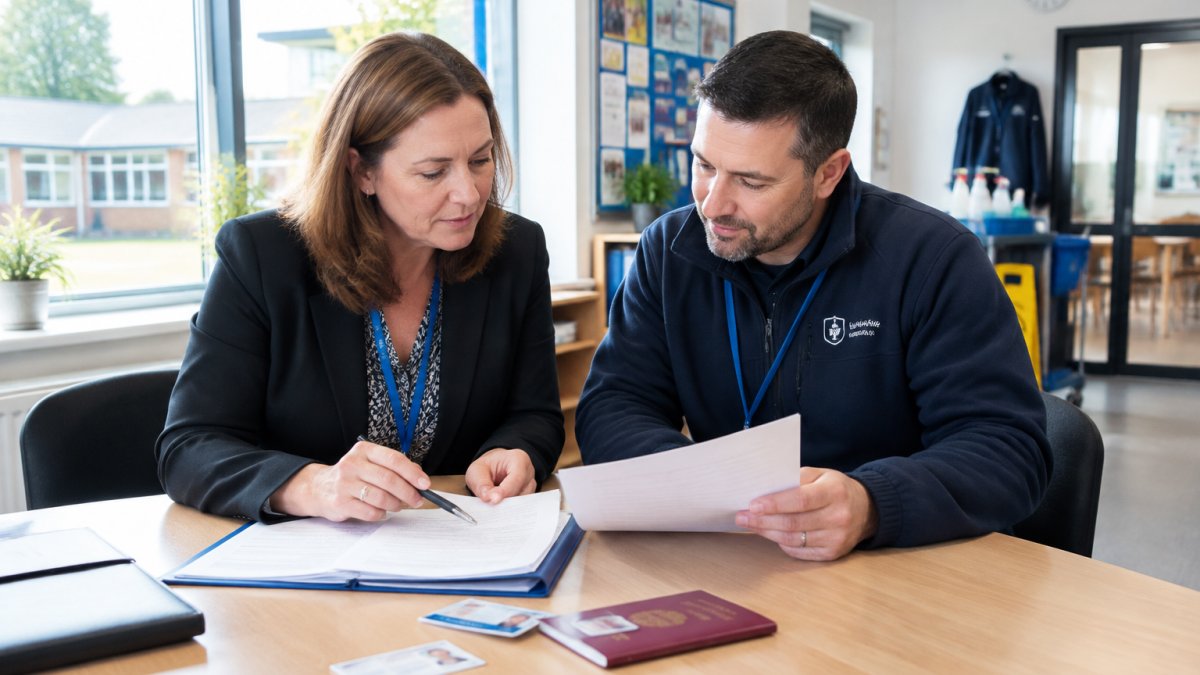
The Department for Education guidance on safeguarding in schools sets out what governing bodies must do. Cleaning staff work in the building during and outside school hours. Treat them as school staff for safeguarding purposes, not as visitors.
The checks to run, and the order to run them
Run the sequence in this order so no step is skipped when a hire is urgent:
- Application and shortlisting, use a standard application form, not just a CV, so employment history is captured in a consistent format. Ask for a full history with no unexplained gaps.
- Identity check, verify photographic ID and proof of address before interview. Confirm the name on the ID matches the application.
- Right-to-work check, complete before employment starts, using original documents or a Home Office online check where eligible. Keep a dated record.
- Interview, ask safeguarding-aware questions, not just cleaning questions. Probe any gaps in employment history at interview.
- Enhanced DBS check, for school cleaning staff this should be an enhanced check, and where the role amounts to regulated activity it should include the children’s barred list. Confirm with your local authority or HR adviser which applies to your setting.
- References, two references, one from the most recent employer. Verify references by phone or email directly with the referee, not through the candidate.
- Employment-history verification, confirm the dates and roles on the application match what referees and records show.
- Induction and supervision, do not leave a new starter alone with children or in a position of trust until checks are complete and induction is signed off.
No cleaner should be on site unsupervised until the enhanced DBS check is back and references are confirmed. That can add time to hire, so build it into your plan rather than discovering it late.
Supervision before clearance
A common pattern in schools is to bring a new cleaner in for induction and shadowing while the DBS check is pending.
A clear DBS certificate does not replace references or employment-history checks, since a candidate can pass a DBS check and still have a gap in their history.
For a full walkthrough of the checks and the order to run them, see our guide on how to ensure DBS compliance for school cleaning staff.
School Cleaner Interview Questions That Test More Than Speed
The best school cleaner interview questions test judgement, not just pace. Anyone can say they work fast. Fewer can explain what they would do if they found a broken socket in a classroom.
Use a fixed question set so every candidate is scored the same way:
- Describe how you would clean a classroom in the time allowed. What comes first?
- What would you do if you found a damaged floor or a spill you could not clear?
- How do you decide which areas need more attention on a given day?
- Tell us about a time you spotted a problem and reported it.
- What does safe handling of cleaning materials mean to you?
Score each answer from 1 to 5 against set criteria: attention to detail, communication skills, safe handling, and reliability. Add the scores up. Gut feel should not override a clear gap.
School Cleaning Staff Retention: Why Good Cleaners Leave
School cleaning staff retention usually fails for three reasons: unclear hours, no on-the-job training, and no one noticing good work. Pay matters, but it is rarely the whole story.
New starters leave when the first week is chaotic. They are handed a cupboard key and a mop and left to work it out.
The other lever is progression. Vocational qualifications in cleaning and support services give people a reason to stay. So do shift patterns that fit around school pick-up.
If turnover is already biting, our piece on school caretaking staff retention best practices goes deeper into the tactics that work.
School Cleaning Absence Cover Without Panic
School cleaning absence cover is the plan for filling a shift when a cleaner calls in sick, and it needs to exist before the call comes. Schools cannot open with toilets uncleaned and corridors unswept.
Build a cover list now:
- Two trained bank staff who know the building
- A named person who makes the cover call each morning
- A written task list for each area so a stand-in can follow it
- A record of who holds keys and alarm codes
The gap that hurts most is the early shift. Parents drop children at the gate and the entrance is the first thing they see.
For a step-by-step plan, read our guide on emergency cleaning cover for schools.
Hiring for Commercial Office Cleaning Alongside School Contracts
The same recruitment workflow carries straight over to commercial office cleaning, with one difference: office contracts run all year and often outside school hours. That widens your candidate pool.
If you manage both, run one recruitment pipeline and tag candidates by site type. A cleaner who suits a term-time school may not want early-morning office shifts, and the reverse is true.
Set out the differences in the advert:
- School roles: term-time hours, holiday deep cleaning, safeguarding checks
- Office roles: year-round shifts, out-of-hours work, keyholder duties
Both need the same screening, induction and quality checks. For the operational side, our article on how to manage commercial office cleaning well covers scheduling and quality control.
Planning Your Next Recruitment Round
Start with a timeline working backwards from the start date. Allow time for the enhanced DBS check and references, because those are the steps you cannot rush.
| Stage | Typical duration | Owner |
|---|---|---|
| Write job description and hours | 1 week | Business manager |
| Advertise and shortlist | 2 weeks | Recruiter |
| Interview and score | 1 week | Panel |
| DBS check and references | 2 to 4 weeks | HR |
| Induction and training | 1 week | Site supervisor |
Keep a simple record of time to hire and first-year retention. Those two numbers tell you whether the process is working.
If you would rather not run the round in-house, a specialist can carry the screening and cover. Our guide to school cleaning staff recruitment agencies sets out how to compare providers.
Recruiting cleaning staff for a school is a workflow, not a single advert, and the schools that get it right treat screening, induction and cover as one system.
Frequently Asked Questions
What checks are needed before hiring a school cleaner in the UK?
An enhanced DBS check is standard for school cleaning roles because the work brings staff into contact with children, and it should be completed before the person starts. Alongside that, verify identity, take up at least two references, confirm the right to work in the UK, and check any qualifications claimed. Keep a record of each step so the file stands up to scrutiny. Safer recruitment guidance also expects gaps in employment history to be explored at interview rather than skipped over.
How can schools retain cleaning staff?
School cleaning staff retention usually comes down to predictability and respect. Offer fixed shift patterns, pay for all contracted hours including holiday deep cleaning, and give cleaners a named supervisor who responds to issues. Induction matters too: show new starters the cleaning schedule, the COSHH assessments and where equipment lives. Small things, such as a staff room welcome and consistent quality checks, reduce the drift to agency work. Exit conversations often reveal that unclear expectations, not pay alone, drove people away.
How should schools arrange cover when a cleaner is off sick?
Build a cover plan before you need one. Keep a small bank of vetted, DBS-checked relief cleaners who have already been inducted, and agree with a managed provider how quickly they can put someone on site. Prioritise cover for shared areas, toilets and high-touch surfaces such as doors, handrails and desks so the school still looks presentable at drop-off. Record who attended and what was cleaned, and review absence patterns monthly to spot recurring gaps.
Can schools use a managed cleaning recruitment service?
Yes. A managed service can handle advertising, screening, DBS checks and induction, then supply absence cover when a regular cleaner calls in sick. That suits schools that lack the time to run recruitment in-house, or that keep losing candidates to faster-moving employers. Agree the cleaning specification, quality checks and escalation route in writing first. Pricing depends on the size of the site, the number of cleaning hours and the level of cover required, so ask for a quote based on your actual schedule.


