Table of Contents
- Why Schools Struggle to Recruit Cleaning Staff
- What School Cleaning Staff Recruitment Agencies Actually Do
- DBS Checked Cleaning Staff for Schools: What to Verify
- Outsourcing School Cleaning vs In-House Teams
- Cleaning Staff Sickness Cover for Schools: Keeping Sites Open
- Commercial Office Cleaning Wrexham and the Wider Region
- Questions to Ask Before Signing with Any Agency
- Conclusion
- Frequently Asked Questions
Last Updated: October 2, 2026
Why Schools Struggle to Recruit Cleaning Staff
School cleaning staff recruitment agencies exist because schools keep losing the same fight: cleaning and caretaking vacancies sit open for months, and the applicants who do apply rarely last. This guide from Nirvana Managed Services LTD explains what agencies actually deliver, what to verify, and how to decide between agency supply, a managed service, and an in-house team.
The problem is structural, not personal. Cleaning shifts start at 3:30pm and finish at 7pm. Term-time hours suit some people and not others. Pay sits close to the National Living Wage, so supermarkets and warehouses can outbid a school for the same candidate. A common mistake is advertising once, waiting, and concluding “nobody wants this job.” In practice, the advert is the problem, not the labour market.
Add absence to the mix. One cleaner off sick means corridors go unmopped, bins overflow, and the site manager covers the gap unpaid. Many schools in Chester and the wider region run a cleaning team of four to eight people, which means a single absence removes up to a quarter of the workforce overnight.
The most expensive mistake is hiring the first applicant who says yes. A bad hire costs you the DBS check, the induction, the uniform, and roughly a term of inconsistent cleaning before you start again. Check references before you offer, every time.
What School Cleaning Staff Recruitment Agencies Actually Do
A school cleaning staff recruitment agency finds, vets, and supplies cleaning and caretaking personnel to schools, usually on a temporary or temp-to-perm basis. The agency employs the worker, pays them, handles their tax, and invoices the school an hourly rate that includes a margin.
That last point matters more than most bursars realise. When you use an agency, the cleaner is not your employee. The agency carries the employer’s National Insurance, pension auto-enrolment, holiday pay, and sick pay. Your school pays one invoice and avoids payroll admin, but you also pay a margin on every hour worked, and that margin is where the cost argument lives.
What agencies typically handle:
- Advertising the role and screening applicants
- Running or verifying enhanced DBS checks
- Reference checks and right-to-work verification
- Payroll, tax, and pension obligations
- Replacing a worker who leaves or underperforms
What they often do not handle: supervising quality on site, covering absence at short notice, or managing the cleaning specification. That gap is exactly where schools get burned, and it is the difference between agency supply and a managed service.
Agency Supply vs a Fully Managed Service
Agency supply means you recruit the worker through a third party but you still manage them. You set the rota, you check the toilets, you chase the missed shift. A fully managed service means the provider owns the whole thing: recruitment, supervision, quality checks, and cover when someone calls in sick.
For schools with a hands-on site manager, agency supply can work. For schools where the business manager is already stretched, a managed service removes an entire category of work from their week. Nirvana Managed Services LTD runs the managed model, combining recruitment, contract management, and sickness cover under one arrangement.
Ask any provider one question before you sign: “If my cleaner calls in sick at 7am, what happens by 3pm?” If the answer involves you ringing round, you are buying agency supply, not a managed service, whatever the brochure says.
DBS Checked Cleaning Staff for Schools: What to Verify
DBS checked cleaning staff for schools must hold an enhanced DBS certificate with a barred list check, because cleaners work in regulated activity settings alongside children. Basic or standard checks are not sufficient for this environment.
Verification is your job, not the agency’s word. Ask to see the certificate, not a summary email. Check three things:
| What to Verify | Why It Matters | What to Ask For |
|---|---|---|
| Enhanced DBS with barred list | Required for regulated activity | Certificate reference and issue date |
| Update Service registration | Lets you check status online | Worker’s consent to a status check |
| Right to work in the UK | Legal requirement before day one | Original documents, checked in person |
| Two references | Flags reliability and conduct | Written references, not verbal |
The Update Service is the practical shortcut. If a worker is registered, you can run a free online status check in minutes rather than waiting weeks for a new certificate. Guidance on eligibility and the correct check level is published by the Disclosure and Barring Service.
One caveat worth stating plainly: an enhanced DBS check is a snapshot, not a permanent clearance. If a certificate is several years old and the worker is not on the Update Service, treat it as expired and start again.
Outsourcing School Cleaning vs In-House Teams
Outsourcing school cleaning vs in-house teams comes down to control versus resilience. In-house gives you direct control over who is on site and how they work. Outsourcing gives you cover, compliance, and a single point of accountability when things go wrong.
The honest trade-offs:
In-house strengths: full control of standards, staff who know the building, no margin paid to a third party, and continuity of relationships with pupils and staff.
In-house weaknesses: every absence is your problem, recruitment falls on already-busy staff, and you carry the full employer cost including pension and holiday cover.
Outsourced strengths: absence cover built into the arrangement, recruitment handled for you, and employer liabilities sit with the provider.
Outsourced weaknesses: less day-to-day control, a margin on every hour, and quality depends entirely on the provider you choose.
A common approach is a hybrid: keep a small core in-house team for daily routines and use a managed provider for cover, deep cleans, and holiday periods.
Outsourcing is not a cost-saving move by default. It is a risk-transfer move. You are paying to stop absence, recruitment, and compliance landing on your desk. Judge it on that basis, not on the hourly rate alone.
Cleaning Staff Sickness Cover for Schools: Keeping Sites Open
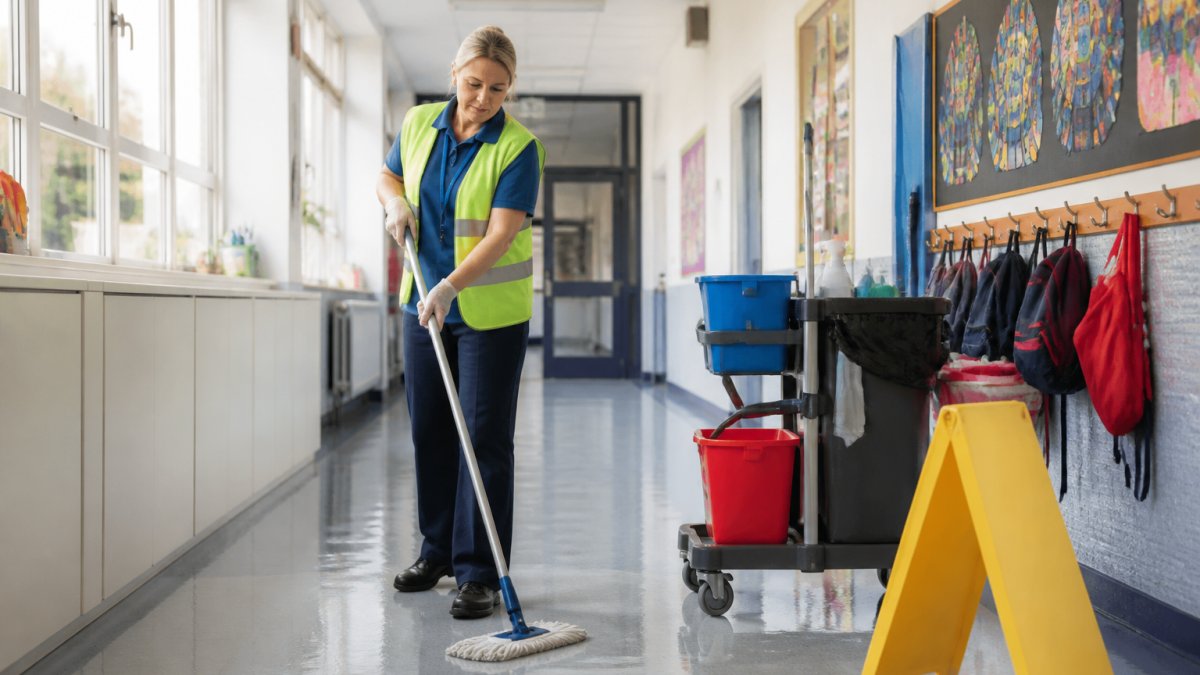
Cleaning staff sickness cover for schools is the single most underrated part of any contract. A school cannot close because a cleaner is off. The site still needs mopping, the bins still need emptying, and parents still walk through the gate at 3:15pm.
What good cover looks like:
- A named contact you ring once, not a call centre queue
- Cover on site the same day for routine cleaning
- A written escalation path for deep cleans and emergencies
- Cover built into the contract, not billed as a surprise extra
Commercial Office Cleaning Wrexham and the Wider Region
Commercial office cleaning in Wrexham and the surrounding area runs on the same operational logic as school cleaning: reliable people, consistent standards, and cover when someone is off. The difference is the specification. Offices need daily touchpoint cleaning, washroom servicing, and periodic deep cleans, often outside working hours.
What keeps quality consistent, in practice:
- A written cleaning specification with frequencies, not a verbal agreement
- Site inspections on a fixed schedule, with findings shared
- One accountable contact who owns the contract
- Cover arrangements documented before the first shift
Walk the site with your provider at the end of month one, not month six. Problems caught early are cheap to fix. Problems caught at the annual review usually mean changing contractor.
Questions to Ask Before Signing with Any Agency
Ask these before you sign, and ask for written answers. Verbal assurances do not survive a change of account manager.
- Who employs the cleaner, you or us?
- What level of DBS check do you run, and can we see the certificate?
- How quickly can you get cover on site for a same-day absence?
- What is the notice period on both sides?
- Who supervises quality, and how often is the site inspected?
- What happens if a worker underperforms or a school asks for a replacement?
- Are there additional charges for cover, deep cleans, or holiday periods?
- Can we move to a fully managed arrangement later without a new contract?
Conclusion
Recruiting and retaining cleaning staff is the part of school and office management that quietly consumes the most time and produces the least thanks. The fix is not working harder at recruitment. It is choosing the right structure: agency supply where you have the capacity to manage, a fully managed service where you do not.
Frequently Asked Questions
What are the benefits of using a recruitment agency for school cleaning staff?
Agencies handle advertising, screening and vetting, which saves school business managers hours of admin. They can fill gaps at short notice and often hold a pool of candidates already checked for school settings. The trade-off is that you still manage rotas, training and performance yourself. A managed service goes further: it takes on recruitment, contracts, supervision and sickness cover, so your site stays clean even when someone calls in sick. Which model suits you depends on how much control you want to keep in-house.
How do I ensure school cleaning staff are DBS checked in the UK?
Ask for the enhanced DBS certificate before anyone starts, and check the certificate matches the role. Cleaning staff working in schools typically need an enhanced check because they have contact with children on site. Confirm the check is registered with the Update Service, or arrange a new one. Keep a record of certificate numbers and renewal dates. Any reputable supplier of DBS checked cleaning staff for schools will provide this documentation as standard, so treat reluctance as a red flag.
What is the difference between a recruitment agency and a managed cleaning service?
A recruitment agency introduces candidates; you employ them, set rotas and cover absences. A managed service employs the cleaning team, supervises standards, manages contracts and provides cover when someone is off sick. For schools, the managed route removes the daily admin burden and the risk of an empty site when a cleaner calls in. It also means one point of contact for quality issues rather than chasing individual staff. Cost structures differ, so ask for a full breakdown before deciding.
How can schools manage staff shortages in cleaning departments?
Shortages hit hardest at short notice. Build a contingency plan before you need it: keep a list of vetted cover staff, agree a call-out process with your supplier, and cross-train caretaking staff on basic cleaning tasks. Where shortages are persistent, a managed service with guaranteed sickness cover removes the problem entirely. Ask any provider how quickly they can get someone on site and what happens if they cannot. Get that commitment in writing.