

Table of Contents
- Why Offices Switch From Spotless Clean
- Commercial Office Cleaning Services: What Sets Providers Apart
- Managed Cleaning Service Benefits: Beyond Standard Contracts
- How to Choose a Commercial Cleaning Company
- Spotless Clean Alternatives Compared
- Common Mistakes When Switching Cleaning Providers
- Frequently Asked Questions
Last Updated: 21 September 2026
Why Offices Switch From Spotless Clean
When a cleaning provider isn’t delivering, the problem usually isn’t the service itself, it’s misalignment between what you need and what they’re actually set up to do. Spotless Clean alternatives for offices exist because businesses outgrow their current arrangements or discover their provider can’t scale with demand.
The real friction points emerge over time. A provider might excel at routine cleaning but struggle when you need emergency cover. They might handle standard contracts well but balk at flexibility. Or they simply can’t staff reliably, leaving gaps when someone calls in sick.
At Nirvana Managed Services LTD, we work with facilities managers and operations teams who’ve hit these walls. The common thread: they needed more than a cleaning company. They needed a partner who could manage recruitment, provide contingency cover, and adapt to changing requirements without renegotiation every quarter.
Understanding what separates one provider from another helps you avoid switching to something equally frustrating.
Commercial Office Cleaning Services: What Sets Providers Apart
Professional office cleaning isn’t one-size-fits-all. The difference between a basic cleaning contractor and a managed service provider often comes down to three factors: reliability, quality consistency, and adaptability.
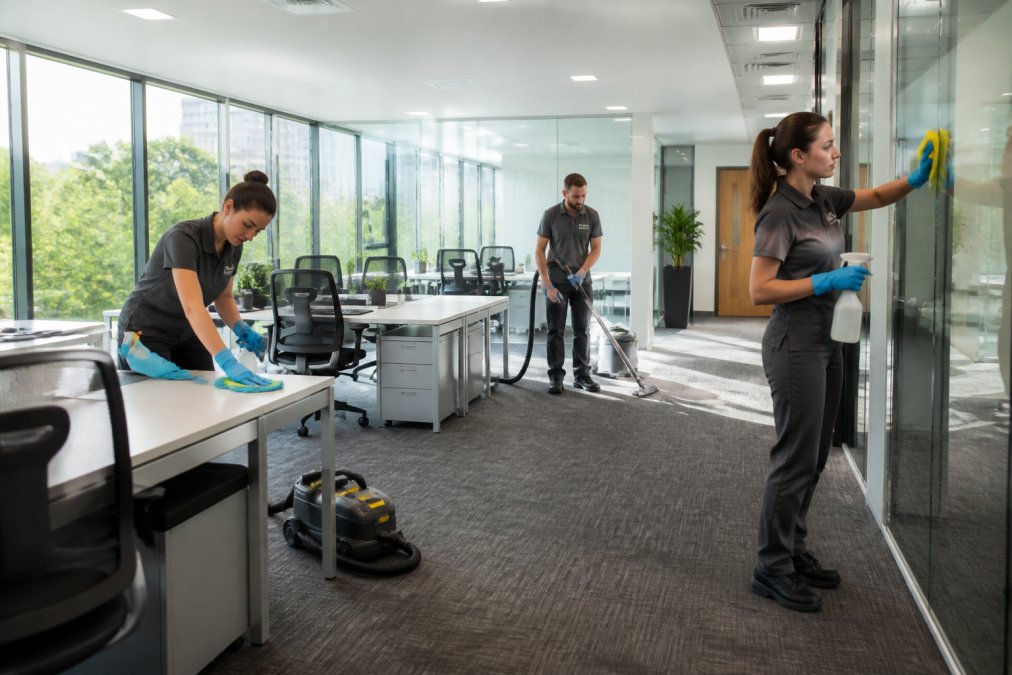
Basic cleaning contractors typically handle scheduled tasks: vacuuming, desk sanitising, bin emptying. They work to a fixed schedule and a set scope. When your needs shift, more frequent cleaning, different areas, emergency cover, the friction begins.
Managed cleaning service providers operate differently. They take on broader responsibility: staffing continuity, quality auditing, scheduling flexibility, and often recruitment support. This matters for commercial offices where disruption costs money and affects your professional image.
The best providers also build in redundancy. If a cleaner calls in sick, they have someone ready to cover. If you need extra attention on high-traffic areas before a client visit, they can adjust. If regulations change or you move to a new space, they adapt the contract without treating it like a new negotiation.
Managed Cleaning Service Benefits: Beyond Standard Contracts
Switching to a managed service model changes what you get, not just who delivers it. The benefits extend beyond cleanliness into operational efficiency and risk reduction.
Staffing continuity becomes someone else’s problem. Rather than managing recruitment, induction, and cover arrangements yourself, the provider carries that load. When someone doesn’t show up, they send a replacement. You don’t scramble.
Quality consistency improves through structured oversight. Managed providers use checklists, audits, and client feedback loops. They track performance and adjust. A basic contractor might clean the same way every week regardless of feedback; a managed provider treats feedback as operational data.
Cost predictability matters more than you’d think. With recruitment and staffing handled externally, you avoid the hidden costs of turnover, training, and gaps. Your budget becomes clearer because contingencies are built in, not treated as emergencies.
Flexibility without penalty is where managed services shine. Need cleaning twice weekly instead of once? Need a deep clean before an event? Need temporary cover while your team is on leave? A managed provider has the infrastructure to absorb these requests without treating them as exceptions that trigger extra fees or delays.
Compliance and standards are managed proactively. Whether it’s health and safety documentation, staff training records, or industry-specific requirements, a managed provider maintains these as part of their service, not as your responsibility.
How to Choose a Commercial Cleaning Company
Selecting the right provider requires clarity on what matters most to your operation. Not every business needs the same thing, and not every provider is equipped for every scenario.
Reliability and Response Time
This is where most switching decisions begin. You need someone who shows up, and when they can’t, someone else does.
Ask potential providers: what’s their contingency process? How quickly can they deploy cover? Do they have a dedicated pool of backup staff, or do they scramble each time?
Check their track record with existing clients on this specific point. Ask for references and ask directly: “Have they ever let you down on coverage?” Most will admit minor hiccups, but patterns matter. Consistent failures suggest weak systems.
Response time also applies to communication. If you report an issue, how quickly do they acknowledge it and propose a fix? Do you have a dedicated contact, or are you cycling through a call centre?
Quality Control and Standards
Cleanliness is subjective until you define it. The best providers document standards in writing: which surfaces get cleaned daily, which weekly, what products are used, how often equipment is replaced.
Ask to see their quality checklist. A professional provider will have one. It should be specific: “vacuum all carpeted areas” is vague; “vacuum all carpeted areas using HEPA filtration, twice weekly, with documented completion times” is operational.
Audit frequency matters too. How often does a supervisor inspect the work? Weekly? Monthly? Do they use client feedback to adjust standards, or do they assume one checklist fits all spaces?
Flexibility and Scalability
Your needs will change. Your office might expand, you might relocate, you might need seasonal adjustments. A provider locked into rigid contracts becomes a problem.
Ask: can you adjust frequency without renegotiating the entire contract? Can you add services, window cleaning, carpet deep clean, specialist sanitising, without switching providers? If you need temporary additional cleaning for a special event, can they accommodate it?
Scalability also applies to growth. If you add another building or expand your team, can this provider scale with you, or will you outgrow them quickly?
Spotless Clean Alternatives Compared
The market offers several approaches to commercial office cleaning. Understanding the differences helps you pick the model that fits your operation.
Full-Service Managed Providers
These are companies that take end-to-end responsibility for cleaning operations. They handle staffing, scheduling, quality control, and contingency cover.
Nirvana Managed Services LTD operates in this category. The service covers recruitment for cleaning and caretaking staff, fully managed delivery with contract management, and cover arrangements when your team is absent. For commercial office cleaning, this means you outsource the entire function, staffing decisions, quality oversight, and continuity, to a single partner.
The advantage is simplicity: one contract, one relationship, one point of accountability. If cleaning standards slip, you escalate to one provider who’s responsible for fixing it. If you need cover, you contact one number. If you need to scale, you negotiate with one partner.
Best for: Facilities managers who want to outsource the entire function, schools managing multiple caretaking roles, offices that value single-point accountability over shopping around.
Recruitment and Staffing Solutions
Some providers focus on filling your team with candidates rather than delivering the service themselves. You hire and manage; they source and vet.
This model works if you have the internal capacity to manage staff, scheduling, quality oversight, cover arrangements, performance management. The provider’s role is narrower: find good candidates, handle onboarding paperwork, manage replacements if someone leaves.
The advantage is control. You keep direct management of your cleaning team. The disadvantage is responsibility: staffing gaps, quality issues, and cover arrangements remain your problem.
Best for: Organisations with strong HR functions and the capacity to manage cleaning staff as part of their broader team.
Software-Enabled Cleaning Operations
Tools like Jobber, FieldVibe, and Fieldtics help cleaning businesses and facilities teams manage operations more efficiently. These platforms handle scheduling, dispatch, client communication, and performance tracking.
Jobber is designed for growing commercial cleaning companies. It automates scheduling and dispatching, integrates with accounting software, and provides real-time job tracking. The interface is polished, and integration capabilities are strong. For larger operations, it scales well, though costs increase with complexity.
FieldVibe suits smaller operations or solo cleaners. It’s freemium, so you can start with no cost. The drag-and-drop scheduling is intuitive, and SMS reminders keep staff and clients aligned. The trade-off is limited enterprise reporting, which matters less for small teams.
Fieldtics emphasises analytics and quality control. It tracks staff performance, integrates payroll, and includes quality checklists for inspections. It’s more complex to set up than competitors, but the depth of operational insight appeals to data-driven cleaning businesses.
These tools don’t replace a cleaning provider, they’re operational infrastructure that a provider uses. If you’re evaluating a provider, ask which tools they use. Good providers invest in software to improve reliability and quality.
| Provider Type | Staffing | Quality Control | Contingency Cover | Contract Flexibility |
|---|---|---|---|---|
| Full-Service Managed | Provider handles | Built-in audits | Guaranteed | High |
| Recruitment & Staffing | You manage | Your responsibility | Your responsibility | Medium |
| Software-Enabled | Varies by provider | Depends on provider | Depends on provider | Depends on provider |
Common Mistakes When Switching Cleaning Providers
Most switching decisions fail not because the new provider is bad, but because the transition wasn’t managed well or expectations weren’t aligned.
Assuming price is the only variable.
Frequently Asked Questions
What should I look for when choosing a commercial cleaning company?
Prioritise reliability, response times for emergencies, and quality control systems. Check whether they offer flexibility to scale services up or down based on your needs, provide trained and vetted staff, and have experience with office environments similar to yours. Ask about their approach to handling staff absences and whether they offer cover arrangements. Request references from existing clients and clarify what’s included in their service agreement.
How does a managed cleaning service differ from a standard cleaning contract?
A managed cleaning service typically includes staff recruitment, training, performance monitoring, and contingency cover when your team is absent. Standard contracts focus solely on delivering cleaning tasks. Managed services handle the operational headaches: hiring, payroll integration, quality audits, and emergency replacements. This approach suits organisations lacking in-house recruitment capacity or struggling with staff turnover in soft services roles.
What are the benefits of using a local managed service provider for office cleaning?
Providers who operate locally can often offer a more personalised service, understanding the specific needs of your facility and building stronger relationships with your team. They may also be able to respond more quickly to urgent requests and adapt to bespoke service arrangements.
How can I ensure consistent cleaning standards when switching providers?
Establish a detailed service specification upfront, including frequency, areas to be cleaned, and quality benchmarks. Request a probationary period with scheduled quality audits. Ensure the new provider uses checklists or inspection systems to verify standards at each visit. Schedule regular review meetings and maintain open communication channels. Ask whether they offer performance guarantees or service credits if standards slip, and confirm their process for addressing complaints quickly.