Last Updated: November 25, 2026
Quick Summary
Choose water saving equipment by matching machine type to each floor: scrubber dryers for hard floors, sweepers to remove grit first, and microfibre systems to cut detergent. Confirm solution use per square metre and calculate payback on water, chemical and labour savings before buying.
- Count floor types, measure open areas and check water and power access before specifying any machine.
- Microfibre mops clean with a fraction of the solution a traditional string mop needs.
- Labour is typically 60-75% of floorcare cost, so fewer passes drives the biggest saving.
- Ask each supplier for a five-year total cost of ownership schedule, not just a quotation.
- Match machine capacity to actual cleaning hours, because an underused machine saves nothing.
Table of Contents
- Why Water Saving Equipment Cuts Cleaning Costs
- Matching Water Saving Equipment to Your Building
- Commercial Floor Cleaning Machines Compared
- How Microfibre Cleaning Systems Reduce Detergent and Water
- Working Out Water Use and Payback Before You Buy
- Your Cleaning Equipment Maintenance Checklist
- Sourcing and Servicing Equipment Around Chester and Wrexham
- Book a Site Survey for Your Chester or Wrexham Building
- Frequently Asked Questions
Why Water Saving Equipment Cuts Cleaning Costs
Water saving equipment is cleaning machinery and systems designed to deliver the same cleaning result using less water, less detergent and less energy.
The saving comes from three places at once. A machine that doses water precisely uses less of it. Less water means less detergent, because dosing is tied to volume. And modern machines recover more soil per pass, so operatives make fewer passes over the same floor.
That last point is the one most buying guides miss. Labour is usually the largest line in any cleaning budget, so a machine that cuts passes cuts the biggest cost of all.
Below, we set out how to match equipment to your building, compare the main machine types, and work out payback before you commit.
Matching Water Saving Equipment to Your Building
The right specification starts with a walk-round, not a catalogue. Count the floor types, measure the open areas, and note where water and power are available.
Hard floors, carpet and washroom areas
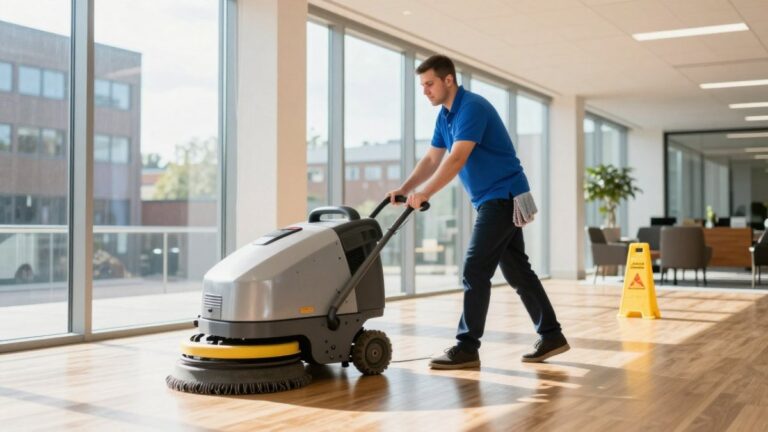
Hard floors in entrance halls and corridors need a scrubber dryer or a low-moisture mopping system.
Entrance matting deserves an early mention. Good matting captures soil before it reaches the floor, which reduces the cleaning load everywhere else.
Washroom hygiene is where water saving and user safety meet. Modern washroom systems use sensor-controlled taps and dual or multiple flushing volumes, so water is only delivered when needed.
Commercial Floor Cleaning Machines Compared
Commercial floor cleaning machines fall into three broad groups: scrubber dryers, sweepers and robotic units. Each saves water in a different way, and each suits a different building.
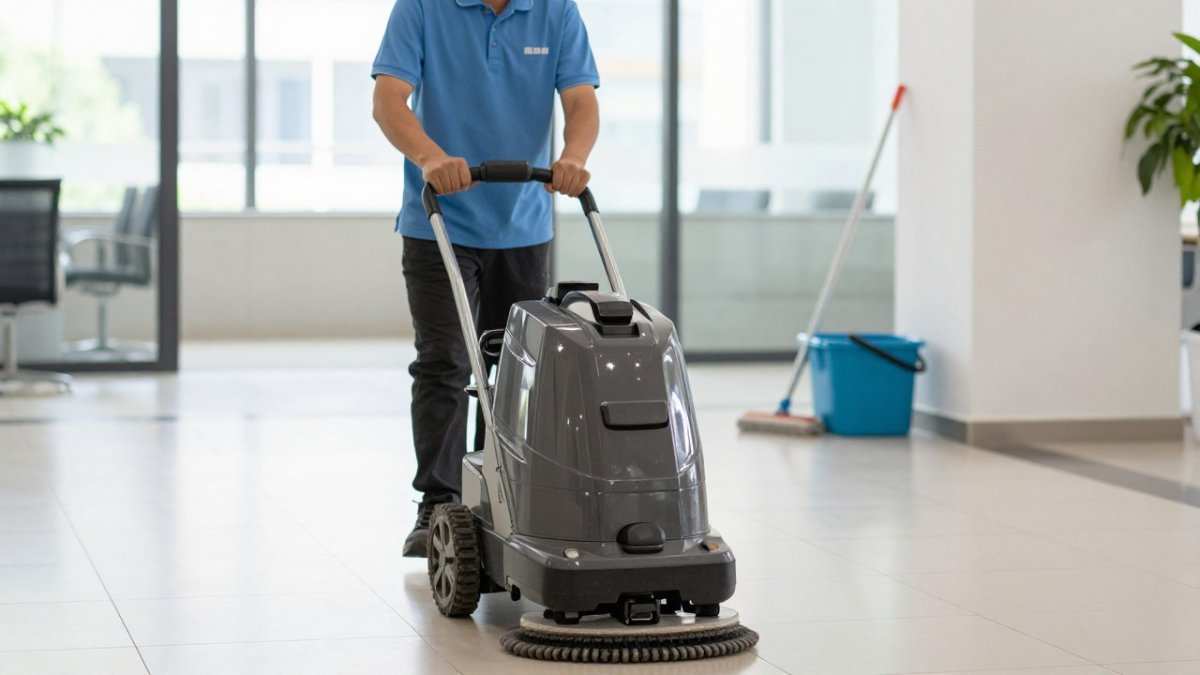
Scrubber dryers clean and dry in a single pass.
Sweepers collect dry debris before any wet cleaning happens.
Robotic units run pre-programmed routes, often outside core hours. They use tightly controlled solution volumes and remove the variability that comes from operator technique.
| Machine type | Best for | Main advantage | Main limitation |
|---|---|---|---|
| Walk-behind scrubber dryer | Corridors, smaller rooms | One-pass clean and dry | Slower on large areas |
| Ride-on scrubber dryer | Large open floors | High output per hour | Higher upfront cost |
| Sweeper | Entrance areas, car parks | Removes grit before washing | Dry use only |
| Robotic unit | Repeatable routes, out of hours | Consistent dosing | Needs a clear route plan |
For a wider view of what commercial facilities need beyond floorcare, our guide to essential cleaning equipment for commercial facilities covers the full kit list.
How Microfibre Cleaning Systems Reduce Detergent and Water
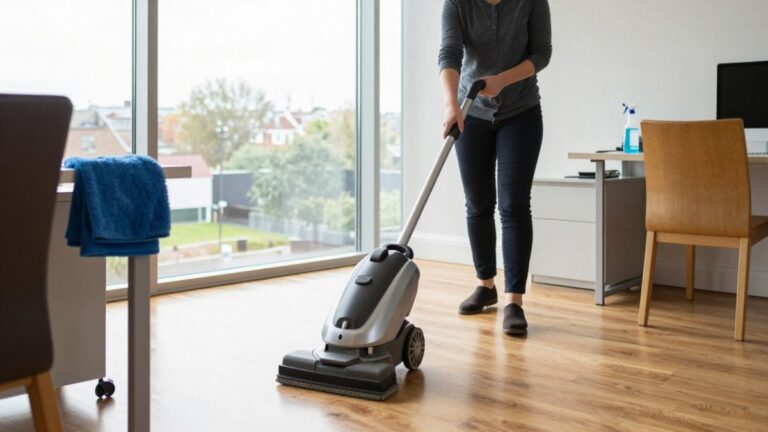
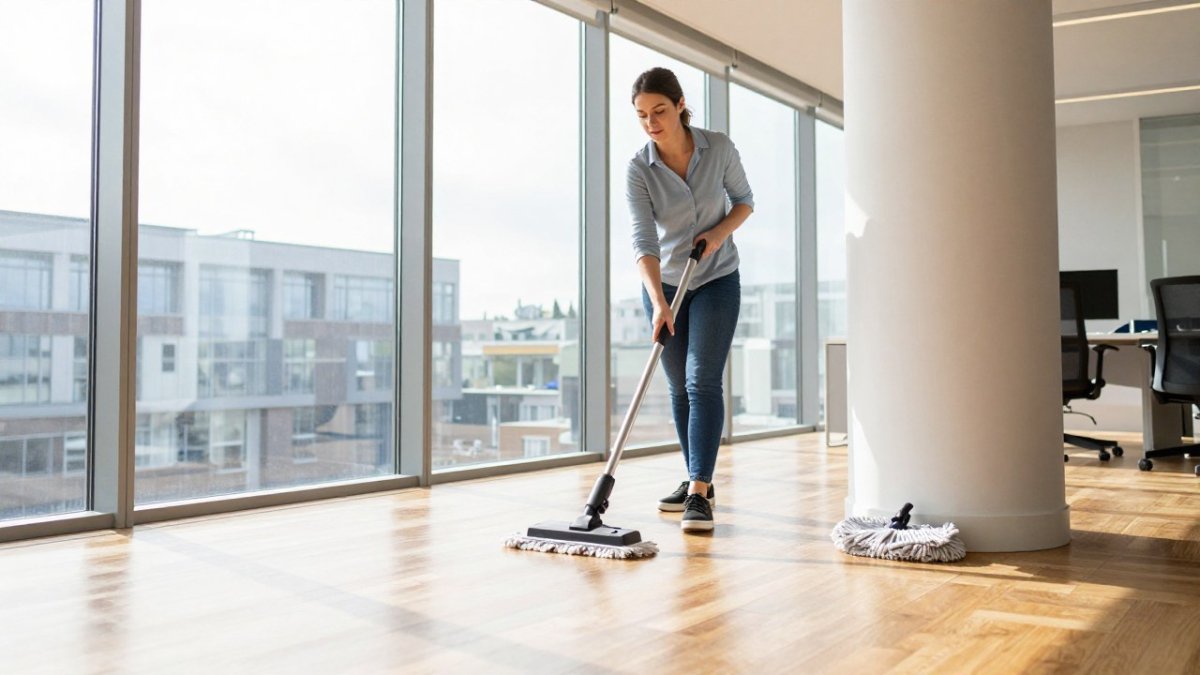
Microfibre cleaning systems use split-fibre cloths and mops that lift soil mechanically rather than chemically.
In practice, this means a microfibre mop can clean a floor with a fraction of the solution a traditional string mop would need.
Microfibre also supports colour-coded systems, which reduce cross-contamination between washrooms and food areas. That matters for hygiene and user safety as much as for cost.
If you are weighing up low-water methods against wider sustainability goals, our article on green cleaning products and their benefits explains what to look for. For practical sustainable cleaning guidance that builds on this section, see how small sites can clean more sustainably.
Working Out Water Use and Payback Before You Buy
Payback is a simple calculation, and most buyers skip it. The gap in most buying guides is that they talk about sustainability without putting a number on it. Here is a worked method you can apply to your own building in Chester or Wrexham.
Step 1: Establish your baseline
Before you shortlist any machine, pull twelve months of metered water bills and chemical invoices for the building. Divide total water spend by floor area cleaned to get a cost per square metre. Do the same for chemical spend. Then estimate operative hours spent on floorcare per week and multiply by the loaded hourly rate (wage plus employer National Insurance and pension contributions).
Step 2: Estimate the new figures
A high-efficiency scrubber dryer typically uses less solution per square metre than mop-and-bucket methods because it applies, scrubs and recovers in one pass.
For labour, the saving comes from fewer passes. If a scrubber dryer replaces a two-pass mop-and-dry routine with a single pass, the time saving is roughly half the floorcare hours, though real-world figures vary with obstructions and operator skill.
Step 3: Calculate payback
Use this formula:
Payback (years) = Purchase price ÷ Annual saving
Where annual saving = (current water + chemical + labour cost per year) − (new water + chemical + labour cost per year) − annual maintenance and consumables.
A common pattern is that the labour saving alone justifies the machine within two to three years on a building with more than 500 square metres of hard floor. On smaller sites, the water and chemical savings may not cover the capital outlay, and hire or shared-use arrangements can make more sense.
Step 4: Build total cost of ownership
The sticker price is not the cost. Total cost of ownership over the machine’s service life includes:
- Purchase price or hire charges
- Delivery, installation and commissioning
- Operator training
Ask each supplier for a five-year cost schedule, not just a quotation. A cheaper machine with expensive consumables and slow parts availability can cost more over its life than a higher-specification unit with local support.
Step 5: Be honest about utilisation
A machine that sits idle saves nothing. If your building is cleaned five nights a week for four hours, a ride-on scrubber dryer sized for eight-hour shifts will be underused and its payback will stretch.
Watch out: a supplier’s quoted water saving is often based on ideal conditions. Ask for the figure per square metre at your soil level, and check whether the machine recovers solution effectively, a scrubber dryer that leaves water behind forces a second pass and wipes out the saving.
Your Cleaning Equipment Maintenance Checklist
A machine that is not maintained will not save water. Blocked filters, worn squeegee blades and scaled heating elements all increase consumption and reduce cleaning performance.
- Rinse solution and recovery tanks at the end of every shift
- Check squeegee blades weekly for nicks and wear
- Clean filters and strainers weekly
Watch out: a dripping coupling or a worn squeegee looks trivial but leaves water on the floor, which is a slip risk and a waste. Fix it the same week.
Sourcing and Servicing Equipment Around Chester and Wrexham
Sourcing locally shortens downtime. A machine that needs a part is unproductive until the part arrives, so delivery, installation and servicing arrangements matter as much as the specification. For buyers in Chester and Wrexham, the practical question is not just who sells the machine but who can get to your building when it stops working. Our guide to eco-friendly cleaning practices in Chester sets out practices relevant to local suppliers and servicing.
What local sourcing actually buys you
A supplier with engineers covering both Chester and Wrexham gives you one point of contact across sites and a shorter response window. Ask each supplier to state, in writing:
- The response time for a breakdown call-out, and whether that is a target or a contractual commitment
- Whether engineers are employed directly or subcontracted
- Which consumables and spare parts are held locally versus ordered in
- Whether installation and commissioning are included or charged separately
A common pattern is that national suppliers quote a lower purchase price but route service through a regional depot, which adds days to a repair. For a building with a single scrubber dryer, two days of downtime can mean floors go unwashed or staff revert to mop-and-bucket, undoing the water saving you paid for.
Delivery and access in Chester and Wrexham
Chester’s city centre has restricted access and loading constraints in parts of the historic core, and Wrexham’s industrial estates and retail parks have different access profiles. Before ordering, confirm the machine’s dimensions against your doorways, lifts and storage space. A ride-on scrubber dryer that will not fit through the service entrance is an expensive mistake. Ask the supplier to carry out a site access check as part of the quotation.
Procurement and budgeting
Most commercial buyers in Chester and Wrexham procure cleaning equipment through one of three routes: outright purchase, lease or hire, or a managed cleaning contract that includes equipment. Each has a different cash-flow profile. Outright purchase ties up capital but gives the lowest total cost over a long service life. Lease or hire spreads the cost and can include servicing, which suits businesses that want predictable monthly outgoings.
When comparing quotations, ask for the five-year total cost of ownership, not the invoice price. Include consumables, servicing, downtime risk and disposal. A supplier who cannot provide that schedule is not giving you a like-for-like comparison.
Servicing arrangements that protect the saving
A wrongly commissioned machine will run at the wrong dose from day one, so commissioning should include a dose verification and a walk-through with the operative who will use it.
For businesses comparing managed arrangements, our office cleaning contracts for Wrexham businesses set out what a managed service includes, and our guide to essential cleaning equipment for commercial facilities covers the wider kit list beyond floorcare.
Best for: buyers who want installation, training and servicing from one supplier covering both Chester and Wrexham.
Skip if: you have in-house engineering that can handle commissioning and repairs and can source parts directly.
Book a Site Survey for Your Chester or Wrexham Building
A site survey turns this guidance into a specification.
At Nirvana Managed Services LTD, we manage commercial cleaning for offices and provide cover when a member of your team is absent, so standards hold even on difficult days.
If you are comparing options for your building, our office cleaning contracts for Wrexham businesses set out what a managed arrangement includes.
Water and chemical savings only materialise when equipment, training and maintenance line up.
Frequently Asked Questions
What cleaning equipment helps reduce water use in commercial offices?
Scrubber dryers with variable flow control, microfibre flat mops and trigger-controlled spray systems all cut water use compared with traditional string mops and buckets. A scrubber dryer recirculates cleaning solution and vacuums it back up, so you use one tank fill for a much larger floor area. Microfibre mops need only a light dampening rather than soaking. Ask suppliers to show litres-per-hour figures for each machine so you can compare like for like before committing to a purchase or lease.
Are microfibre cleaning systems effective for commercial cleaning?
Microfibre works well on most hard surfaces and glass because the split fibres lift soil rather than just pushing it around. In practice, teams often use colour-coded microfibre cloths and flat mops for daily office cleaning, reserving heavier mechanical scrubber dryers for large hard floors and entrances. The main gain is reduced detergent and water per task, plus faster drying times. Effectiveness depends on laundering the cloths properly between shifts, so factor in a laundry cycle when you plan your equipment.
How can cleaning teams measure water use?
Start with a simple log: record tank capacity, number of refills per shift and the floor area cleaned. Over a fortnight you can calculate litres per square metre for each machine or method. Compare that against detergent dosing records and the time taken. Once you have a baseline, set a target reduction and review it monthly. A cleaning equipment maintenance checklist should include checking flow settings and filters, because a blocked filter or a worn valve will quietly push water use back up.
How often should commercial cleaning equipment be maintained?
Daily checks cover emptying and rinsing tanks, clearing debris from brushes and squeegees, and confirming battery charge. Weekly tasks include cleaning filters, checking hoses and inspecting squeegee blades for wear. Monthly, review dosing systems and flow rates, and book a service visit for scrubber dryers and any powered machinery. Keep a written cleaning equipment maintenance checklist on site so operatives sign off each task. A machine running with a worn squeegee leaves streaks and forces repeat passes, which wastes both water and time.