Last Updated: 25 October 2026
Quick Summary
Best practices for office hygiene and maintenance form the backbone of a professional workplace, requiring daily cleaning of high-touch surfaces and toilets, weekly deep-clean of floors and surfaces, and monthly maintenance of specialist areas. A strong cleaning checklist, clear responsibility assignment, and regular audits ensure consistent standards that protect staff health and signal professionalism to clients.
- Daily high-touch surface cleaning should happen at predictable times, ideally early morning and mid-afternoon when traffic peaks
- High-traffic commercial office spaces with large visitor volumes may need twice-daily toilet servicing and more frequent floor maintenance
- Health and Safety at Work etc. Act 1974 requires workplaces to be kept clean and safe under law
- Managed cleaning services provide consistent standards without managing cleaners directly, with trial periods of 4-8 weeks recommended
- Weekly review meetings with the cleaning team dramatically improve consistency and prevent the failures that sink cleaning standards
Table of Contents
- Why office hygiene and maintenance standards matter
- Creating an office cleaning checklist that covers all areas
- Determining office cleaning frequency for your workplace
- Using an office cleaning schedule template to stay organised
- Commercial office cleaning standards and compliance
- Common hygiene maintenance mistakes to avoid
- Outsourcing office hygiene and maintenance to professionals
- Frequently Asked Questions
Why office hygiene and maintenance standards matter
Following best practices for office hygiene and maintenance forms the backbone of a professional workplace. When standards slip, the consequences ripple across productivity, employee wellbeing, and your business reputation.
A workspace that’s visibly clean signals competence to clients, partners, and staff. High-touch surfaces, door handles, light switches, shared keyboards, become vectors for illness when neglected. Beyond health, the condition of your office directly influences how your team performs. Research from leading workplace health organisations shows that employees in clean, well-maintained environments report higher engagement and fewer sick days.
The real challenge isn’t understanding why standards matter. It’s maintaining them consistently when staffing pressures mount, budgets tighten, and priorities shift. This is where many facilities managers stumble: they create ambitious cleaning schedules that collapse under real-world pressure, or they outsource without proper oversight and standards drift silently.
Creating an office cleaning checklist that covers all areas
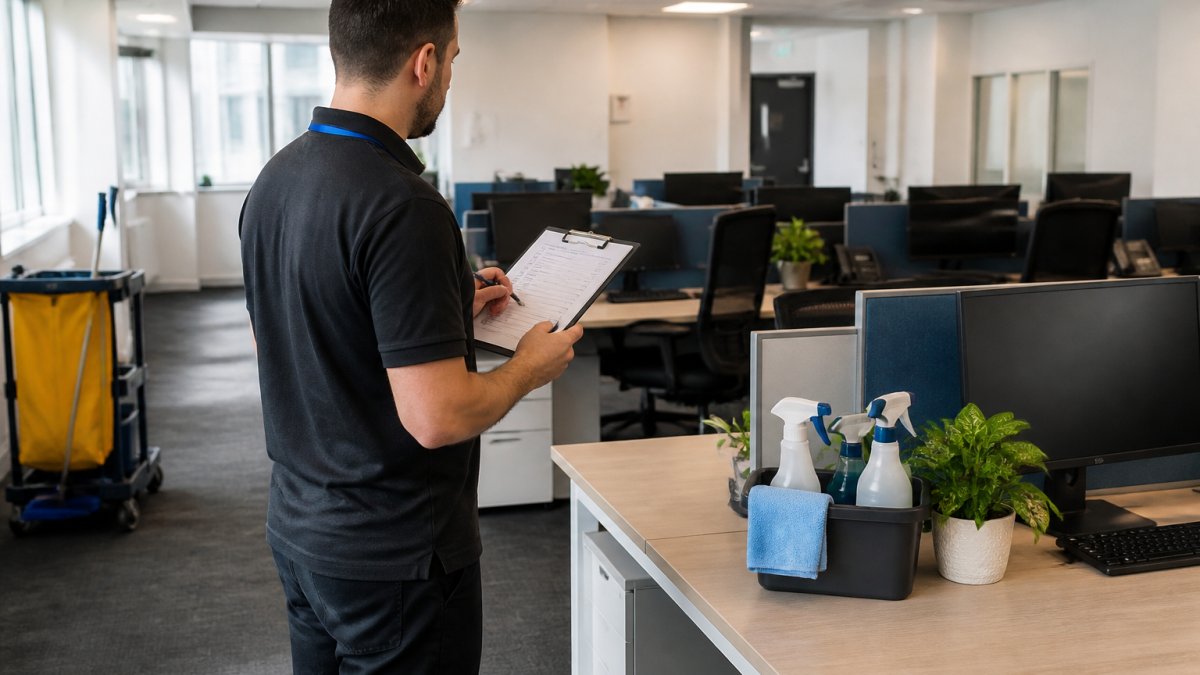
A strong office cleaning checklist is your operational blueprint. Without one, cleaning becomes reactive and inconsistent. With one, your team knows exactly what needs doing, when, and to what standard.
Start by mapping your physical space. List every area: reception, corridors, toilets, kitchens, individual desks, meeting rooms, stairwells. Then identify what each space requires. Reception needs daily attention because it’s high-traffic and client-facing. Toilets need multiple cleans per day. Kitchens need daily deep-clean protocols to prevent pest issues and cross-contamination.
The most effective checklists separate tasks by frequency and criticality. Daily tasks are non-negotiable; weekly tasks prevent buildup; monthly tasks address deeper maintenance. Your checklist should specify not just what to clean, but how, the product to use, the technique, the time allocation.
High-touch surfaces and daily priorities
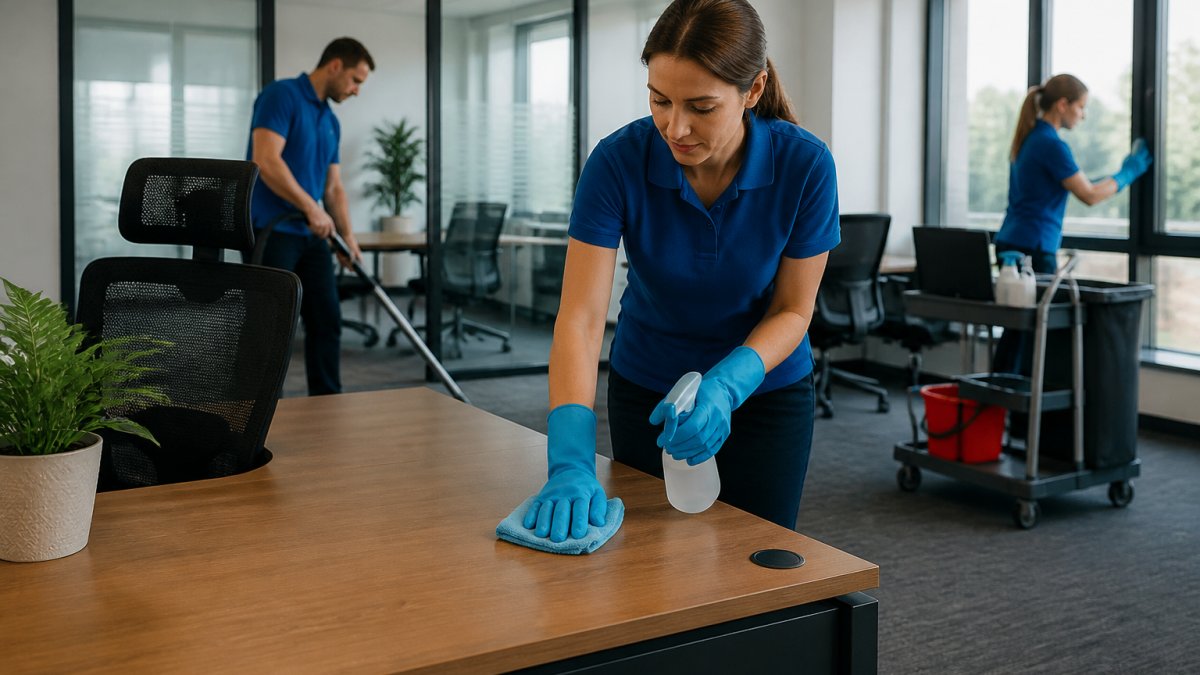
High-touch surfaces are where contamination concentrates. Door handles, light switches, lift buttons, shared keyboards, and meeting room tables demand daily attention. These surfaces see dozens of hands per day and are proven transmission points for illness.
Daily high-touch surface cleaning should happen at predictable times, ideally early morning before staff arrive, and mid-afternoon when traffic peaks. Use appropriate disinfectants according to your workplace risk assessment. For most office environments, a neutral detergent followed by a disinfectant is sufficient. In healthcare or food-adjacent settings, stronger protocols apply.
Your checklist should name each surface category and specify the cleaning agent. Vague instructions like “sanitise common areas” fail. Specific ones succeed: “Door handles in reception: spray with approved disinfectant, wipe with clean cloth, repeat at 09:00 and 15:00.”
Weekly and monthly deep-clean tasks
Weekly tasks address surfaces that don’t need daily attention but deteriorate quickly without regular care. Carpeted areas benefit from vacuuming weekly; hard floors need deep scrubbing. Walls, skirting boards, and light fittings accumulate dust and require attention. Upholstered furniture in waiting areas or staff rooms needs vacuuming.
Monthly tasks are deeper interventions. Window cleaning, blind dusting, carpet shampooing in high-traffic zones, and deep-clean of kitchen appliances fall here. Many facilities schedule these for quieter periods, often Friday afternoons or outside core business hours, to minimise disruption.
Adhering to best practices for office hygiene and maintenance through well-structured monthly tasks prevents the slow decline that leads to crisis-level cleaning. If you wait until carpet looks visibly dirty or windows are opaque, you’ve already lost client confidence.
Determining office cleaning frequency for your workplace
Cleaning frequency depends on several variables: office size, staff numbers, client footfall, industry sector, and current health considerations. A small Chester-based accounting firm has different needs than a busy medical practice or a large corporate office.
The baseline for most office environments is daily cleaning of high-touch surfaces and toilets, weekly deep-clean of floors and surfaces, and monthly maintenance of specialist areas. But this isn’t universal.
High-traffic commercial office spaces with large visitor volumes may need twice-daily toilet servicing and more frequent floor maintenance. Smaller offices with stable staff and rare visitors might operate effectively on a reduced schedule. The key is matching frequency to actual usage and risk.
Consider seasonal factors too. Winter months see increased illness transmission, which may justify more frequent disinfection protocols. Summer brings different challenges, dust, pollen, and higher temperatures affecting cleaning product efficacy.
Your facilities team should audit actual cleaning needs monthly. Are certain areas showing visible wear? Are staff complaints rising? Are illness absence rates climbing? These signals indicate frequency needs adjustment.
Using an office cleaning schedule template to stay organised
A cleaning schedule template transforms good intentions into consistent execution. The template should be visual, accessible to all staff, and updated in real time.
A simple template includes columns for: area, task, frequency, responsible person, time allocation, and completion sign-off. You might add a column for “completed by” and “verified by” to ensure accountability.
Digital templates, spreadsheets or dedicated facilities management software, offer advantages over paper. They send automatic reminders, flag overdue tasks, and create audit trails. Paper-based systems work for very small teams but become unreliable as staff numbers grow.
Assigning responsibilities and tracking completion
Clarity on who owns each task prevents the “I thought you were doing that” failures that sink cleaning standards. Assign tasks to specific people or roles, not vague groups. “Reception team” is unclear; “Sarah, Monday-Friday 08:00” is not.
Track completion through sign-off. A simple checkbox or timestamp proves the task happened. This matters not just for accountability, it creates evidence for compliance and shows you’re taking standards seriously.
For offices with multiple cleaners or shifts, handover documentation is critical. If the morning team cleans reception and the afternoon team cleans offices, both need to know what the other did. A shared log prevents duplication and gaps.
Many facilities managers find that weekly review meetings, 15 minutes with the cleaning team, dramatically improve consistency. Staff can flag problems, ask clarifications, and feel their work is valued.
Commercial office cleaning standards and compliance
Commercial office cleaning operates within a framework of standards and expectations. Understanding these prevents costly oversights and protects your business.
Health and Safety at Work etc. Act 1974 requires workplaces to be kept clean and safe.
Beyond legal minimums, many sectors have specific standards. Healthcare settings follow stricter infection control protocols. Food-adjacent offices require pest-prevention measures. Client-facing spaces have implicit appearance standards that affect business reputation.
The best approach is to define your own standards, in writing, based on your sector, client expectations, and staff needs. Document what “clean” means for each area.
Health and Safety Executive guidance on workplace cleanliness provides the regulatory framework. Use this as your baseline, then add industry-specific requirements.
For offices using outsourced cleaning services, written standards become your contract foundation. Service providers need clarity on what they’re delivering. Vague expectations lead to disappointment; specific standards lead to consistent results.
Explore how to maintain cleaning standards in offices for practical guidance on implementation and monitoring.
Common hygiene maintenance mistakes to avoid
Most office cleaning failures follow predictable patterns. Recognising them helps you avoid costly missteps.
The first mistake is assuming cleaning will happen without a system. Busy teams deprioritise cleaning when there’s no schedule and no accountability.
The second mistake is using the wrong products for the job. Not all disinfectants work on all surfaces. Some damage electronics; others are ineffective against certain pathogens.
The third mistake is neglecting high-touch surfaces while obsessing over visible dirt. A sparkling floor means nothing if door handles are contaminated. Prioritise transmission vectors over aesthetics.
The fourth mistake is cleaning without a documented standard. If you can’t describe what “clean” means, you can’t measure it or hold anyone accountable. Staff interpret standards differently, leading to inconsistency.
The fifth mistake is outsourcing without oversight. Contractor-managed cleaning often deteriorates over time as initial enthusiasm wanes and supervision lapses. Regular audits and clear performance expectations prevent this.
Watch out: Mixing cleaning products, especially bleach with ammonia-based cleaners, creates toxic fumes. Train staff on safe product handling and storage.
Outsourcing office hygiene and maintenance to professionals
When internal staffing capacity fails, whether through recruitment difficulties, unexpected absences, or workload peaks, outsourcing becomes necessary.
Managed office cleaning services handle day-to-day cleaning and maintenance under contract. This approach suits businesses that want consistent standards without managing cleaners directly.
The critical decision is choosing a provider who understands your standards and can deliver consistently.
Nirvana Managed Services LTD offers managed cleaning services for commercial offices, handling everything from daily surface cleaning to scheduled deep-cleans.
When evaluating providers, ask for references from similar-sized businesses in your area. Ask how they handle absence cover, this is where many contractors fail.
Learn more about reliable office cleaning cover options and how to choose managed office cleaning providers to guide your decision.
You can also compare managed versus ad-hoc cleaning approaches to determine which model fits your operational needs.
Office hygiene and maintenance standards aren’t optional luxuries, they’re operational foundations. A clean, well-maintained workspace protects staff health, signals professionalism to clients, and reduces costly problems down the line.
Frequently Asked Questions
How often should an office be cleaned in the UK?
Most offices benefit from daily cleaning of high-touch surfaces, communal areas, and washrooms, with weekly deep cleaning of carpets, upholstery, and less-frequently touched zones. The exact frequency depends on foot traffic, number of staff, and industry type. Healthcare settings and food preparation areas require more frequent cleaning than standard office spaces. Your cleaning schedule should reflect your specific workplace needs and any relevant Health and Safety Executive guidance.
What should be included in an office cleaning checklist?
A comprehensive office cleaning checklist covers desks and work surfaces, keyboards and computer equipment, door handles and light switches, washroom facilities, kitchen areas, floors and carpets, waste bins, and communal spaces like meeting rooms and corridors. Daily tasks focus on high-touch points and visible clutter; weekly tasks include deeper cleaning of carpets and upholstery. Seasonal deep cleans should address windows, air vents, and storage areas. Tailor your checklist to your office layout and specific hygiene risks.
How can businesses maintain good hygiene in a shared office?
Establish clear cleaning protocols and assign responsibilities to staff or hire professional cleaners. Supply hand sanitiser, antibacterial wipes, and cleaning products in common areas. Encourage employees to clean their own workstations daily and report spills immediately. Schedule regular deep cleans and monitor compliance with your cleaning schedule. Good ventilation and waste management also reduce hygiene risks. Communication about hygiene expectations helps everyone contribute to a clean workplace.
What is the difference between routine office cleaning and deep cleaning?
Routine cleaning addresses daily maintenance: wiping surfaces, emptying bins, vacuuming high-traffic areas, and cleaning washrooms. Deep cleaning is more thorough and less frequent, involving carpet shampooing, upholstery cleaning, window washing, and cleaning behind and under furniture. Deep cleans typically happen quarterly or bi-annually and tackle areas routine cleaning doesn’t reach. Both are essential: routine cleaning prevents dirt buildup and maintains hygiene standards, while deep cleaning removes embedded dirt and allergens.
When should a business use a commercial office cleaning service?
Consider professional cleaning if your team lacks time, expertise, or resources to maintain standards consistently. Commercial cleaners are ideal when you need daily or frequent cleaning, have large premises, require specialised equipment or training, or want guaranteed compliance with hygiene standards. They’re also valuable for covering absences of in-house staff or managing unexpected cleaning demands.
How can an office manager organise cleaning tasks and responsibilities?
Use a cleaning schedule template to assign daily, weekly, and monthly tasks to specific staff members or teams. Clearly document what each task involves and when it should be completed. Create a simple checklist for accountability and review it regularly. Rotate responsibilities to prevent burnout and ensure everyone understands hygiene standards. Consider colour-coding tasks by frequency or area. If outsourcing, provide your cleaning contractor with a detailed brief and schedule regular quality checks to ensure standards are met consistently.


