
Last Updated: 24 October 2026
Quick Summary
Preventive maintenance is the planned, scheduled inspection and repair of school grounds and outdoor spaces before faults become failures, replacing react-and-repair with a calendar of small, predictable checks. It lowers costs because small faults are cheap to fix and expensive to ignore, and it meets your duty to keep premises safe through recorded, regular checks.
- Walk every path, car park and playground surface each half term, logging trip hazards the day you find them.
- Inspect play equipment weekly during term time and record the result, checking fixings, swing seats and safety surfacing.
- Build your schedule around term dates, with larger jobs run during the summer holidays.
- Carry out outdoor safety checks at three levels: daily visual sweeps, weekly recorded play equipment checks and termly formal inspections.
- Keep a one-page maintenance plan listing each asset, its check frequency and who owns it, reviewed every term.
Table of Contents
- The Real Cost of Reactive Grounds Maintenance
- How Preventive Maintenance Cuts Repair Bills and Safety Risks
- What a School Grounds Maintenance Checklist Should Cover
- Building a School Grounds Maintenance Schedule Around Term Dates
- School Outdoor Safety Checks: What to Look For and How Often
- Using a School Maintenance Plan Template to Stay Consistent
- Bringing in a Managed Service for Grounds and Cleaning
- Next Step: Book a Grounds and Cleaning Review
- Frequently Asked Questions
The Real Cost of Reactive Grounds Maintenance
Most schools do not have a grounds budget. They have a grounds emergency fund, and they spend it one broken gate at a time.
That is the trap with reactive maintenance. Nothing gets fixed until it fails. A path cracks, a fence panel loosens, a drain blocks. Each job arrives as a surprise, so each job gets paid for at the worst possible moment, at short notice, usually at a premium. This guide from Nirvana Managed Services LTD looks at why preventive maintenance for school grounds matters, and how to build a plan that stops the surprises.
Preventive maintenance is the planned, scheduled inspection and repair of grounds and outdoor spaces before faults become failures. It replaces the cycle of react-and-repair with a calendar of small, predictable checks.
The difference shows up in three places:
- Budget: planned work can be quoted and spread across the year
- Safety: hazards get found by staff, not by a child
- Staff time: caretakers stop firefighting and start maintaining
Small schools feel this most. With one caretaker and a tight budget, a single unexpected repair can wipe out a term’s contingency. For a closer look at how small settings manage this, see our guide to school site maintenance for small schools.
How Preventive Maintenance Cuts Repair Bills and Safety Risks
Preventive maintenance lowers costs because small faults are cheap to fix and expensive to ignore. A loose bolt on a climbing frame is a spanner job. The same bolt, left for a term, can mean replacing the frame, closing the area, and answering questions from parents.
The safety side matters more. Schools carry a duty to keep premises safe for pupils, staff and visitors. In practice, that duty is met through recorded, regular checks. A written schedule is your evidence that you looked.
Here is where reactive maintenance quietly drains a school:
- Emergency call-outs cost more than planned visits
- Repeated small repairs shorten the life of equipment and surfaces
- Unplanned closures disrupt PE, playtime and lettings income
- Insurance claims and incident investigations take senior staff time
A common mistake is treating grounds work as something that happens in the summer holidays only. Grounds deteriorate all year. A schedule that runs across all three terms catches problems while they are still small.
What a School Grounds Maintenance Checklist Should Cover
A school grounds maintenance checklist should cover every outdoor area pupils and staff use, with a named person and a frequency against each item. The checklist is the backbone of preventive maintenance: it turns “someone should look at that” into a dated record.
Split it by surface type. Hard areas and play areas fail in different ways and need different eyes.
Hard Surfaces and Paths
Walk every path, car park and playground surface each half term. Look for lifted slabs, potholes, cracked tarmac, blocked drains and slippery patches from moss or algae. Check gate hinges, bollards and markings too.
Watch out: a trip hazard on a school path is the single most common source of playground injury claims. Log it the day you find it, even if the repair waits.
Play Equipment and Sports Areas
Inspect play equipment weekly during term time and record the result. Check for loose fixings, worn swing seats, splintered timber, exposed bolts and damaged safety surfacing under and around equipment. On sports areas, check goal posts are anchored, line markings are intact and drainage is clear.
- Weekly: play equipment visual check, logged and signed
- Half termly: full path and hard surface walk
- Termly: fence line, gates, bins and external lighting
- Annually: full grounds condition survey with photos
Building a School Grounds Maintenance Schedule Around Term Dates
A school grounds maintenance schedule should follow the school year, not the calendar year. Work backwards from the dates that matter: the start of term, Ofsted visits, open days, and the summer break when larger jobs can run without disrupting pupils.
The pattern that works:
- Autumn term: clear drains and gutters before winter rain, cut back summer growth
- Spring term: post-winter inspection of paths, fences and play surfaces
- Summer term: prepare for sports day and end-of-year events, plan holiday works
- Summer holidays: the big jobs, from resurfacing to tree work
- Each half term: the routine checklist walk
Scheduling is only half the battle. Schools also face wider facilities pressures, from staff absence to compliance paperwork, which we cover in our look at school facilities management challenges.
School Outdoor Safety Checks: What to Look For and How Often
School outdoor safety checks should happen at three levels: daily visual sweeps by site staff, weekly recorded checks of play equipment, and termly formal inspections of the whole site. Each level catches different problems.
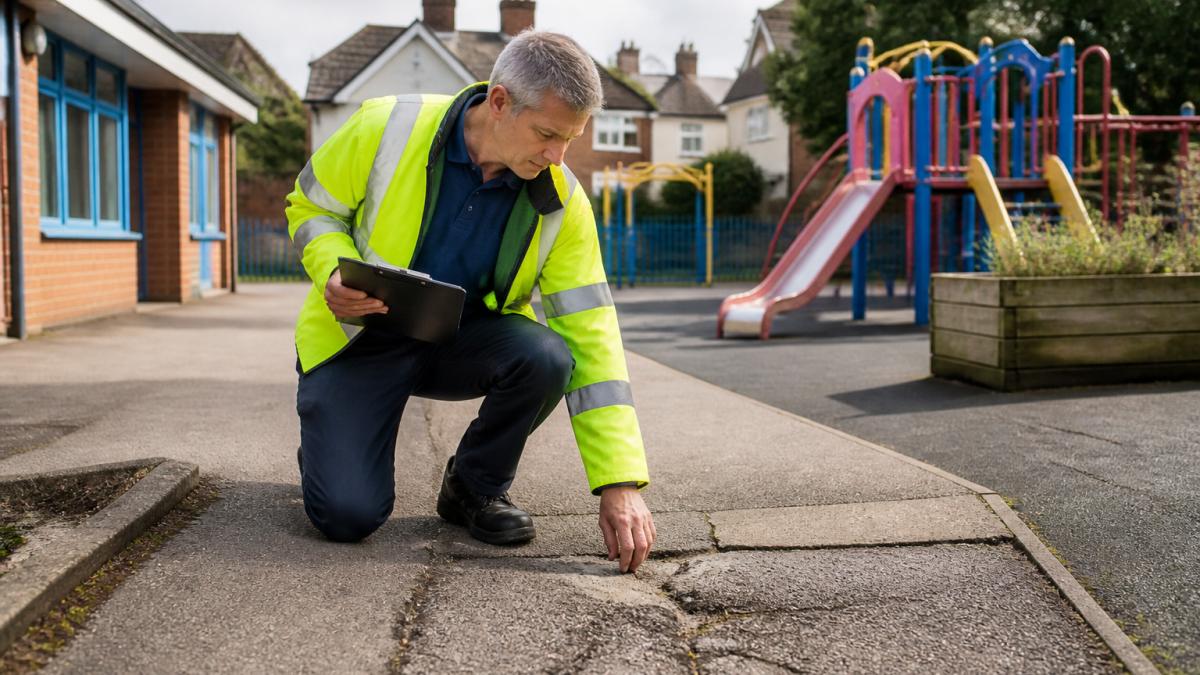
What to look for on a walk-round:
- Loose or missing fixings on play equipment
- Broken glass, litter or sharps in play areas
- Lifted slabs, potholes and standing water on paths
- Damaged fences, gates that do not latch, and gaps in boundaries
- Overhanging branches and low limbs near play space
- Worn or displaced safety surfacing under equipment
Record every check with a date, a name and a note of any fault found. A blank checklist proves nothing. A completed one protects the school.
Using a School Maintenance Plan Template to Stay Consistent
A school maintenance plan template is a single document that lists every outdoor asset, its condition, its check frequency and who owns it. The template is what keeps preventive maintenance from drifting when staff change or term gets busy.
Build it with these columns:
| Asset | Check frequency | Who checks | Last inspected | Action needed |
|---|---|---|---|---|
| Play equipment | Weekly | Caretaker | Date | Yes/No |
| Paths and hard surfaces | Half termly | Site manager | Date | Yes/No |
| Fencing and gates | Termly | Caretaker | Date | Yes/No |
| Drains and gutters | Termly | Contractor | Date | Yes/No |
| Trees and hedges | Annually | Contractor | Date | Yes/No |
Keep it simple. A one-page plan that gets used beats a forty-page document that sits in a drawer. Review it each term and update the condition notes.
If funding the plan is the sticking point, our guide to planning school maintenance budgets sets out how to build the numbers into the year.
Bringing in a Managed Service for Grounds and Cleaning
A managed service takes the schedule, the checks and the cover off the school’s plate. Instead of chasing contractors and covering absences, the school holds one contract and one point of contact for grounds and cleaning.
This is where most schools get stuck. Recruitment for caretaking and cleaning roles is hard, and agency cover often sends whoever is available rather than who fits a school. A managed service works differently: the provider owns the roster, the standards and the sick cover.
What to weigh before committing:
- Does the provider cover both grounds and cleaning, or only one?
- Who steps in when a cleaner or caretaker calls in sick?
- How are standards checked and reported back to the school?
- Can the contract scale down in the holidays?
For the full picture, read our guide to outsourced facilities management for schools. If you are still deciding whether to move at all, our piece on whether outsourcing school maintenance is worth it sets out the trade-offs honestly.
We also handle commercial office cleaning for schools with lettings, trusts and office space, and for businesses across the region, including Chester and the Wrexham area.
Next Step: Book a Grounds and Cleaning Review
The schools that avoid emergency repair bills are not the ones with the biggest budgets. They are the ones with a written schedule and someone who owns it. That is the whole point of preventive maintenance: it turns grounds work from a series of surprises into a plan you can see and fund.
At Nirvana Managed Services LTD, we help schools and commercial sites with exactly that. Our managed service covers grounds and cleaning under one contract, with recruitment handled, contract management in place, and cover arranged when a member of staff is off sick. We work with small primary schools as well as larger sites, and we cover commercial office cleaning alongside school grounds and caretaking. If you are searching for a grounds and cleaning partner near you, we work across the region from our Chester base, including the Wrexham area.
Get started with Nirvana Managed Services LTD and put a grounds and cleaning schedule in place before the next repair bill lands.
Frequently Asked Questions
Why is preventive maintenance important for school grounds?
Preventive maintenance keeps outdoor spaces safe and stops small faults becoming expensive repairs. Cracked paths, loose fencing and worn play surfaces are trip hazards, and fixing them early costs far less than replacing them. A regular preventive maintenance routine also protects your budget from emergency call-outs and helps you meet your duty of care under the Health and Safety at Work etc. Act 1974.
What should a school grounds maintenance plan include?
A school maintenance plan template should list every outdoor area, the checks each one needs, who carries them out and how often. Include hard surfaces, drainage, fencing, gates, play equipment, sports pitches, trees and bins. Add a section for recording defects and closing them out, plus a term-by-term calendar. Keep it short enough that staff actually use it rather than filing it away.
How often should school grounds be inspected?
Daily visual checks of paths and play areas catch obvious hazards like broken glass or damaged equipment. A fuller school outdoor safety check should run weekly or monthly depending on use, with a detailed termly inspection covering fencing, drainage and trees. Record every inspection so you can show a clear audit trail to governors, insurers and Ofsted.
Can a managed cleaning and caretaking service help with school maintenance?
Yes. A managed service covers cleaning and caretaking staff, contract management and cover when someone is off sick, which keeps your grounds maintenance schedule on track. It also takes recruitment pressure off your business manager. For commercial office cleaning, the same provider can handle both sites, giving you one point of contact and consistent standards across your estate.


