
Table of Contents
- What Managed Soft Services Actually Cover
- Commercial Office Cleaning Services Without the Recruitment Headache
- Managed Cleaning Services for Schools: Cover When Staff Are Absent
- The Benefits of Managed Soft Services: A 2026 Breakdown
- How Managed Soft Services Help with Recruitment and Retention
- Who Benefits Most from a Managed Soft Services Contract
- Common Mistakes When Choosing a Provider
- Conclusion
- Frequently Asked Questions
Last Updated: September 10, 2026
What Managed Soft Services Actually Cover
Managed soft services is the outsourcing of non-core, people-facing site functions, cleaning, caretaking, security, reception and grounds upkeep, to a single provider who employs, manages and covers the staff on your behalf. For a bursar or facilities manager, that means one contract instead of a rota of agency calls, absence cover and compliance paperwork.
This guide from Nirvana Managed Services LTD breaks down where that model pays off, where it doesn’t, and what to check before you sign. The stakes are real: when a cleaner calls in sick at 6am, someone still has to open the building by 7.
Most organisations start looking at managed soft services for one reason. Recruitment has stopped working. The practical benefits are what keep them there.
Commercial Office Cleaning Services Without the Recruitment Headache
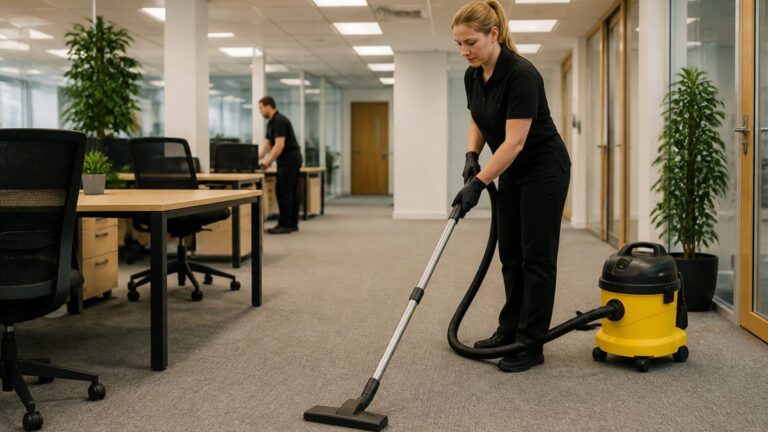
Commercial office cleaning services are the single most common entry point into a managed contract, and the reason is rarely cost. It is the vacancy that has been open for eleven weeks.
A cleaning operative on minimum wage in a competitive labour market has options. Advertise the role, screen thirty applications, interview five, train one, and you may still be back at the advert in three months. Each cycle costs management time that nobody budgets for. A managed provider absorbs that cycle entirely: recruitment, vetting, induction, uniforms, equipment and supervision sit with them, not with your office manager.

What most guides miss is that the recruitment saving is the smaller half. The larger half is that a managed provider has a bench. When your allocated operative is on holiday, the provider moves someone in rather than asking your team to mop the kitchen.
Ask any prospective provider one question before anything else: “How many trained operatives do you have within a thirty-minute drive of this site?” A provider with no local bench is an agency with a nicer logo.
Managed Cleaning Services for Schools: Cover When Staff Are Absent
Managed cleaning services for schools solve a problem that commercial contracts rarely face: the site cannot close. A primary school with fifteen staff still needs toilets cleaned, floors mopped and bins emptied before the gates open, whether or not the caretaker has a sick note.
Caretaking and cleaning absence in a school is uniquely disruptive because the roles overlap with site safety. A missing caretaker can mean a broken gate stays broken, a spill stays unmarked, and a headteacher spends a morning on facilities instead of pupils. A managed contract shifts that risk to the provider, who is contractually obliged to put a trained person on site.
The service also removes the awkward middle ground where a school business manager ends up managing a cleaner informally, without HR training or the authority that comes with it.
The most common mistake schools make is signing a contract that specifies “cover within 24 hours.” For a school, that is often too late. Insist on a defined morning response window.
The Benefits of Managed Soft Services: A 2026 Breakdown
The benefits of managed soft services fall into two buckets: commercial and operational. The commercial case is straightforward. The operational case is where the real difference shows.
| Benefit | What It Replaces | Why It Matters |
|---|---|---|
| Single point of contact | Multiple agency and supplier contacts | Faster decisions, clear accountability |
| Absence cover guarantee | Emergency agency bookings | Site stays presentable and compliant |
| Consolidated compliance | Fragmented records per contractor | Easier audit and inspection prep |
| Predictable invoicing | Variable agency and overtime spend | Cleaner budgeting across the year |
| Vetted, trained staff | Ad hoc inductions | Consistent standards from day one |
One Contract, One Point of Contact
A single contract means one invoice, one account manager and one number to call when something goes wrong. That sounds trivial until you have spent a morning chasing three suppliers about a leak, a broken lock and a missed clean.
The operational gain is decision speed. When the person answering the phone has authority over the staff on site, problems get fixed in hours rather than emails. For a facilities manager running several buildings, that is the difference between managing a service and administering a supply chain.
Consistent Standards and Compliance
Consistency is the benefit clients underrate before signing and value most afterwards. A managed provider works to a written specification, audits against it, and trains to it. That means the standard on a Tuesday afternoon matches the standard on a Friday morning.
Compliance sits alongside it. Health and safety documentation, COSHH records for cleaning chemicals, staff right-to-work checks and insurance certificates are held by the provider and produced on request. Under UK health and safety law, employers must assess risks to their staff, and a managed provider should be able to evidence its own assessments without you chasing them (hse.gov.uk). The Health and Safety Executive guidance on risk assessment is the reference point to hold them to.
How Managed Soft Services Help with Recruitment and Retention
Recruitment and retention are where the managed model earns its keep, because the provider carries the parts of employment that consume the most management time. Advertising, shortlisting, interviewing, referencing, DBS checks for school roles, contracts, payroll, holiday rotas and disciplinary process all sit with them.
There is a second effect that rarely gets mentioned. Staff employed by a specialist provider often stay longer, because they are managed by people who do this full time rather than by an office manager who inherited the responsibility. Continuity of staff matters on site: a cleaner who knows the building works faster and notices more.
The strongest argument for outsourcing is not cost. It is that recruitment, absence and HR stop being your problem on a Monday morning.
Who Benefits Most from a Managed Soft Services Contract
The organisations that gain most share three traits: they employ soft services staff directly, they have no dedicated facilities function, and their site cannot afford to look neglected.
That profile fits schools and multi-tenant office buildings particularly well. A bursar managing cleaning and caretaking alongside finance and HR is a classic case. So is a property management firm running several sites with no on-site facilities manager.
Smaller organisations often assume they are too small to interest a provider. In practice, a single-site primary school or a two-floor office can be an excellent fit, because the provider’s overhead is spread across many contracts. The question to ask is not “are we big enough” but “is our specification clear enough for someone else to deliver.”
If you are weighing this up for a site in the Wrexham area, the practical test is the same as anywhere else: how quickly can a provider get a trained person through the door. Nirvana Managed Services LTD works with schools and commercial offices on exactly that basis, combining commercial office cleaning with caretaking recruitment and guaranteed absence cover under one contract.
Common Mistakes When Choosing a Provider
The mistakes are predictable, and they all trace back to the same root cause: buying on price per hour rather than on what happens when things go wrong.
- Specifying hours instead of outcomes. “Three hours a night” tells the provider nothing about the standard you expect. Write the specification around what the site must look like at 8am.
- No defined absence response time. Without a written window, “we’ll cover it” can mean anything.
- Ignoring the TUPE position. If you are moving existing staff across, take advice on your obligations before you sign, not after. GOV.UK guidance on TUPE transfers sets out the framework.
- Skipping the site visit. A provider who quotes without walking the building is guessing.
- No review clause. Insist on a periodic service review with measurable criteria, so problems surface early.
- Choosing on headline rate alone. The cheapest hourly rate often excludes consumables, equipment and out-of-hours cover.
The costliest mistake is signing a twelve-month contract with no break clause and no performance review. If the service slips, you have no lever until renewal.
Conclusion
The hard part is not deciding whether managed soft services make sense. It is finding a provider who will still answer the phone in month nine, when the novelty has worn off and the absence cover actually matters.
Nirvana Managed Services LTD was built around that gap. We combine commercial office cleaning with caretaking recruitment, full contract management and guaranteed cover when your own member of staff is off sick, all under a single agreement. For schools, that means the gates open on time regardless of who is absent. For offices, it means one contact and one invoice.
Get started with Nirvana Managed Services LTD and put recruitment, absence cover and compliance into one contract instead of five.
Frequently Asked Questions
What is included in soft services for commercial buildings?
Soft services cover the people-led, non-technical side of running a building: cleaning, caretaking, waste and recycling, front-of-house and reception, grounds upkeep and security support. Hard services cover the fabric and systems, such as heating, ventilation, electrical and plumbing work. A managed soft services contract bundles the soft side under one provider, so cleaning rotas, caretaking duties and absence cover sit with a single account manager rather than several in-house teams.
How does a managed service model improve cleaning standards?
Standards hold up because the provider, not your in-house rota, carries the risk of absence. Scheduled audits and agreed service levels replace ad hoc checks, and any shortfall is the contractor’s problem to fix. Staff are trained and vetted to one standard across every site, so quality does not depend on which individual turns up that day. For commercial office cleaning services, that consistency matters most in washrooms, kitchens and reception areas where visitors judge the whole building.
How do managed soft services help with staff recruitment and retention?
Recruitment for cleaning and caretaking roles is slow and expensive, particularly for schools competing with the wider jobs market. A managed provider holds the talent pool, handles vetting and DBS checks, and rotates staff between sites when someone leaves or calls in sick. Your business manager stops writing adverts and chasing references. Retention improves because staff are employed, trained and supported by a specialist employer rather than squeezed into a school or office budget as an afterthought.
What is the difference between hard and soft facilities management?
Hard facilities management covers the building itself: heating, ventilation, air conditioning, electrical systems, plumbing, lifts and statutory compliance such as gas safety and fire systems. Soft facilities management covers the people and services that keep the building usable day to day, including cleaning, caretaking, security, reception and grounds. Most organisations outsource one or both. The two are often bundled, but a soft services specialist will usually deliver better standards on cleaning and caretaking than a hard services contractor adding them on.