Last Updated: 22 November 2026
Quick Summary
Effective school hygiene standards rest on a written policy where every task is auditable, organised by area with named responsible people, daily and weekly schedules, and signed records. School hygiene practice should include at least twice-daily toilet checks plus a full clean after pupils leave, and handwashing stations stocked with soap and paper towels.
- Split your cleaning checklist by area: classrooms, toilets, corridors, kitchens and sports areas.
- Record each toilet check with a time and initials on a signed sheet.
- Teach pupils to wash for at least 20 seconds, including between fingers and under nails.
- Map each legal duty to a specific action and state where the evidence is kept.
- Name a fallback colleague and written priority list before any cleaner absence occurs.
Table of Contents
- Building a School Hygiene Policy Template That Works
- The Essential School Cleaning Checklist for Every Area
- Setting the Right School Toilet Cleaning Frequency
- Designing Effective School Handwashing Facilities
- Mapping UK Legal Duties to Your Hygiene Actions
- Managing Cleaning Staff Absence and Recruitment Gaps
- Choosing a Managed Hygiene Partner for Your School
- Frequently Asked Questions
Building a School Hygiene Policy Template That Works
A school hygiene policy is a written framework that sets out who cleans what, how often, to which standard, and how the school proves it happened. Many schools find the same failure repeatedly: policies are written for the file, not for the corridor. The document exists, nobody reads it, and the cleaning still depends on one caretaker’s memory.
Good school hygiene practice rests on one principle: every line of the policy must be auditable. If you cannot produce a record showing a task was done, the policy is decoration. Below, we set out how to build one that survives an inspection and a staff absence in the same week.
A workable template has five parts:
- Scope and responsibilities: named roles, not job titles alone
- Area-by-area schedules: frequency and method per room type
- Records: who signs off, and where the evidence lives
- Absence cover: what happens when the cleaner does not arrive
- Review date: a fixed point to revise, not a vague promise
Watch out: the most common mistake is copying a policy from another school without adjusting the schedules to your building. Room counts, pupil age groups and toilet ratios differ, and an unachievable schedule is abandoned within a term.
The Essential School Cleaning Checklist for Every Area
A school cleaning checklist works when it is organised by area rather than by task type, because cleaners move room to room, not chemical to chemical.
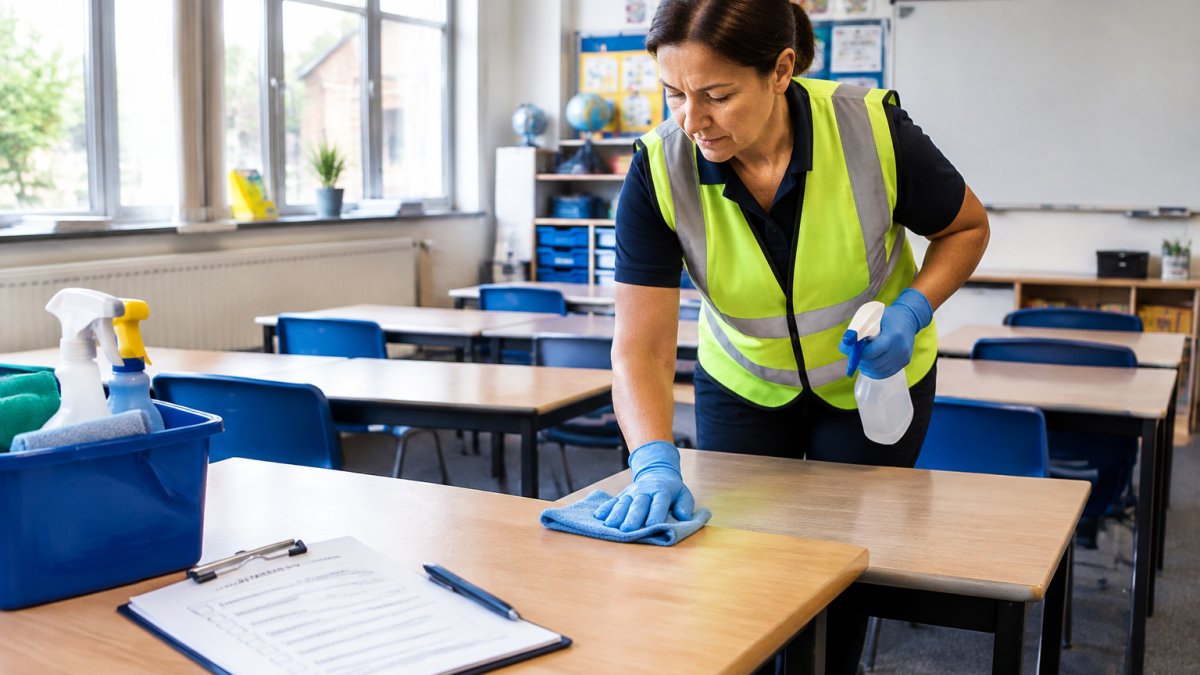
The difference between a checklist that survives an inspection and one that gathers dust is the level of operational detail.
Classrooms
Daily tasks: desks and chairs wiped with a general-purpose detergent, floors cleared and mopped, bins emptied, high-touch points such as door handles, light switches and shared equipment disinfected.
Toilets and washrooms
Daily tasks: full clean before the school day, mid-morning check and spot clean with restocking of soap and paper, lunchtime check, full clean and disinfection after the last pupils leave.
Corridors and shared spaces
Daily tasks: floors swept and mopped, handrails and door plates wiped, bins emptied. Weekly tasks: walls spot-cleaned, notice boards dusted. Termly tasks: deep clean of floor edges and any upholstered seating.
Kitchens and dining areas
These fall under separate food hygiene expectations and should be treated as their own schedule. Daily tasks: food contact surfaces cleaned and disinfected before and after use, floors mopped, bins emptied, handwashing stations restocked.
Sports and changing areas
Daily tasks: floors cleaned, benches and lockers wiped, showers cleaned and disinfected, bins emptied. Weekly tasks: deep clean of shower heads and drainage. Termly tasks: inspection of ventilation and dehumidification systems.
Inspection-ready records
A checklist is only as good as the evidence it produces. For each area, keep a schedule that shows the task, the frequency, the responsible person, and the date and time of completion.
Audit measures
Set a monthly audit where a senior staff member or external contractor inspects a sample of areas against the checklist and records any gaps.
If you are building the classroom and toilet sections from scratch, our guide on how to build a school cleaning checklist for classrooms and toilets gives you a ready-made structure to adapt to your own room count.
Setting the Right School Toilet Cleaning Frequency
School toilet cleaning frequency should be at least twice during the school day plus a full clean after pupils leave, with a named person checking condition at break and lunch. Toilets are the single most scrutinised area on any parent visit or inspection, and the one most likely to be skipped when staffing is tight.
The practical routine looks like this:
- Full clean before the school day starts
- Mid-morning check and spot clean, restocking soap and paper
- Lunchtime check and spot clean
- Full clean and disinfection after the last pupils leave
- Weekly deep clean of floors, drains and fixtures
Record each check with a time and initials. A signed sheet on the back of the toilet door is crude but effective, and it is the first thing an inspector looks at. Where a toilet block serves younger pupils or pupils with additional needs, increase the check frequency and make sure staff can enter safely and promptly.
Designing Effective School Handwashing Facilities
Effective school handwashing facilities need running water, liquid soap and paper towels at every station, at a height pupils can actually reach, with supervision for younger year groups. Provision is only half the job. Technique is the other half.
Guidance on school hygiene and infection control recommends washing for at least 20 seconds, cleaning between the fingers, under the nails and up to the wrists. Teach it as a routine rather than a lecture: line up, soap, count, rinse, dry, leave. For reception and key stage one, demonstrating the steps works better than describing them.
Watch out: soap dispensers that run empty teach pupils to skip the soap entirely. Build restocking into the mid-morning check, and keep a spare supply in the caretaking store rather than in a locked office.
Mapping UK Legal Duties to Your Hygiene Actions
UK school hygiene duties come from several directions at once, and the policy has to show how each one translates into a task someone performs.
Health and Safety at Work etc. Act 1974
Legal duty: employers must provide a safe working environment for staff and pupils. Action: the school must have a written health and safety policy that covers cleaning chemicals, slips and trips, and manual handling. This is not optional.
Management of Health and Safety at Work Regulations 1999
Legal duty: employers must carry out risk assessments. Action: a written risk assessment for each cleaning task that involves hazardous substances, working at height, or lone working. Review annually or when circumstances change.
Control of Substances Hazardous to Health Regulations 2002 (COSHH)
Legal duty: employers must assess and control exposure to hazardous substances (Control of substances hazardous to health (COSHH)).
Food Hygiene Regulations 2006
Legal duty: food businesses must ensure food is safe to eat.
Department for Education guidance
Non-statutory guidance: the DfE publishes advice on health and safety for schools, including cleaning and hygiene. Action: use this to benchmark your policy, but recognise it is guidance, not law.
UK Health Security Agency advice
Non-statutory advice: the UK Health Security Agency publishes infection prevention guidance that is useful when writing outbreak procedures. Action: align your outbreak response with UKHSA advice, but note this is recommended practice rather than a legal duty.
Disclosure and Barring Service checks
Legal duty: anyone working regularly in a school setting must be checked through the DBS. Our guide on ensuring DBS compliance for school cleaning staff covers what that means for cleaners and agency cover.
How to build a compliance checklist
Create a table with three columns: legal duty, action required, and evidence. For each row, name the regulation, describe the specific task, and state where the record is kept. Review the checklist termly and update it when regulations change. This is the document an inspector will ask for, and it is the difference between a policy that looks good on paper and one that survives scrutiny.
Watch out: the most common mistake is treating all guidance as law. The DfE and UKHSA documents are useful, but they are not statutory requirements.
Managing Cleaning Staff Absence and Recruitment Gaps
Cleaning staff absence is the point where most hygiene policies quietly collapse. A single unreplaced absence means toilets go unchecked and corridors go unswept, and the standard drops within a day.
Build the absence plan before you need it:
- Identify critical tasks: toilets, handwashing stations and bin emptying cannot wait
- Name a fallback: a colleague who covers the first morning, with a written priority list
- Keep a cover contact: a named number to call, not a general inbox
- Record the gap: note what was missed so the standard can be recovered
Recruitment is the harder half. Schools often struggle to fill caretaking and cleaning roles, and a vacancy that runs for weeks can erode standards. Our step-by-step guide on planning school cleaning cover when staff are absent sets out a workable process for arranging cover at short notice.
Choosing a Managed Hygiene Partner for Your School
A managed hygiene partner takes responsibility for recruitment, scheduling, cover and quality records, rather than supplying a name and leaving the rest to you. That distinction matters most in a bad week, when a cleaner calls in sick at seven in the morning and the school opens at eight.
Weigh the options honestly:
| Approach | Best for | Main risk |
|---|---|---|
| Fully in-house | Schools with a settled, full team | Every absence is your problem |
| Agency supply only | Short-term single gaps | Standards vary by whoever arrives |
| Managed service | Schools wanting records and cover included | Less direct day-to-day control |
For a direct comparison of the trade-offs, our guide on outsourcing versus in-house cleaning for schools sets out the cost and control questions to work through before you commit.
Nirvana Managed Services LTD provides a fully managed service for schools, covering recruitment of cleaning and caretaking staff, contract management, and cover when a member of staff is off sick. The service also covers commercial cleaning for offices.
If you are searching for a school cleaning provider near me, the questions to ask are the same: who covers an absence, what records do you leave behind, and how quickly can someone be on site. Ask them before you sign, not after.
A hygiene policy is only as strong as the week when two cleaners are off and an inspector arrives. If your current arrangement depends on goodwill and memory, it is worth testing it against a real absence before the inspection does. Nirvana Managed Services LTD handles recruitment, contract management and absence cover as one managed service. Get in touch with Nirvana Managed Services LTD to discuss your school’s cover arrangements.
Frequently Asked Questions
What are the best hygiene practices for schools?
The best school hygiene practices combine a written policy, a detailed cleaning checklist, and clear routines. Focus on daily cleaning of high-touch surfaces like door handles and desks, regular toilet cleaning, and providing accessible handwashing facilities with soap and running water. Promote hand hygiene before eating and after using the toilet, and ensure waste bins are emptied daily. Assign specific responsibilities to staff and keep records to show your standards are being met consistently.
How often should school toilets be cleaned?
School toilet cleaning frequency should be at least twice a day during term time, with a deeper clean at the end of each day. High-use periods, such as break and lunchtimes, may require additional checks and spot cleaning. Keep a signed cleaning schedule on display and ensure records are kept. This helps you monitor standards and provides evidence of your routine if needed for inspection or parent enquiries.
What should a school cleaning checklist include?
A school cleaning checklist should cover every area: classrooms, toilets, corridors, dining halls, and gyms. List daily tasks like emptying bins, sanitising desks, and disinfecting high-touch surfaces. Include weekly and termly tasks such as deep cleaning carpets and washing windows. Assign each task to a role and include a sign-off column. This creates accountability and makes it easy to spot missed tasks before they become a problem.
How can schools encourage pupils to wash their hands?
Encourage handwashing by making it part of the daily routine. Teach the correct technique, including washing between fingers and under nails for at least 20 seconds. Use peer learning and child-to-child education to reinforce the message. Ensure handwashing facilities are child-friendly and always stocked with soap and paper towels. Display posters at key points and schedule handwashing before eating and after using the toilet. Praise good habits to embed them.
How should schools manage cleaning staff absence?
Plan for absence by having a clear procedure in place. Cross-train existing staff on essential cleaning tasks and keep a list of approved cover providers. A managed service can provide cover when a regular cleaner is off sick. Keep a daily checklist so any cover staff know exactly what needs doing and to what standard.