Last Updated: 14 November 2026
Quick Summary
A school cleaning quality audit template is a scored, repeatable record of what was cleaned, where, and how well, using a three-point scale of pass, acceptable and fail. Build one page per area group, write a one-line pass standard for every task, and log each failure with an owner, deadline and verification date.
- Score each task as 2 for pass, 1 for acceptable and 0 for fail, with every zero triggering corrective action.
- Sample washrooms, entrances and high-touch points daily, and run a full audit across every area group termly.
- Calibrate auditors each term with a joint inspection of one washroom, one classroom and one corridor.
- Allow about 45 minutes for a single-area walkthrough and half a day for a full termly audit.
- Refer maintenance defects to the site team rather than scoring them against the cleaner.
Table of Contents
- Why a School Cleaning Audit Template Beats Informal Spot Checks
- What to Put in Your School Cleaning Checklist Template
- Building Your School Cleaning Inspection Checklist for Each Area
- Designing a Cleaning Audit Scoring System That Holds Up
- How to Run the Audit: A Step-by-Step Walkthrough
- Recording Failures, Corrective Actions and Follow-Up
- Adapting Your Audit for Commercial Office Cleaning Checklist Standards
- Getting an Independent Audit and Cleaning Cover in Chester and Wrexham
- Frequently Asked Questions
Why a School Cleaning Audit Template Beats Informal Spot Checks
A school cleaning quality audit template is a scored, repeatable record of what was cleaned, where, and how well.
Informal spot checks fail because they depend on who is looking and what mood they are in.
A headteacher walking a corridor at 8am sees different things to a bursar walking it at 3pm.
A template fixes that. It gives you:
- The same inspection points every time
- A score you can track across terms
- Evidence you can show a contractor, a governor or an inspector
That last point matters most. An audit with no follow-up is just paperwork.
What to Put in Your School Cleaning Checklist Template
Start with three things: the areas you inspect, the tasks per area, and the standard each task must meet.
Most templates fail because they list tasks without a standard. “Bins emptied” tells you nothing. “Bins emptied, liners replaced, lid wiped” gives you something to score.
Build your school cleaning checklist template in this order:
- List every area a cleaner touches, including outdoor areas and entrances
- List the daily tasks in each area
- Add the less frequent tasks: weekly, termly, holiday deep cleans
- Write a one-line pass standard for each task
- Add a column for evidence, such as a photo or initials
Keep it to two pages per area group. A template nobody completes is worse than no template.
Areas and Tasks: Classrooms, Corridors and Washrooms
Classrooms need desks and surfaces wiped, floors cleared and mopped, bins emptied, and whiteboards left clean. Corridors need floors, handrails, door glass and display boards checked. Washrooms need the most detail.
For washrooms, score these separately:
- Toilets and urinals cleaned and flushed
- Sinks, taps and splashbacks
- Mirrors and dispensers refilled
Washrooms are where complaints start. Give them their own scoring weight rather than folding them into a general area score.
High-Touch Points and Hygiene Checks
High-touch points are the surfaces many hands meet in a day: door handles, push plates, light switches, stair rails, shared keyboards and taps.
Score them on a simple scale: clean, acceptable, failed. Then record how often they are cleaned, a surface clean at 7am and untouched by lunchtime is not a pass.
Add a short hygiene check to the same page:
- Hand soap present in every washroom
- Paper towels or dryers working
- Sanitiser stations stocked
That last box links to your COSHH records. Keep safety data sheets where staff can reach them, and check them during the audit rather than assuming.
Building Your School Cleaning Inspection Checklist for Each Area
A school cleaning inspection checklist should differ by area, because a hall and a toilet do not share standards.
The common mistake is one generic list applied everywhere. It produces scores that look neat and tell you nothing.
Split your inspection into these area groups:
- Classrooms and teaching areas: desks, floors, boards, bins, displays
- Washrooms and toilets: the detailed list above
- Corridors and hallways: floors, rails, glass, notice boards
Each group gets its own pass standard. A corridor floor and a gym floor are judged differently because they are used differently.
Outdoor Areas, Entrances and Shared Spaces
Outdoor areas and entrances are the first thing a visitor sees, and the last thing most audits check. Give them a proper section.
Score these points:
- Paths swept and free of litter
- Bins emptied and lids closed
- Entrance mats clean and flat
Presentation counts here more than anywhere else. A parent dropping off at 8:45am judges the school on the entrance, not the classroom.
Designing a Cleaning Audit Scoring System That Holds Up
A cleaning audit scoring system works when two different people can inspect the same area and reach the same score. If scores swing wildly between auditors, the system is the problem, not the cleaners. The fix: define the standard, sample consistently, classify defects the same way, and calibrate the people scoring.
Use a simple three-point scale and define each point in writing:
| Score | Label | What it means |
|---|---|---|
| 2 | Pass | Meets the written standard, no action needed |
| 1 | Acceptable | Minor issue, fix by next visit |
| 0 | Fail | Standard not met, corrective action required |
Then set a pass standard per area. For example, a washroom might need every point at 2 to pass. First, a zero always triggers a corrective action, whatever the average. Second, the same auditor does not score the same area every time.
Sampling, Frequency and Risk-Based Prioritisation
You cannot inspect every room every day, and you should not try. Sample instead, weighted by risk. A workable pattern for a school:
- Daily: washrooms, entrances and high-touch points, spot sampled
- Weekly: a rotating sample of classrooms and corridors
- Monthly: halls, gym and shared spaces
Risk-based prioritisation means washrooms, food areas and reception get inspected more often than storage rooms. Record why you chose each sample so the pattern is defensible, a fixed rota covering every teaching space at least once per half-term, with washrooms and entrances sampled daily because they fail fastest.
Calibrating Auditors and Classifying Defects
Two auditors looking at the same dirty corner should reach the same score. Calibrate them with a joint inspection of three rooms, one washroom, one classroom, one corridor, comparing scores point by point. Where they disagree, rewrite the pass standard until the disagreement disappears.
Classify defects so the data tells you what to fix:
- Hygiene defect: visible soil, odour, or a surface that fails a wipe test
- Presentation defect: untidy but hygienic, bins not lined, chairs askew, smeared glass
- Consumable defect: soap, paper or sanitiser missing
Maintenance defects should be referred to the site team, not scored against the cleaner. Separating them stops the audit becoming a list of things the cleaning team cannot fix.
Setting Thresholds That Trigger Action
A threshold is the score at which something must happen. Set them before the first audit: any area below 1.5 triggers a reinspection within five working days; any repeat zero on the same point across two audits triggers a schedule review; any washroom scoring zero on odour or stock triggers same-day corrective action.

The man is British.
How to Run the Audit: A Step-by-Step Walkthrough
Run the audit the same way every time. Consistency is what makes the scores worth comparing.
- Prepare. Print the template, check the previous audit and note any open corrective actions.
- Walk the route in the same order. Start at the entrance and work through the building.
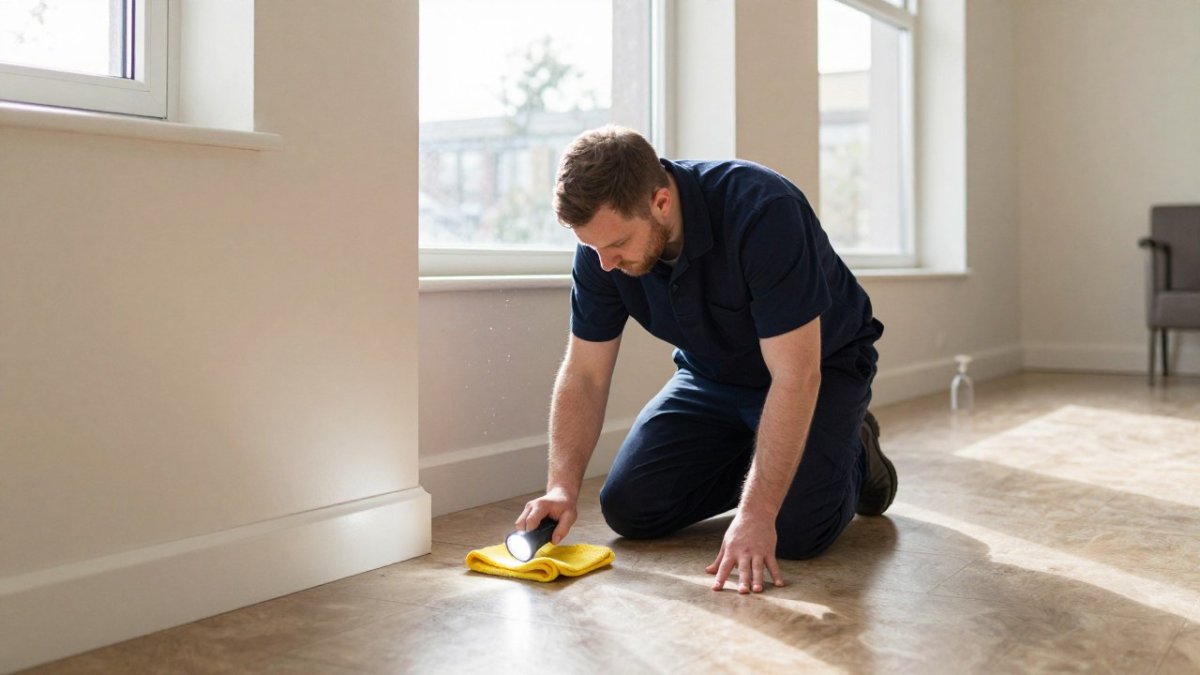
- Inspect, do not tidy. If you fix it, you cannot score it.
- Score against the written standard. Not against memory or last week.
- Photograph failures. A photo settles most disputes.
- Note the time and the cleaner on shift. Context explains a lot.
- Sign and date the sheet. An unsigned audit is not evidence.
Allow about 45 minutes for a single-area walkthrough and half a day for a full termly audit. For the full procedure, our guide on how to audit school cleaning standards walks through each step.
Watch out: auditing straight after a deep clean gives you a false high score. Inspect on a normal teaching day.
Recording Failures, Corrective Actions and Follow-Up
Every zero needs an owner, a deadline and a check. Without those three, the audit becomes a list of things everyone already knew.
Log each failure like this:
| Field | What to record |
|---|---|
| Area and inspection point | Washroom 2, floor behind door |
| Score | 0 |
| Photo reference | IMG_0442 |
| Owner | Named supervisor |
| Deadline | Date and time |
| Verification | Date rechecked and by whom |
Then verify. A corrective action is not closed when someone says it is done. It is closed when a second inspection confirms it.
Track two measures across the term: open corrective actions and repeat failure rate. If the same point fails three audits running, the problem is the schedule or staffing, not the cleaner.
Our guide on managing cleaning staff performance in schools covers how to handle that conversation properly.
Adapting Your Audit for Commercial Office Cleaning Checklist Standards
The same template structure works for offices, with different inspection points and weighting. If you manage both a school and an office site, keep one method and two checklists.
A commercial office cleaning checklist should cover:
- Desks, hot desks and shared screens
- Meeting rooms and presentation kit
- Kitchen and breakout areas, including fridges and microwaves
Offices usually need a presentation standard as well as a hygiene standard. A meeting room can be hygienically clean and still look untidy on camera. Score presentation separately so a hygienic but scruffy room does not pass on hygiene alone.
Office-Specific Inspection Points
Add these to the office version of the template:
- Hot-desking: screens, keyboards and shared mice wiped; cables tidy; no food debris
- Meeting rooms: tables cleared, whiteboards clean, chairs pushed in, presentation kit dust-free
- Kitchen and breakout: fridge interiors checked on a rota, microwaves wiped, sinks free of standing water, dishwashers emptied
Score washrooms and kitchens as high-risk areas and sample them daily. Score storage rooms and plant rooms monthly. Record the sample rota so a client or facilities manager can see the pattern is deliberate.
Adapting the Audit for Wrexham and Chester Offices
When setting up an audit for an office, the audit should reflect the site rather than a generic list. A client-facing reception needs a stricter presentation standard than a back-office suite.
Where the same contractor cleans a school and an office, keep the scoring scale identical across both so performance can be compared, but keep inspection points separate, so a washroom failure at either site triggers the same corrective-action process.
For the office version of this method, see our guide on improving office cleaning standards.
Getting an Independent Audit and Cleaning Cover in Chester and Wrexham
If absence is your recurring problem, our guide on planning school cleaning cover when staff are absent sets out a practical plan.
If you are building the checklist itself, our guide on building a school cleaning checklist for classrooms and toilets breaks down the tasks area by area.
Cleaning standards slip quietly, and usually when the person who owns them is off site.
Frequently Asked Questions
How often should a school cleaning audit be carried out?
Most schools run a full scored audit once a term, with lighter visual checks weekly and daily checks on washrooms and high-touch points. Risk-based prioritisation helps: areas with more traffic, younger pupils or recent complaints get audited more often. If a previous audit scored poorly, schedule a follow-up inspection within two to four weeks to confirm corrective actions have worked.
What is the difference between a cleaning checklist and a cleaning audit?
A school cleaning checklist template lists the tasks a cleaner completes, such as mopping floors or wiping desks. A school cleaning audit is a separate inspection that checks whether those tasks were actually done to standard. The checklist is the instruction; the audit is the evidence. You need both, plus a cleaning audit scoring system so results can be compared over time rather than judged on impression.
Who should carry out a school cleaning quality audit?
The person auditing should not be the person doing the cleaning. In-house, that usually means a facilities manager, bursar or site supervisor. For an independent view, an external provider can audit against your school cleaning inspection checklist. Whoever carries it out needs a consistent scoring method, evidence such as photos and audit records, and the authority to raise corrective actions with a named owner.
How do schools record and follow up cleaning audit failures?
Log every failure against the area, task and date, then assign a named owner and a deadline. Keep a complaint log and KPI tracker alongside the audit records so patterns are visible. A follow-up inspection should verify the fix rather than assume it. Reviewing failures monthly with the cleaning contractor turns the audit into a quality control loop instead of a one-off snapshot.