
Table of Contents
- Why Cleaning Staff Absence Hits Schools Harder Than Other Buildings
- Building a School Cleaning Contingency Plan Template
- Managing Short-Term Absence: Daily Cover Protocols
- Handling Long-Term Absence and Vacancies
- Managing Commercial Office Cleaning Staff: Lessons for Schools
- Outsourcing School Cleaning Services Benefits for Absence Cover
- Communication Protocols That Keep Staff and Parents Informed
- Conclusion: Build a Resilient Cleaning Team
- Frequently Asked Questions
Last Updated: 6 September 2026
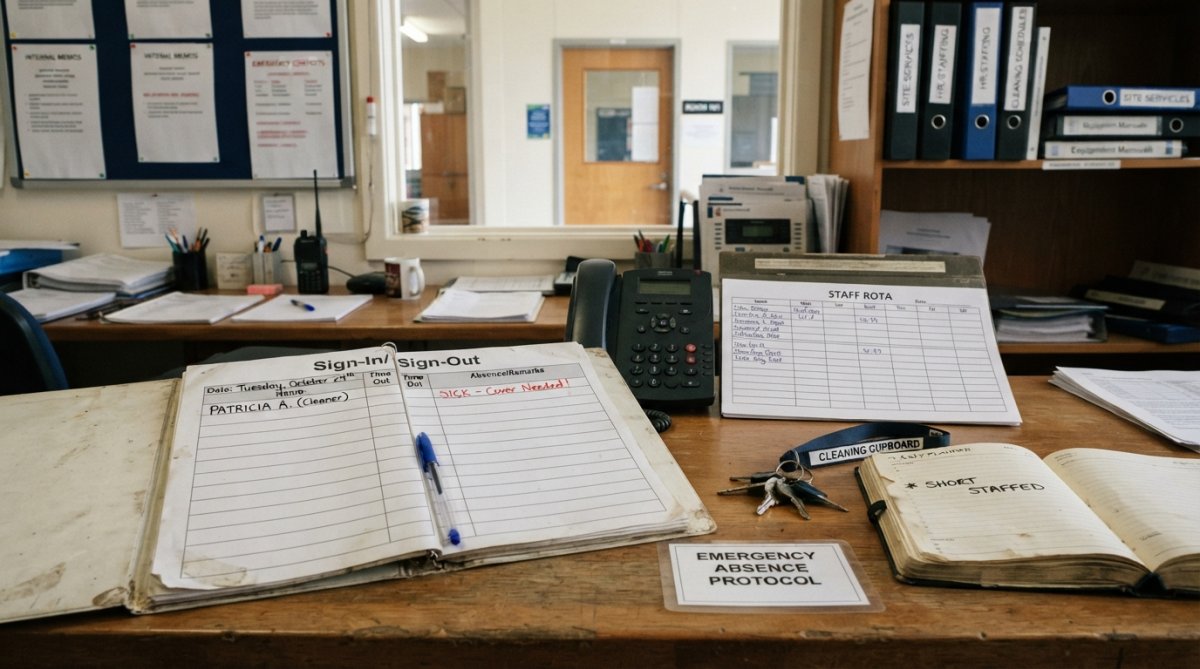
Managing cleaning staff absence in schools is one of the most disruptive operational challenges a bursar or site manager faces. When a cleaner calls in sick at 6am, the knock-on effect is immediate: classrooms aren’t ready, corridors look neglected, and parents notice within minutes of dropping off their children. This guide from Nirvana Managed Services LTD walks through practical strategies for keeping standards high when your team is short-staffed, from daily cover protocols to long-term contingency planning.
The reality is that cleaning staff absence is not a matter of “if” but “when”. Sickness, family emergencies, and transport issues all create gaps in your rota. The schools that handle this well don’t rely on luck. They have a documented plan, clear priorities, and trusted cover arrangements already in place before the first absence occurs.
Why Cleaning Staff Absence Hits Schools Harder Than Other Buildings
Schools face a unique combination of pressures that make cleaning staff absence particularly damaging. Unlike a commercial office where a dusty desk goes unnoticed, a school operates under strict hygiene expectations. Young children are more vulnerable to infections, and the guidance from the UK Health Security Agency sets clear expectations for cleanliness in educational settings.
The timing problem compounds the issue. Cleaning happens in a narrow window between the last child leaving and the first staff member arriving the next morning. When you lose one person from a small team, the remaining cleaners must absorb that workload in the same number of hours.
There is also a safeguarding dimension. Schools cannot simply send an untrained stranger into classrooms and toilet blocks. Any cover cleaner must be DBS-checked and familiar with school protocols, which rules out the casual “ask around” approach that might work elsewhere (gov.uk).
Building a School Cleaning Contingency Plan Template
Every school needs a written contingency plan before an absence happens, not during the crisis. A school cleaning contingency plan template should be a working document that your site manager can execute without making decisions under pressure.
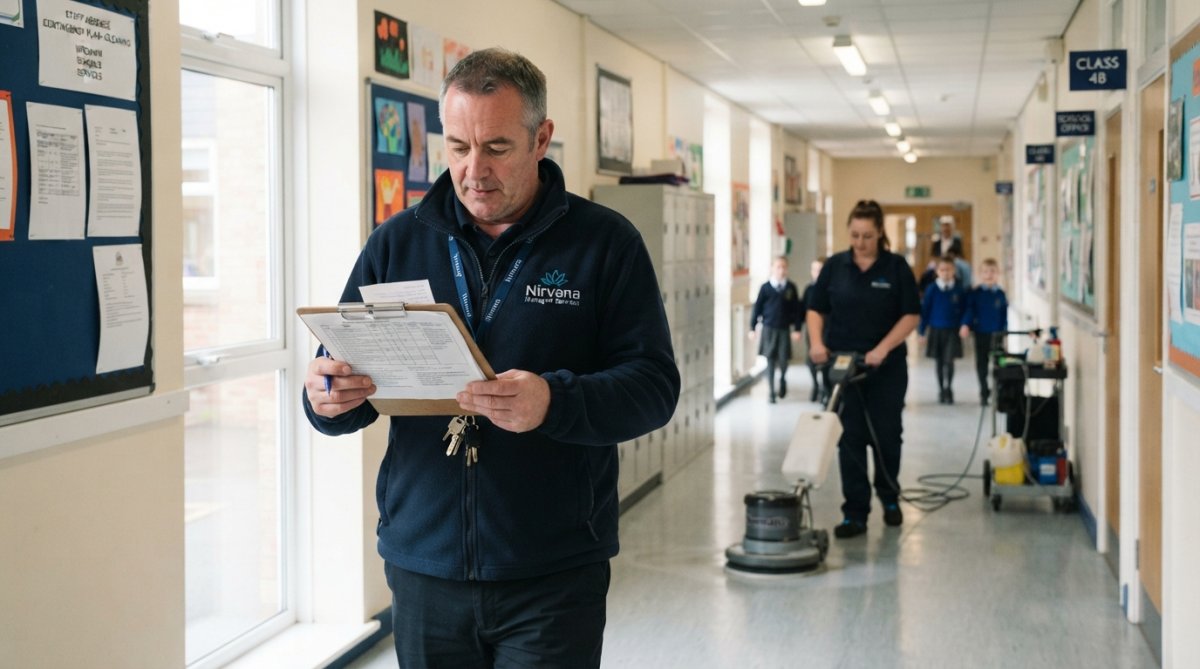
The plan should name a single decision-maker, usually the site manager or bursar, who has authority to arrange cover and reprioritise tasks. It should also list your cover options in order of preference, from internal staff overtime through to a contracted provider.
Mapping Critical Tasks and Cover Priorities
Not all cleaning tasks carry equal weight during a staff shortage. Your contingency plan must rank them.
- Critical daily tasks: toilet blocks, food preparation areas, and spillage response. These are non-negotiable for health and safety.
- High-priority tasks: classroom floors, door handles, and shared touchpoints.
- Deferrable tasks: deep cleaning of windows, polishing floors, and less-used storage areas.
A common mistake is trying to do everything to the usual standard with half the team. That approach leads to burnout and further sickness absence. Agree in advance which tasks drop to a “minimum acceptable” standard during cover periods.
Managing Short-Term Absence: Daily Cover Protocols
Short-term absence, typically one to five days, demands a fast response. The first hour after you learn of an absence is the most important. Your site manager should immediately assess which tasks are critical for that day and brief the remaining team.
For a single day’s absence, internal cover is often sufficient. Ask your cleaning team if anyone can start earlier or stay later to cover the critical zones. Many schools keep a small overtime budget precisely for this scenario.
The gap appears when several staff are off simultaneously, or during peak sickness periods like winter flu season. This is where a pre-arranged relationship with a cover provider pays for itself. A reliable provider can have a DBS-checked cleaner on site within a day, often within hours, which is impossible when you are calling local agencies cold.
Do not wait until a cleaner is off sick to start phoning agencies. The vetting and DBS checking process takes time, and agencies will prioritise schools they already work with. Establish your cover arrangement before you need it.
Handling Long-Term Absence and Vacancies
Long-term absence, lasting more than a few weeks, changes the problem from a logistical one to a recruitment one. Covering the rota indefinitely with overtime will exhaust your existing team and likely trigger more sickness absence.
For a long-term absence, you have two realistic options. The first is to recruit a temporary replacement, which carries recruitment costs and the risk that the candidate does not work out. The second is to transfer the hours to a managed service provider that supplies its own staff.
A managed service is often the more practical route because the provider handles recruitment, payroll, and DBS checks. You pay for the hours delivered rather than managing an employment relationship for someone who may only be with you for six weeks. When the absent staff member returns, the arrangement simply winds down.
Managing Commercial Office Cleaning Staff: Lessons for Schools
Cleaning staff absence is not a challenge unique to education. Facilities managers in commercial offices wrestle with the same issue, and their playbooks contain lessons worth borrowing.
Commercial office managers typically build more slack into their contracts. They specify a minimum staffing level in their service agreement and hold the provider accountable for backfilling absences without asking the client to coordinate cover. Schools can adopt the same principle by insisting that any outsourced cleaning contract includes guaranteed cover for sickness and holiday.
Another lesson from commercial cleaning is the use of task-based specifications rather than hours-based ones. Instead of saying “one cleaner for four hours per night”, you specify the outcomes: “all toilet blocks cleaned and stocked daily, all floors in classrooms vacuumed, all touchpoints sanitised”. This shifts the responsibility for managing absence onto the provider, who must deliver the outcomes regardless of which individual turns up.
Outsourcing School Cleaning Services Benefits for Absence Cover
The benefits of outsourcing school cleaning services become obvious the first time a cleaner phones in sick and you do not have to scramble. When you outsource to a managed provider, absence cover is built into the service rather than treated as an emergency.
A fully managed cleaning contract typically includes recruitment, training, supervision, and cover for absent staff. The provider maintains a pool of trained, DBS-checked workers who can be deployed at short notice. For the school, this means consistent standards and no gap between one cleaner leaving and a replacement starting.
There is also a financial argument. Managing recruitment, sickness pay, and cover arrangements in-house carries hidden costs that rarely appear in a single budget line. A managed contract converts those unpredictable costs into a predictable monthly figure.
The strongest reason to consider outsourcing is resilience. A school with an in-house team of three cleaners has no buffer when one is off. A managed contract provides a buffer as standard.
Communication Protocols That Keep Staff and Parents Informed
Absence cover is only half the battle. Schools also need to communicate effectively so that reduced cleaning capacity does not become a reputational issue.
Internal communication should be simple: the site manager briefs the cover cleaner on safeguarding procedures, emergency exits, and any specific requirements for that day. Written instructions are better than verbal ones, particularly for a cleaner who does not know the building.
For parents and staff, the guiding principle is to communicate only what is necessary. There is no need to announce that a cleaner is off sick. However, if a specific facility will be unavailable, such as a toilet block closed for deep cleaning, that information should go out early through your usual channels.
The guidance on health and safety in schools makes clear that cleanliness standards directly affect the duty of care schools owe to pupils. Keeping parents informed demonstrates that you are managing the situation responsibly, even when resources are stretched.
Conclusion: Build a Resilient Cleaning Team
Managing cleaning staff absence in schools comes down to preparation. A documented contingency plan, clear task priorities, and a reliable cover arrangement will carry you through most absences without a visible drop in standards.
For schools that find themselves repeatedly firefighting recruitment and absence issues, a fully managed service removes the problem at the root. Providers like Nirvana Managed Services LTD supply cleaning and caretaking staff, handle contract management and recruitment, and provide cover when your regular staff are off sick. The same managed approach extends to commercial office cleaning, giving facilities managers the same resilience.
The goal is a cleaning operation that runs itself, whatever the staffing weather. Get the contingency plan in place, agree your cover arrangements, and you will spend less time managing absences and more time running the school. Contact Nirvana Managed Services LTD to discuss how managed cleaning cover can support your school or office.
Frequently Asked Questions
How do you maintain school hygiene standards during staff sickness?
Maintain standards by prioritising high-touch surfaces such as door handles, light switches and handrails. Your contingency plan should list which tasks are non-negotiable daily, and which can be postponed. If cover staff are not trained on specialist equipment, keep a simple checklist for them. A contracted provider can supply trained cover staff who already know COSHH and safeguarding requirements, so standards do not slip when your regular cleaner is off.
What are the legal requirements for school cleaning staff cover?
Schools must maintain a safe environment under the Health and Safety at Work etc. Act 1974 and the Management of Health and Safety at Work Regulations 1999. This means providing adequate cover to keep areas hygienic, particularly where food is prepared or clinical waste is handled. You also have a duty of care to pupils and staff. A contingency plan helps you meet these obligations by identifying minimum staffing levels and ensuring cover staff have the right training before they start.
How can schools reduce the impact of cleaning staff absenteeism?
Reduce the impact by cross-training a small pool of staff on essential tasks, and by building relationships with a local cleaning provider that can supply vetted cover at short notice. Keep a contingency plan that lists priority areas, keyholder contact details and equipment instructions. Review absence patterns termly to spot recurring issues. Schools that outsource cleaning often see less disruption because the provider manages cover as part of the contract, not as a favour.
Should teaching staff be involved in school cleaning duties?
Teaching staff should not be expected to perform cleaning duties as routine cover. Their contract, workload and skills are focused on education, and using them for cleaning creates safeguarding and insurance complications. For a genuine emergency, a teacher might wipe down a surface, but sustained cover needs trained cleaners. Outsourcing providers supply staff who have the right training and DBS checks, keeping teaching staff focused on pupils rather than mops and buckets.


