
Table of Contents
- What Reliable School Cleaning Contract Management Actually Involves
- Building a School Cleaning Service Level Agreement Template That Works
- Cleaning Staff Absence Cover for Schools: Planning Before You Need It
- Commercial Office Cleaning Standards You Can Apply to School Sites
- Evaluating Providers: A Checklist for Bursars and Business Managers
- Common Pitfalls in School Cleaning Contract Management
- Conclusion
- Frequently Asked Questions
Last Updated: 13 September 2026
What Reliable School Cleaning Contract Management Actually Involves
Reliable school cleaning contract management is the practice of specifying, procuring, monitoring and enforcing cleaning provision on an education site so that standards hold every single day, not just on the day of the inspection.
Get those four parts right and disputes drop sharply. Get them wrong and you end up paying twice: once for the contract, once for the cover you didn’t plan for.
The Four Parts of Every Contract
Every workable arrangement rests on the same four pillars:
- Specification: what gets cleaned, to what standard, and how often, room by room.
- Resourcing: who attends site, at what hours, with what supervision.
- Performance management: how quality is measured, logged and escalated.
- Contingency: what happens when a cleaner calls in sick at 6am.
Most failing contracts are strong on the first and silent on the fourth.
The specification wins the tender. The contingency clause decides whether the contract survives its first winter.
Building a School Cleaning Service Level Agreement Template That Works
A school cleaning service level agreement template is a written schedule that defines cleaning tasks, frequencies, response times and remedies, and it forms the enforceable annexe to the main contract. The template itself is straightforward; the discipline is in the clauses you refuse to leave out.
Start with a room-by-room frequency matrix. Classrooms daily, toilets twice daily, halls weekly deep clean, and so on (gov.uk). Then attach measurable response times, because “promptly” is not a standard anyone can audit.
Clauses That Prevent Most Disputes
Four clauses do the heavy lifting:
- Frequency matrix with named rooms, not categories like “general areas”.
- Rectification window, for example a defined hours-based deadline to re-clean after a logged failure.
- Absence notification and cover trigger, stating how quickly replacement staff must be on site.
- Variation mechanism, so holiday deep cleans or building works don’t become informal favours.
Vague contracts create the disputes that consume a bursar’s term. Precise ones settle them in a single email.
Cleaning Staff Absence Cover for Schools: Planning Before You Need It
Cleaning staff absence cover for schools is the contractual guarantee that a site remains clean when a regular cleaner is unavailable, and it should be triggered automatically rather than negotiated on the morning (hse.gov.uk). Schools rarely struggle with planned absence. They struggle with the 5:45am phone call.
A common mistake is treating cover as goodwill. If it isn’t written into the agreement with a response window, you are relying on someone else’s staffing luck.
Contracts that promise cover “where possible” give you no recourse. Insist on a defined response window and a named escalation contact, or you will be scrubbing toilets yourself before assembly.
Commercial Office Cleaning Standards You Can Apply to School Sites
Commercial office cleaning standards are the documented benchmarks used in workplace contracts, covering frequency, verification and audit trails, and they transfer well to education sites. Offices have spent decades refining how to prove a building is clean; schools can borrow that rigour without borrowing the overhead.
The useful habits are simple. Inspections happen at a fixed time, on a fixed form, with results scored rather than described (bsigroup.com). Faults are logged with a timestamp and closed out with evidence. Cleaning schedules are displayed so staff, visitors and contractors all see the same expectation.
Run inspections at different times of day across a term. A site that looks immaculate at 7am and tired by 3pm has a scheduling problem, not a cleaning problem.
Evaluating Providers: A Checklist for Bursars and Business Managers
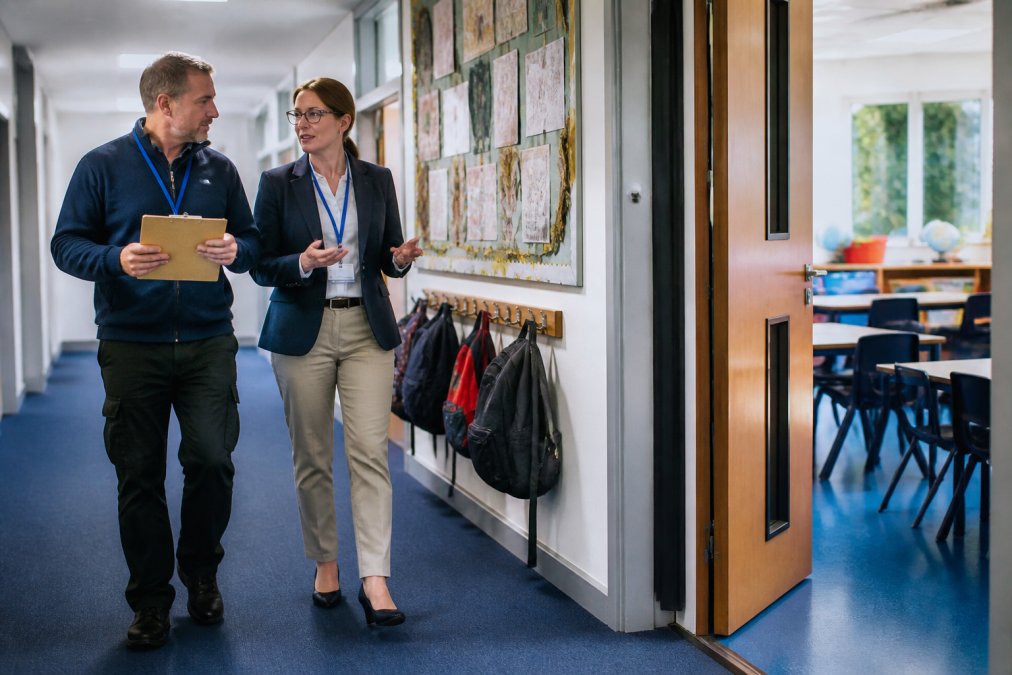
Evaluating a cleaning provider comes down to evidence, not presentation. Ask for the specification they would write for your site, the cover model behind it, and two references you can actually telephone.
Work through this before you sign:
- Room-by-room specification supplied, not a generic brochure
- Named supervisor with stated site hours
- Written absence cover window and escalation route
- Inspection regime with scoring and reporting frequency
- Insurance, safeguarding checks and site induction process confirmed
- Exit terms and notice period stated plainly
- Two contactable references from comparable sites
If a provider cannot answer the cover question in one sentence, that tells you more than the pitch deck.
Common Pitfalls in School Cleaning Contract Management
The recurring failures are predictable. Specifications written for a tender rather than a Tuesday. Cover promised verbally and never documented. No named supervisor, so nobody owns quality. Inspections that stop after the first term because everyone got busy.
Then there is the quiet one: no exit plan. Schools that cannot leave a poor contract cleanly tend to stay in it for years. Keep your specification current, your inspection log complete, and your notice terms understood. That combination gives you leverage long before you need it.
Conclusion
Managing a school cleaning contract well is less about procurement and more about the unglamorous work of specification, inspection and contingency. Nirvana Managed Services LTD supports schools and commercial sites with recruitment for soft services, fully managed contract management, and cover when a member of your team is off sick, alongside commercial cleaning for offices. If your current arrangement leaves you exposed when someone calls in sick, get in touch with Nirvana Managed Services LTD and put a cover model in place before you need it.
Frequently Asked Questions
What are the key performance indicators for school cleaning contracts?
Most contracts track a handful of measures: cleaning frequency against the specification, inspection scores, response times for reactive jobs, and absence cover fill rates. Attendance and punctuality matter too, since a cleaner arriving after the school gates open disrupts the whole site. Agree the KPIs before signing, record them in the service level agreement, and review them at fixed points through the year rather than waiting for the annual review.
What should be included in a school cleaning service level agreement template?
A school cleaning service level agreement template should set out the cleaning specification room by room, frequency of each task, agreed KPIs, inspection and reporting methods, absence cover arrangements, safeguarding and DBS requirements, insurance levels, complaint escalation steps, and termination terms. Vague wording such as ‘clean as required’ causes most disputes, so list tasks explicitly and state how quickly issues must be resolved.
How can schools ensure continuity of service during staff absence?
Plan absence cover before it is needed. That means a written procedure naming who contacts whom, a target response time, and access to trained, DBS-checked cover staff who already know the site. Keep a site induction pack and key access ready so a replacement can start without delay. Schools that rely on ad hoc cover from agencies often see standards slip within a day or two of a sickness absence.
How do you monitor compliance in school cleaning contracts?
Use a mix of scheduled inspections, spot checks, and a simple logging system for complaints and reactive jobs. Score each inspection against the specification so trends are visible over time. Monthly or termly review meetings with the contractor keep both sides accountable. If the provider manages the contract on your behalf, insist on seeing the same monitoring data rather than taking verbal assurances.