
Table of Contents
- Why Businesses Are Moving Away From Traditional Office Cleaning Contracts
- Managed Cleaning Services vs Traditional Contracts: What’s the Difference
- In-House Cleaning Teams: Building Your Own Workforce
- How to Manage Office Cleaning Staff Recruitment Effectively
- Technology Solutions for Contract-Free Cleaning Management
- Commercial Office Cleaning in Chester and Wrexham: Flexible Service Models
- Hybrid Models: Combining In-House and Outsourced Cleaning
- Frequently Asked Questions
Last Updated: September 30, 2026
Why Businesses Are Moving Away From Traditional Office Cleaning Contracts
Rigid cleaning contracts have become a liability for many businesses. They lock you into fixed terms, inflexible pricing, and often leave you scrambling when staff call in sick or workload demands shift. At Nirvana Managed Services LTD, we’ve seen firsthand how these constraints frustrate facilities managers and operations teams.
The real problem isn’t the concept of outsourced cleaning, it’s that traditional contracts treat cleaning as a commodity rather than a service that adapts to your actual needs. You’re paying for coverage whether you need it or not. Quality often suffers because contractors prioritise cost-cutting over consistency. And when something goes wrong, you’re stuck negotiating with a provider who has little incentive to respond quickly.
Businesses are now exploring alternatives that offer flexibility, accountability, and genuine partnership. These approaches range from building in-house teams to adopting managed services with real-time oversight tools. The shift reflects a broader recognition: cleaning isn’t just about having someone show up with a mop. It’s about maintaining standards, managing staff effectively, and adapting to your changing needs.
Below, we’ll explore the main alternatives to traditional office cleaning contracts, what makes each one work, and how to choose the right model for your situation.
Managed Cleaning Services vs Traditional Contracts: What’s the Difference
Managed cleaning services flip the traditional contract model on its head. Instead of hiring a contractor to staff and oversee cleaning independently, you partner with a provider who handles recruitment, training, scheduling, and quality control on your behalf.
The core difference comes down to accountability and flexibility. With a traditional contract, you negotiate terms annually or every few years and live with whatever staffing model the contractor provides. With managed services, the provider adapts to your needs in real time. Staff absence? They arrange cover. Quality drops? They investigate and correct it immediately. Your building needs change? The service scales up or down without contract renegotiation.
For commercial office cleaning, this distinction matters significantly. Office environments require consistent standards, first impressions affect client perception, and maintenance standards impact employee morale. Managed services providers carry the responsibility for maintaining those standards, not just delivering hours of labour.
Another key difference: transparency. Traditional contracts often obscure how much you’re actually paying per hour or per square metre. Managed services typically offer clear pricing structures tied to specific outcomes: clean common areas, sanitised facilities, waste management, and documented compliance. You know exactly what you’re paying for and what standards you’re receiving.
In-House Cleaning Teams: Building Your Own Workforce
Some organisations choose to build their own cleaning teams entirely. This approach gives you complete control over standards, scheduling, and culture, but it comes with significant operational overhead.
Running an in-house team means you become an employer. You’re responsible for recruitment, onboarding, payroll, National Insurance contributions, holiday pay, and all the compliance that comes with employment law. You manage rotas, arrange cover when people are ill, and handle performance issues directly. For a small school or office, this can be manageable. For larger facilities, it becomes a full-time operations job.
The advantage is consistency. Your team knows your building intimately. They understand your standards and can adapt quickly to changes. There’s no contractor middleman, you set expectations directly and enforce them directly. Many organisations find this creates stronger accountability.
The disadvantage is resilience. When your cleaner is ill, you need a backup. When someone leaves, you need to recruit and train a replacement. If you’re managing a small team, absence can leave you without cover. This is where many organisations struggle, they build in-house teams successfully until staffing disruptions expose the fragility of the model.
Recruitment and Training Responsibilities
Building an in-house team starts with finding the right people. You’ll need to advertise, interview, and select candidates, a process that typically takes 4-8 weeks. Then comes training: induction, site-specific procedures, equipment familiarisation, and standards documentation. Most organisations spend 2-3 weeks getting a new cleaner to full productivity.
Training also means documenting your standards clearly. What does “clean” mean for your building? How often should different areas be serviced? What products and equipment should be used? Without clear documentation, you’ll get inconsistent results and frustrated staff who don’t know what you actually expect.
You’ll also need to handle compliance: ensuring staff have appropriate training for hazardous substances, understanding health and safety obligations, and maintaining records. For schools, this includes DBS checks and safeguarding training. It’s not complex, but it requires attention.
Managing Absence and Cover
This is where in-house teams often fail. When your full-time cleaner is ill, you need someone to cover. Do you have a backup cleaner on standby? Do you ask other staff to pitch in? Do you let standards slip for a day?
Most organisations don’t plan for this adequately. They assume staff will rarely be absent, then scramble when someone has a week off or a longer-term issue emerges. Over a year, even one person taking a few weeks’ sick leave can create 10-15 days without cover.
Some organisations build a small pool of casual staff or part-time cleaners to provide flexibility. Others negotiate arrangements with local cleaning companies for emergency cover. Both approaches work, but they require upfront planning and ongoing relationship management.
How to Manage Office Cleaning Staff Recruitment Effectively
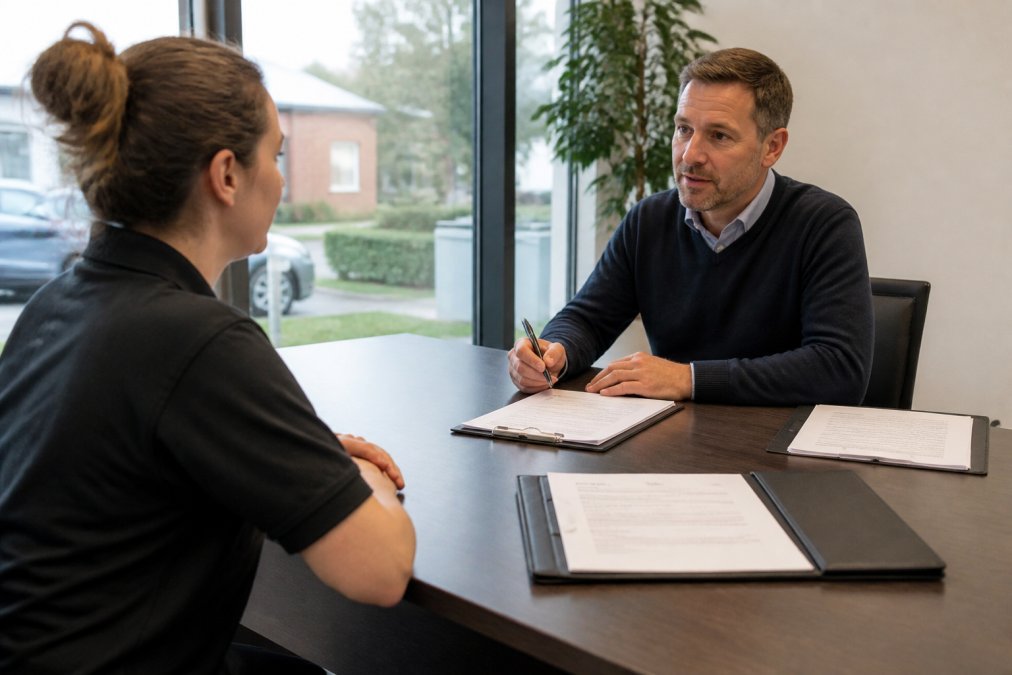
Recruitment is the foundation of any in-house cleaning operation. Get it wrong and you’ll spend months managing performance issues. Get it right and you have a stable, reliable team.
Start with a clear job description. Specify the role, responsibilities, hours, pay, and key expectations. Be specific about what “clean” means: daily tasks, weekly deep-clean tasks, equipment use, and reporting procedures. A vague job description attracts unsuitable candidates and creates misunderstandings later.
Advertise through multiple channels. Local job boards, social media, recruitment agencies, and word-of-mouth all work. For cleaning roles, word-of-mouth often produces the most reliable candidates, people recommended by existing staff tend to understand the role and fit the culture better.
When interviewing, focus on reliability and attitude. Can they commit to regular hours? Do they understand the standards you’re describing? Have they worked in similar environments before? Ask about their experience with different cleaning methods and their approach to health and safety.
Reference checks matter. Contact previous employers and ask specific questions: Did they show up reliably? How was the quality of their work? Why did they leave? Don’t skip this step, it often reveals patterns you won’t spot in an interview.
Once hired, invest in proper induction. Show them the building, explain your standards, demonstrate the equipment, and pair them with an experienced team member for the first week if possible. Clear induction reduces errors and builds confidence.
Technology Solutions for Contract-Free Cleaning Management
If you’re managing your own team or working with a flexible provider, technology can dramatically improve coordination and accountability. Modern cleaning management platforms handle scheduling, task tracking, quality inspection, and communication, replacing the clipboard-and-spreadsheet approach.
Staff Scheduling and Task Management Platforms
Platforms like Connecteam and Swept simplify the logistics of managing cleaning staff. You create a schedule, assign tasks, and staff access it from their phone. If someone can’t make a shift, they notify you through the app. If something needs urgent attention, you can message the team instantly.
The real value emerges when you scale beyond one or two people. Managing five cleaners across multiple buildings becomes chaotic without a system. A scheduling platform keeps everyone aligned, reduces missed tasks, and makes absence cover easier to arrange.
Quality Control and Inspection Tools
Swept specialises in quality assurance for cleaning operations. Cleaners use the app to document their work with photos and checklists. Managers can inspect their work remotely and flag issues immediately. This creates accountability, staff know their work is being reviewed, and it provides you with a record of what was actually done.
This is particularly valuable for commercial office cleaning, where client expectations are high and standards are visible. With photo documentation, you can demonstrate compliance to clients and resolve disputes quickly. If a client says an area wasn’t cleaned, you have evidence.
Commercial Office Cleaning in Chester and Wrexham: Flexible Service Models
The shift away from traditional contracts is particularly pronounced in commercial office cleaning. Office environments require consistent standards and rapid response to issues, exactly where traditional contracts underperform.
Many businesses in these areas are now adopting hybrid models or fully managed services.
Hybrid Models: Combining In-House and Outsourced Cleaning
Many organisations find the best solution sits between fully in-house and fully outsourced: a hybrid model that combines both approaches.
Frequently Asked Questions
What are the main drawbacks of traditional office cleaning contracts?
Traditional contracts often lock you into fixed terms with limited flexibility, making it difficult to scale services up or down based on seasonal demand. If the contractor fails to meet standards, you’re bound by lengthy notice periods. You also lose direct control over staff quality and scheduling, and emergency cover during absences can be slow. Many businesses find themselves paying for services they don’t need or unable to respond quickly when standards slip.
How does a managed cleaning service differ from a standard contract?
Managed cleaning services provide ongoing oversight and flexibility that traditional contracts don’t. Instead of a fixed agreement with a single provider, managed services typically include staff recruitment support, contract management, quality monitoring, and emergency cover when staff are absent. This approach gives you greater control over standards and faster response times to issues, whilst reducing the administrative burden of managing cleaning teams directly.
How do I handle staff sickness in a self-managed cleaning arrangement?
Self-managed cleaning requires you to maintain a backup roster or use agency staff for emergency cover. You’ll need contingency plans, such as keeping contact details for relief cleaners or having a relationship with a local staffing agency. Some businesses cross-train existing staff, whilst others build a small pool of casual workers. Without a structured plan, staff absences can leave your office unstaffed and impact cleanliness standards.
Can I hire in-house cleaning staff instead of using a contractor?
Yes, you can hire permanent or casual in-house cleaning staff. This gives you direct control over quality, scheduling, and training. However, you become responsible for recruitment, employment contracts, payroll, National Insurance, training, and managing absences. For smaller offices, the administrative overhead and cost of recruiting suitable candidates can be significant. Many businesses find a hybrid approach, combining a small in-house team with outsourced support for peak times or absences, more practical.